
This article is general information, not veterinary advice. If your pet seems unwell, is in pain or may have eaten something harmful, contact your vet or an animal poison control line right away. Read our vet disclaimer.
How to manage litter box problems starts with a veterinary check when a cat suddenly urinates or defecates outside the box.
AAHA says medical problems, stress, litter box setup, and territorial behavior can all contribute (AAHA, updated 2026). Therefore, a thorough veterinary exam is the first step for new house soiling.
How to Manage Litter Box Problems: Rule Out Health Causes First
AAHA lists urinary disease, kidney disease, diabetes, osteoarthritis, and other medical problems among possible causes of inappropriate elimination (AAHA, 2026).
Cornell lists difficult urination, frequent attempts, blood in urine, and urination outside the box among lower urinary tract signs (Cornell, updated 2016). A behavior-only explanation is not safe at the start.
Meanwhile, keep the environment easy to use. The daily cat care checklist, pet odor guide, and calm-space guide cover cleaning, observation, and low-stress routines. They support the litter-box plan but do not replace the veterinary exam.
| Setup point | Source-backed target | Source |
|---|---|---|
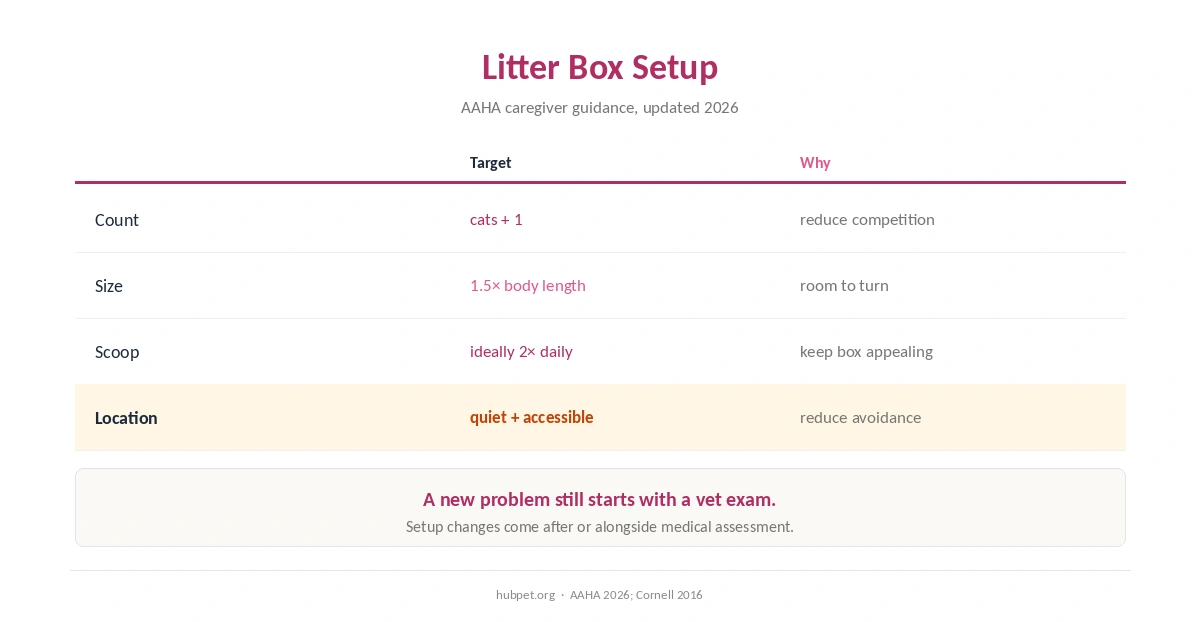
| Box count | One box per cat plus one extra | AAHA, 2026 |
| Box size | At least one and a half times the cat’s nose-to-tail length | AAHA, 2026 |
| Scooping | Ideally twice daily | AAHA, 2026 |
| Location | Quiet, accessible, away from food and loud appliances | AAHA, 2026 |
How to Manage Litter Box Problems After Medical Causes Are Addressed
Once the veterinarian has ruled out or treated medical causes, make the box easier to choose. AAHA recommends fine, granular, clumping, odor-free litter unless the cat shows a different preference, plus shallow uncovered boxes for many cats and quiet placement away from food, water, and noisy appliances (AAHA, 2026). The 2021 AAHA/AAFP guidance also says caregivers should never reprimand cats for toileting in an undesired location.
- Provide enough boxes so each cat can reach one without another cat blocking access. AAHA recommends one per cat plus one extra (AAHA, 2026).
- Choose a large, easy-entry box and adapt the edge height for kittens, seniors, or cats with mobility problems (AAHA/AAFP, 2021).
- Scoop frequently and clean with mild soap and water; avoid strong-smelling disinfectants (AAHA, 2026).
- Place boxes in quiet, accessible areas rather than beside food, water, loud appliances, or cramped dead ends (AAHA, 2026).
- If the problem began after a household change, reduce social pressure and give each cat separate key resources (FelineVMA, 2026).
- Do not punish the cat or carry the cat to the litter box as punishment (AAHA/AAFP, 2021).

How to manage litter box problems also depends on recognizing stress. Compare signs of cat stress and indoor cat environmental needs. If the issue follows a new-cat arrival, use the two-cat introduction plan instead of forcing shared space.
How to manage litter box problems gets easier after medical causes are addressed. Then the practical target is simple: clean boxes, easy access, and less social pressure.
When to Call Your Vet About Litter Box Problems
Call your veterinarian promptly for a new house-soiling problem. This matters especially when the cat strains, urinates frequently, cries in the box, passes blood, or seems painful (AAHA, 2026; Cornell, 2016).
A cat that repeatedly strains but passes little or no urine may have a urethral obstruction. Cornell describes that as an absolute emergency; go now and use pet emergency signs.
For prevention, the pet-proofing checklist can help protect quiet box access. The new pet owner checklist helps set up basic resources before problems begin.
In multi-pet homes, the goal is access without competition. Do not make every cat share one preferred location.

How We Research
HubPet uses veterinary and feline-welfare sources rather than personal anecdotes. Sources read on October 11, 2026: AAHA 2026 and AAHA/AAFP 2021. We also checked Cornell and FelineVMA 2026. See How We Research for our method.
How to Manage Litter Box Problems FAQ
No. AAHA recommends a thorough veterinary exam first because medical conditions can cause house soiling (AAHA, 2026).
AAHA recommends at least one box per cat plus one extra, placed in separate useful locations (AAHA, 2026).
AAHA’s 2026 caregiver guidance says ideally twice daily. HubPet also keeps the older “at least daily” source entry in its care table rather than hiding the difference.
No. AAHA/AAFP guidance tells caregivers not to reprimand cats or carry them to the litter box as punishment (2021).
Repeated straining with little or no urine can signal urethral obstruction and needs immediate veterinary treatment (Cornell, 2016).
The Bottom Line
How to manage litter box problems is a two-track process. First, rule out pain or disease. Then make toileting easy, clean, quiet, and low-conflict. Punishment misses both parts and can add stress instead of solving the cause (AAHA, 2026; AAHA/AAFP, 2021).