
Dog leashes with traffic handles have a second hand loop near the dog end. That low loop briefly shortens walking distance. Use it at a doorway, on a narrow sidewalk, or to make space for someone passing. It also creates another place where fingers, collars, and nearby objects might snag. A thick-looking extra handle does not prove safe handling. Check whether you can reach it smoothly. Hold it only as needed, then return to a loose leash. The following checks help you choose a workable design and use it without squeezing or jerking.

Identify the working length of the second handle
Lay the leash flat and find the distance between the hardware clip and the secondary loop. A traffic handle placed immediately beside a large snap may be awkward to grasp without reaching near the dog’s face. One farther away may not reduce distance enough for a busy crossing. Check the actual position on your dog and the height of the handler rather than relying on a product photo. Stand upright without bending abruptly into the dog’s path. Never wrap the loop around your wrist.
Understand temporary control, not constant restraint
The short loop is useful when there is a specific nearby hazard and the handler can stay calm. Hold it only for the brief period needed to create space, then return to the main handle. Continuous pressure may reduce natural walking movement and may make sensitive dogs uncomfortable. Never use the second handle to lift a dog, drag one away from a scent, or restrain a dog against a veterinary procedure. The leash is a connection for walking, not a lifting sling or a replacement for suitable training.
Inspect how the loop joins the webbing
Look at the base of the second handle. It folds back over the main strap. The stitches should be even and intact, with no loose seam opening under gentle handling. Some models use rivets, a rubber grip cover, or a padded sleeve over the joint. Confirm that the reinforcing piece has no rough edges that could rub your hand. Check both sides because a smooth front can hide damage at the back. If the loop is partly torn or its attachment moves unexpectedly, replace the leash instead of stitching a casual repair.
Keep both hands free of extra loops
When switching handles, let the main loop hang in a controlled way rather than wrapping it around the other hand. Do not place either loop around your wrist; a dog who lunges may tighten it rapidly. Homeward Trails warns about wrapped leashes causing injury when a handler loses balance. Keep the leash clear of strollers, shopping bags, wheelchair wheels, and bicycle spokes. Practice the hand change with the dog standing in a quiet room. The goal is a confident, predictable transfer rather than a frantic grab during a surprise.

Choose a harness that allows natural movement
A traffic handle does not make a neck collar the best attachment for a dog who pulls forcefully. VCA recommends equipment that fits comfortably and does not restrict shoulder motion. For a dog with pulling or neck sensitivity, discuss an appropriate body harness with your veterinary team or a qualified trainer. Confirm that the leash clip can move with the back ring without pressing into the coat. Practice a few steps with the short handle and watch whether the dog can walk naturally without its front end rising unnaturally.
Keep a safe distance from moving hazards
A narrow curb, bus stop, or shop entrance can tempt the handler to rely on a short grip for too long. Instead, choose the widest available route, wait for a clear moment, and use calm cues and rewards. Hold the secondary handle briefly to prevent a sudden step into a dangerous area, not to force close contact with strangers or dogs. A short leash cannot make a dangerous crossing safe. If the crowd overwhelms your dog, turn away and find a calmer route.
Compare padded and plain traffic loops
Soft padding can reduce pressure on the palm, but a bulky sleeve may be difficult to grasp quickly. Plain webbing gives a compact loop yet can become slippery when wet. Try the grip with dry and slightly damp hands before depending on it. Look for a loop that permits an easy release if something goes wrong. Avoid sharp seams, abrasive edges, and metal rings inside the grip. Choose comfort based on your hand size, the dog’s strength, and the specific environment rather than a claim such as maximum control.
Check hardware at both ends
The primary snap, any swivel, and the strap connecting them still carry the dog’s pull even if a second handle is used. Open and close the spring gate several times before a walk and look for corrosion or bent metal. Examine stitching beside the snap and the two ends of the added loop. Wash according to the manufacturer’s instructions; abrasive dirt near a seam can speed wear. If you discover a split stitch or a faulty gate, do not assume the second handle makes that equipment safe to keep using.
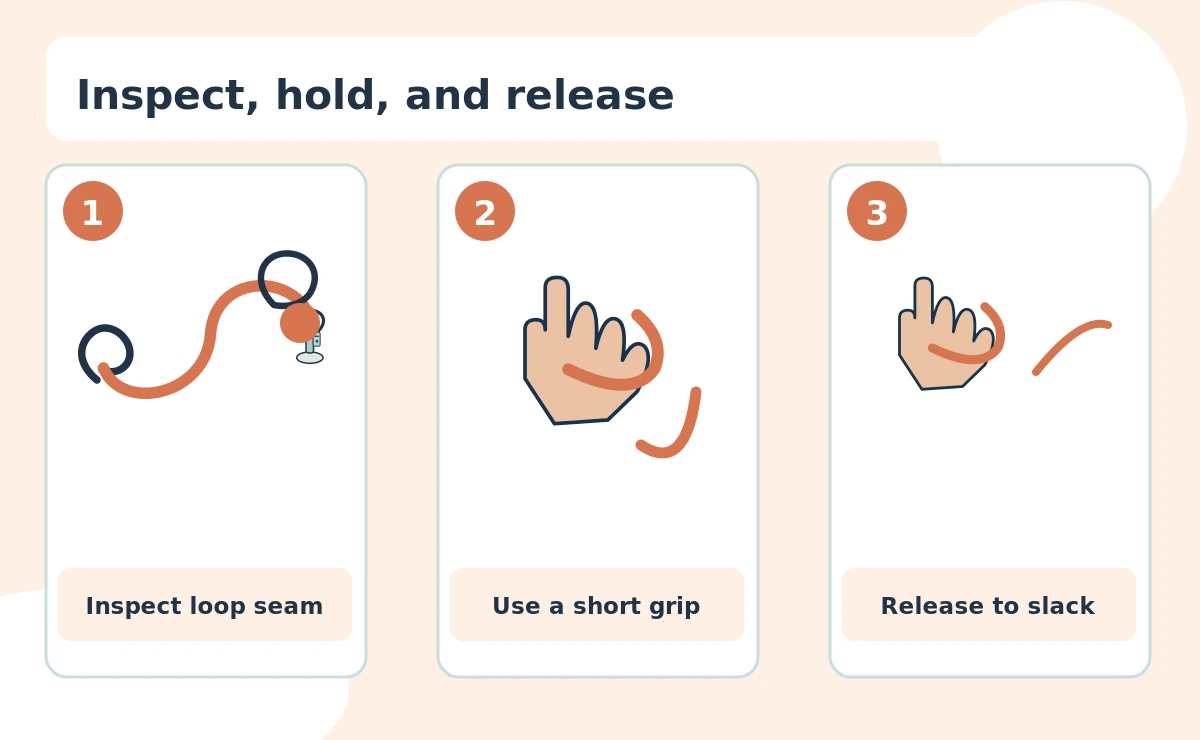
Practice a three-stage hand change
First ask for a relaxed stand or a few calm steps. Second reach down to the short handle without tugging, using the other hand to manage the main leash. Third return to the long handle once the narrow section is clear, restoring comfortable slack. Reward the dog when it checks in with you. Rehearse this transition in a quiet place before trying it at a roadside. If the handle is impossible to reach without a jerk, choose a different length or design rather than compensating with force.
Recognize when the design is the wrong tool
A dog who panics around traffic needs a calm route and a behavior plan. Closer restraint alone will not solve those reactions. Seek veterinary evaluation for pain or sudden behavior changes and a qualified reward-based professional for walking support. Stop using the short grip if it causes coughing, a harness shift, repeated paw entanglement, or painful tension in your hand. Effective handling means making a safer choice early, before a traffic loop becomes a last-minute defense against an unsafe encounter.
How We Research
We compared veterinary and animal-welfare guidance with the physical shape of clips, straps, buckles, rings, and the movement of a walking dog. Because fit differs by breed, body proportions, and manufacturer, our drawings illustrate what to inspect instead of inventing universal dimensions or product tests. For more on our approach see our editorial information and veterinary disclaimer. Seek veterinary help for pain, persistent coughing, skin injury, or sudden mobility changes.
Sources
VCA Animal Hospitals — Collar and Harness Options for Dogs — external guidance on fit, comfortable walking, humane handling, and equipment risks.
VCA Animal Hospitals — Controlling Pulling on Walks — external guidance on fit, comfortable walking, humane handling, and equipment risks.
Homeward Trails — Safety and Containment of Your New Dog — external guidance on fit, comfortable walking, humane handling, and equipment risks.
Calgary Humane Society — Dog Walking Equipment — external guidance on fit, comfortable walking, humane handling, and equipment risks.
It is a secondary grip close to the dog end that temporarily reduces walking distance during narrow or busy situations.
No. It is meant for brief close control; return to a comfortable loose leash when the path is clear.
No. The leash handle and attachment gear serve different purposes, and the collar or harness still must fit comfortably.
Not always. Padding can help grip comfort, but thick material may be bulky or slippery for some handlers.
A fraying load seam, partially detached loop, jammed snap gate, or cracked connector is a reason to stop using it.