
A six-foot leash is a practical starting point for a neighborhood walk, but length alone does not make it safe. The handle has to stay secure in your hand, the clip must close fully, and the line needs enough slack for a dog to move without constant pressure. This guide shows where to measure six feet, how to inspect hardware, and when a shorter working distance is useful. It also explains why six feet is not permission to approach every person, dog, or roadway. Choose the gear that your dog and your grip can control. See our veterinary disclaimer for pet-health questions.
What six feet actually measures
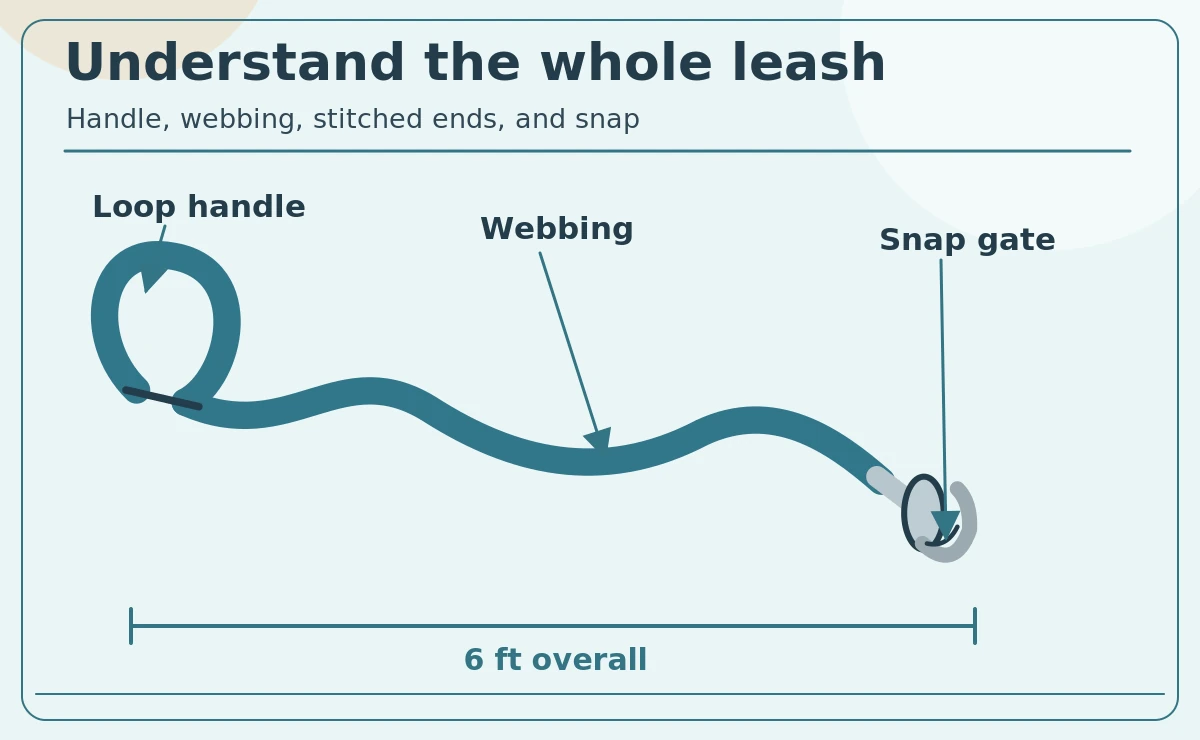
A leash advertised as six feet may count the handle loop and snap, while another maker measures only the usable webbing. Lay the leash straight on the floor and compare the end of the handle with the attachment point. In a narrow hallway or beside traffic, you may need to gather some of that length safely in your hands. In an open, permitted walking area, the additional space can allow sniffing. The goal is adjustable working distance, not a taut line at every moment. A leash cannot replace training or awareness of surroundings.
Choose a handle you can hold comfortably
Slip a hand through a sewn loop and check its width without pulling tight. A hard seam can rub your knuckles, and thick padding may feel bulky to someone with smaller hands. Try holding the handle while wearing your normal walking gloves. The loop should stay easy to grasp without trapping your wrist. Do not wrap extra leash around your hand, wrist, or fingers to shorten it. That makes sudden tension harder to release and may cause injury. A second hand can manage loose folds without creating knots.
Read the webbing and stitching together
A leash is only as reliable as its weakest part. Examine the webbing edge for fraying, cuts, heat damage, and stiff or brittle patches. Follow the stitches near the handle and snap attachment; loose threads or a spreading seam mean the leash needs replacement. A light leash should not rely on thin, decorative stitching as its sole structural connection. Wider straps can distribute pressure across your palm, but they can also be heavy for a very small dog. Choose an appropriate weight and secure hardware instead of assuming the thickest leash is always best.
Check the snap gate at the harness ring
Open the snap hook with the leash disconnected, then release the gate and confirm that it closes completely. Look for cracks, rust, rough edges, or a weakened spring. Clip it to the intended metal attachment ring, not to a fabric loop that merely holds a logo or tag. Rotate the clip gently to see whether it sits freely and cannot slip off during an ordinary movement. A swivel helps manage twisting, but it does not repair a weak gate. Replace damaged hardware rather than trusting a quick household fix.
Measure useful slack on a real sidewalk
Stand beside your dog in a quiet, low-distraction area. Hold the handle near your body and allow a shallow U-shape in the leash between you and the harness. This curve signals that neither end is pulling. Watch the line during turns; it should not drag under paws or loop around ankles. If the sidewalk narrows, shorten the working length by gathering the webbing in loose folds. Give space again when the path opens. This length works well only when the handler can adjust distance smoothly and reward comfortable walking.
Compare a fixed leash with a retractable line
With a fixed six-foot leash, the handler sees the webbing and knows the maximum length. By contrast, a retractable line may extend quickly, and its thin cord can create entanglement or friction injuries. In busy areas, the extra distance can put a dog near a road before the handler reaches the lock. The fixed design is not automatically foolproof; letting it drag or wrapping it around a wrist creates hazards too. For ordinary neighborhood walks, reputable humane organizations commonly favor a fixed leash over a retractable one.

Use the leash without applying neck pressure
A dog that lunges, coughs, or strains against a collar should not be managed with leash jerks. A comfortably fitted body harness usually makes a better walking connection for that situation. Keep the line slack when possible, move away from triggers, and reward the dog for choosing an easier position. Clip only to a point designated for leash load by the harness maker. A leash is a connection and communication tool, not a method of punishment. If you regularly feel overpowered, seek qualified reward-based training and a gear fit check.
Prevent tangles with simple handling habits
Before opening the door, look for loops caught under the dog’s chest or behind a front leg. Keep the free portion away from stroller wheels, bicycle tires, and other people’s feet. Avoid attaching an unheld leash to a shopping cart, bench, or loose object. A dog can pull the item over or become trapped. On a crowded path, move aside rather than pulling the line taut to force a passing encounter. At home, store the leash where children and pets cannot become tangled in its handle.
Clean and retire gear before it fails
Mud, salt, and water can hide damage around hardware. Clean the leash according to its material instructions, rinse residues when appropriate, and let it dry thoroughly before storage. Test the snap again after exposure to sand or grit. Do not soak a leash with leather parts unless the maker allows it. Examine older equipment more often because seams and webbing wear gradually. A frayed line or unreliable latch is not a good candidate for one more walk. Replace the whole leash or use a properly rated professional repair.
Make a thirty-second departure check
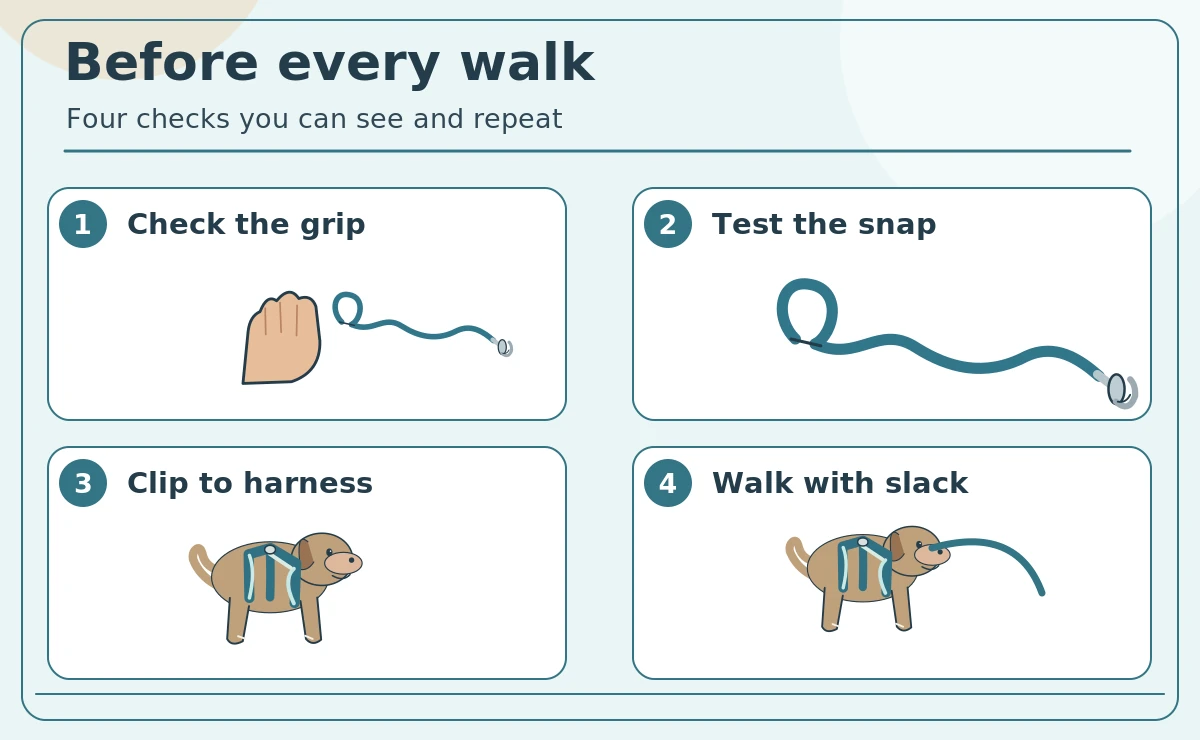
Start at the handle and follow the entire line to the snap with your eyes and hands. Confirm a secure loop, sound stitches, intact webbing, and a fully closed gate. Check the harness on the dog separately and verify the attachment ring. Hold the leash before you open the outside door, and practice a calm pause rather than rushing into the sidewalk. On the walk, watch for slack, comfortable breathing, and changing traffic. Repeat the equipment check after a sudden hard pull or a snag on a fence.
When six feet is not the right choice
A six-foot leash may be too much line for a crowded stairwell or transit platform, and it is too short for some structured recall exercises. Use a safer short working distance in tight environments. For supervised training in open spaces, a purpose-designed long line is a separate tool with different handling risks. If your dog is highly reactive or your balance is limited, ask a reward-based trainer to assess your setup. No single leash length promises control for every dog, person, or location.
How We Research
We checked veterinary and animal-welfare guidance on fit, equipment pressure, and reward-based handling. We separated the features a buyer can inspect from guarantees that a product cannot make. The illustrations explain common construction and use; they are not product certification or individual fitting advice. Every dog has different proportions, movement, and handling needs. Our priority is a comfortable, secure connection and a practical stop rule when gear causes distress. See our editorial approach for more about HubPet.
Sources
San Francisco SPCA, Collars and Leashes — https://www.sfspca.org/resource/collars-and-leashes/ (accessed October 2026).
American Kennel Club, Choosing the Right Dog Leash — https://www.akc.org/expert-advice/training/choosing-right-dog-leash/ (accessed October 2026).
Pasadena Humane, Loose Leash Walking — https://pasadenahumane.org/loose-leash-walking/ (accessed October 2026).
VCA Animal Hospitals, Collar and Harness Options for Dogs — https://vcahospitals.com/know-your-pet/collar-and-harness-options-for-dogs (accessed October 2026).
Safety note: Do not use walking equipment to jerk, punish, or restrain a distressed dog. Seek veterinary advice for pain, coughing on leash, abnormal gait, or exercise intolerance. Check the manufacturer’s exact fitting and care directions before use.
Both can work. A six-foot leash offers a little more sniffing room, while a shorter working distance may suit crowded paths. Grip and handling matter most.
It depends on the maker. Lay the leash flat and check the usable distance from your hand to the attached clip.
Avoid winding or locking the leash around your wrist or fingers. Hold a secure handle so sudden tension does not trap your hand.
No. Connect to a ring specifically intended for leash attachment on a properly fitted collar or preferably an appropriate harness.
Replace it if the gate sticks, does not close, has visible damage, or is loose at its attachment. Do not rely on a damaged closure.