
Educational information only, not veterinary diagnosis or individualized behavior treatment. Sudden behavior changes, pain signs, persistent distress, and bite risk warrant appropriate veterinary or qualified professional advice. Read our veterinary disclaimer.
Cats speak with their bodies long before a hiss or swipe. The position of the ears, tail, whiskers, and limbs can help you notice when a cat feels comfortable, curious, uncertain, or threatened. But a tail tip, dilated pupil, or exposed belly is not a standalone translation. Light, excitement, posture, and individual differences all influence what you see. A practical reading checks several signals and how the cat responds when given more space.
This article is a broad visual guide, not a replacement for specific advice about petting-related biting or recognizing stress in cats. Those guides go deeper into particular problems. Here you will build a repeatable method for safer greetings, petting, multi-cat interactions, and noticing changes that merit professional support.
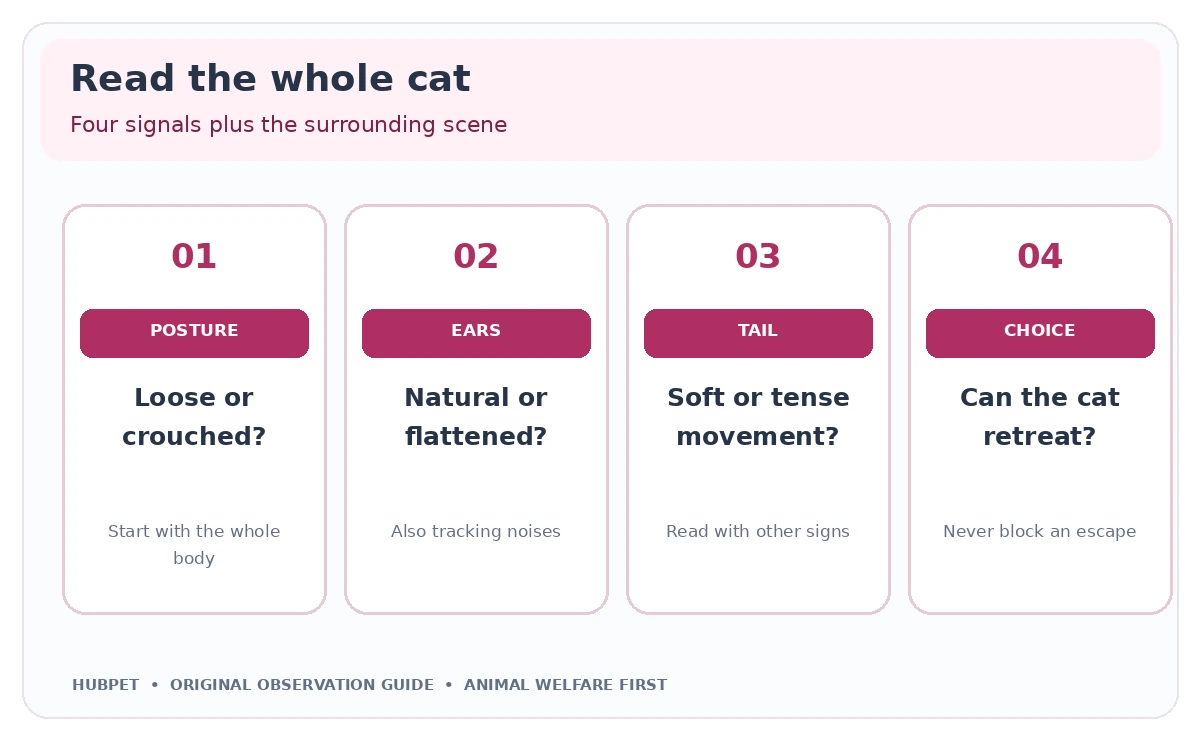
Read the Whole Cat in Four Parts
Start with overall posture: relaxed and fluid, tightly crouched, stretched out, or enlarged with raised fur? Look at the ears: comfortably oriented, swiveling to investigate a noise, or flattened sideways/back? Then examine tail movement and eyes, but interpret them with the body. Finally, ask whether the cat can approach, retreat, or rest without being blocked by people or other animals.
Best Friends Animal Society and Cat Friendly Homes illustrate how similar-looking features can occur across different situations. Dilated pupils, for example, may reflect darkness or arousal as well as worry. A high tail often appears in friendly approaches, yet its meaning changes if the cat is rigid or agitated. The most reliable habit is to note combinations and transitions, never pronounce a single signal definitive.
Relaxed, Curious, and Ready-to-Interact Cues
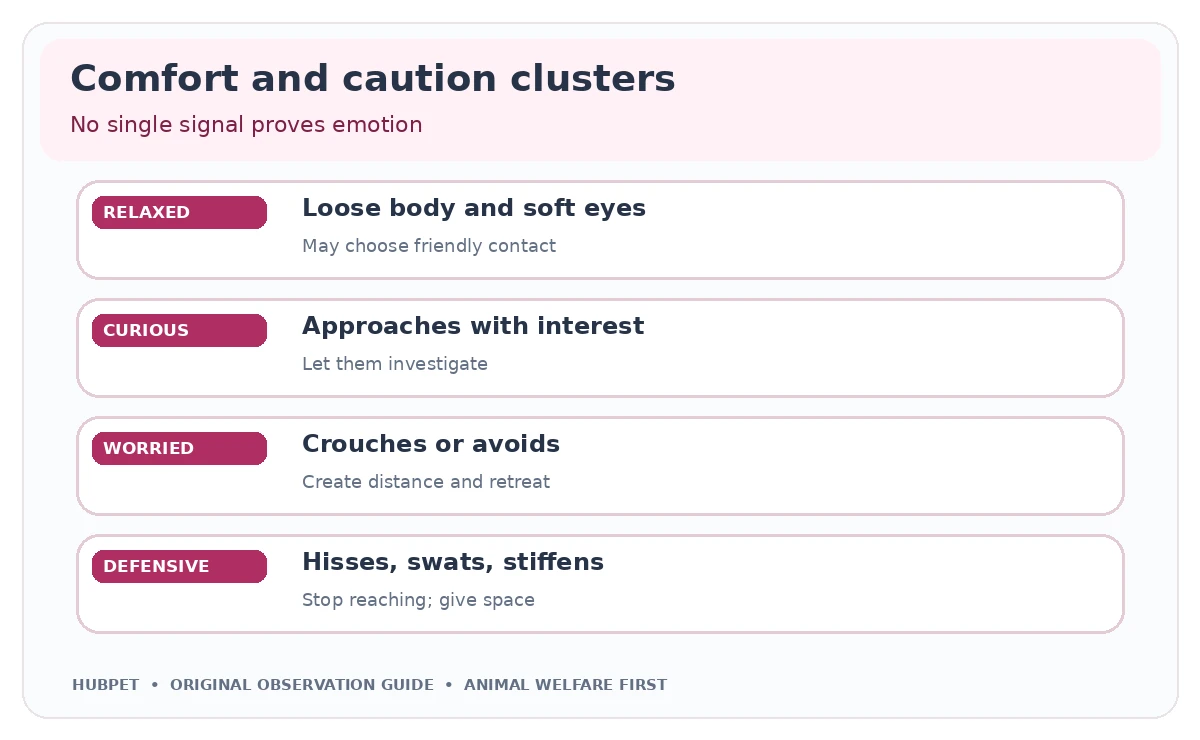
A comfortable cat may have loose limbs, naturally positioned ears, soft eyes, and a tail moving without sharp, tense whipping. Some cats approach with an upright tail and a slight curve at the tip. Curiosity may bring ears and whiskers forward, wide attention, and careful movement toward a new object. None of these cues are blanket permission to pick the cat up or touch a sensitive area.
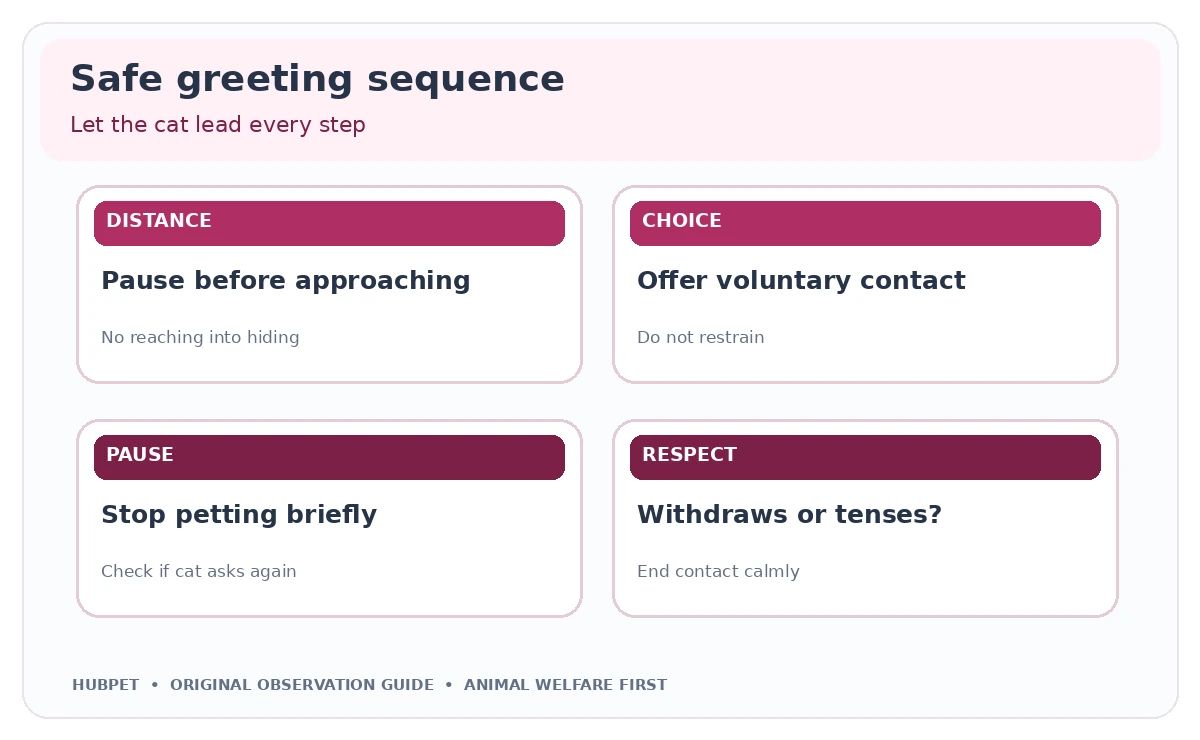
Test consent through a low-pressure interaction. Offer a still hand at the cat’s level without moving it into the face, let the cat choose to approach, and stop petting after a few strokes. If the cat leans in or returns, that can support continuing gently; if they turn away, allow the interaction to finish. Children should have adult supervision and clear rules against chasing or cornering cats.
Worried or Defensive: When More Space Helps
A worried cat may crouch low, pull the tail close to the body, turn the ears sideways or backward, hide, or move away. A more defensive cat may hiss, arch the back, puff the fur, or swat to create distance. These behaviors should change what you do immediately. Stop reaching toward the cat, avoid blocking escape, and offer a quiet retreat where the animal cannot be pursued.
ASPCA explains that offensive and defensive postures can differ: not every upright, stiff cat has the same motivation as a frightened cat who makes their body small. Treat tension and warning signals as a reason to reduce pressure, not an invitation to challenge the cat. Do not punish growling or hissing; these warnings may prevent a more serious confrontation.
Tail, Ears, Eyes, and Whiskers Are Clues, Not Commands
Tail held upright during an easy approach may fit social confidence; fast whipping or a tightly wrapped tail may occur when the cat is tense or trying to withdraw. Ears turning backward can reflect concern, but ears also track sound. Eyes that look half closed can accompany relaxation, whereas a wide-eyed frozen cat might be alarmed. Compare each observation with normal behavior for this individual.
Whiskers often move forward with investigation, while a tense face and retracted whiskers can accompany stress. Do not pull whiskers, pin ears, or manually manipulate a tail to “check the signal.” Photographs capture a split second and may be misleading. Prefer watching an unforced sequence: approach, pause, change of body tension, and whether the cat chooses contact.
Use Body Language to Prevent Petting and Play Problems
During petting, watch for the tail tip starting to flick, a head turn toward your hand, a freeze, or the cat moving away. Stop before a bite. During play, offer toys on a wand or other suitable distance from hands, allow a pause, and give the cat a choice to continue. If a cat becomes defensive near another cat, increase space and remove crowding around doorways, resting spots, or resources.
The habit that matters is responding early. Rather than insisting your cat enjoy company, arrange places to hide, elevated retreats where appropriate, and access to food, litter, and water without conflict. See our multi-pet household checklist for practical space and resource planning. Safety improves when cats can opt out without needing to escalate.
When Body Language Suggests More Than a Mood
Sudden hiding, marked withdrawal, reluctance to jump, a change in gait, poor grooming, appetite change, or repeated sensitivity to touch may point to a health concern. Body language can alert you to a change but cannot diagnose pain. VCA recommends veterinary assessment when everyday behavior or activity shifts noticeably, especially if a cat seems uncomfortable.
If a cat threatens a bite, scratches, or seems frightened, avoid handling and secure distance while arranging appropriate help. For routine interactions, a three-step observation—context, whole-body cues, and ability to choose distance—will take you further than a chart claiming to decode every ear flick. Respecting communication is the goal, not becoming certain of every feeling.
How We Research
We reviewed the linked veterinary, animal welfare, and behavior resources on October 26, 2026, using the HubPet editorial approach. The cited organizations provide guidance, while the observation prompts and practical household examples are our own. Editorial checks addressed unsupported mind-reading of animals, aversive training suggestions, and advice that could delay necessary veterinary care. Our original diagrams serve as teaching tools, not diagnostic charts or findings from clinical studies. Individual animals differ: consider your pet’s usual behavior, age, medical history, and safe opportunity to disengage.
Sources
Best Friends Animal Society: How to read cat body language and emotions. Accessed October 26, 2026.
Cat Friendly Homes: How to recognize intercat tension. Accessed October 26, 2026.
ASPCA: Aggression in cats: reading feline body language. Accessed October 26, 2026.
Animal Welfare Victoria: Understanding dog and cat body language. Accessed October 26, 2026.
VCA Animal Hospitals: Signs of pain in cats. Accessed October 26, 2026.
It often appears during a comfortable social approach, but context matters. Also check the cat’s movement, posture, ears and whether contact is voluntary.
No. Lighting and excitement can also change pupil size. Evaluate the eyes with posture, ears, tail and the current situation.
Not necessarily. A cat may expose the belly while relaxed or in a defensive posture. Let the cat choose contact and avoid assuming the abdomen is an invitation.
Stop approaching, give the cat an escape route and do not punish the warning. Seek qualified help if the situation is recurring or dangerous.
Pause when the body stiffens, tail flicks sharply, ears rotate, the cat looks at your hand, or they move away. Respect the withdrawal and do not restrain the cat.