
A wet-food feeder serves pre-portioned meals by uncovering one compartment at a scheduled time. That is different from a dry-kibble hopper, which releases loose pellets through a chute. The wet-food design must manage moisture, residue, and temperature. A cat may also return to an open plate. Start with a realistic question: how long must prepared food remain in the machine before your cat eats it? A rotating lid alone cannot answer that question. The U.S. Food and Drug Administration advises prompt refrigeration or disposal of leftover canned and pouched food. Any automated routine has to respect food handling first and convenience second.
Separate the clock from the cooling system
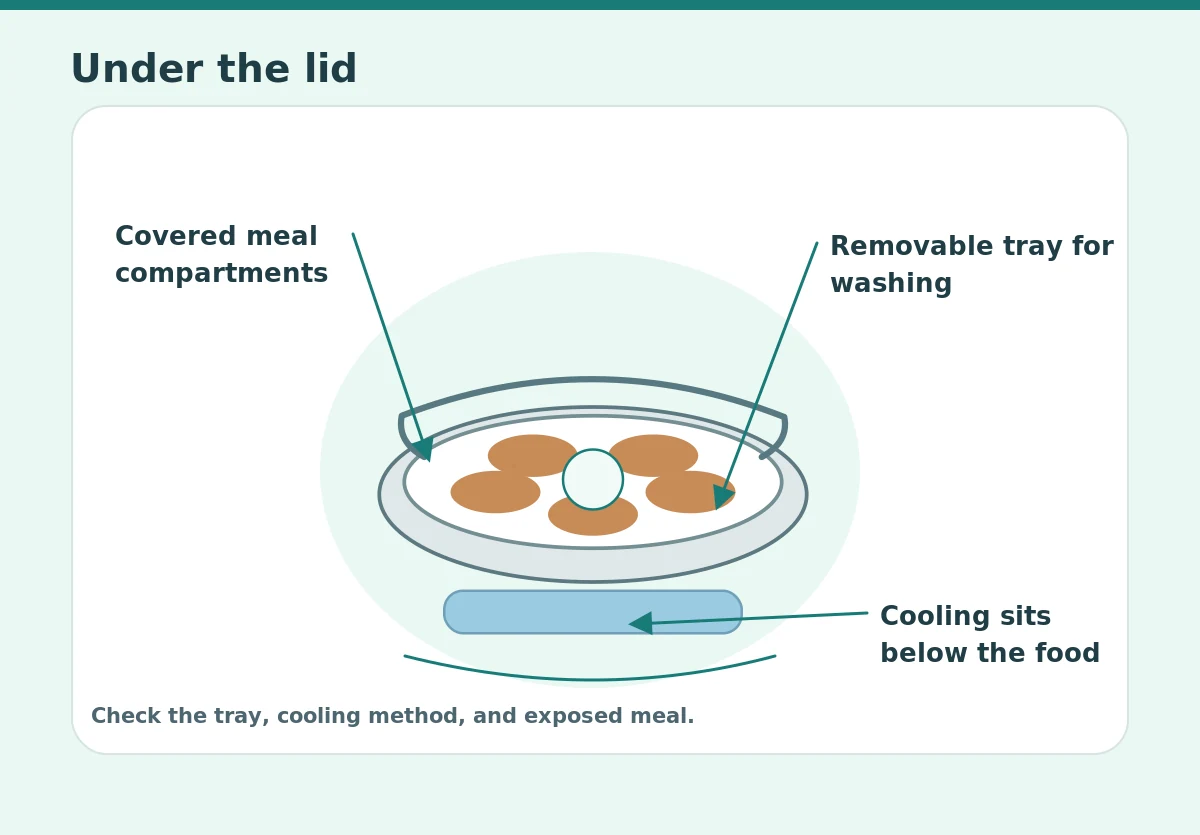
Check two parts of the product instructions. One should explain lid movement; the other must explain how portions stay appropriately chilled. A timer can work perfectly while the food becomes unsuitable. Some machines have space for reusable frozen inserts; those inserts gradually warm in room air and do not maintain a measured refrigerator temperature indefinitely. Other feeders use powered cooling and depend on uninterrupted electricity and the specified operating environment. Never treat an ice pack, a sealed lid, or an advertisement about freshness as proof that a portion stays safely cold for any arbitrary interval. Ask for documented operating instructions rather than a vague all-day claim.
Inspect the tray and lid geometry
A useful food tray lifts out without forcing fingers into a motor housing or exposed moving gear. Check the actual compartments: can you wipe every corner and see residue beneath the rim? A shallow, smooth insert is easier to wash than a tray with narrow grooves that trap food. Look at the lid path. It should uncover the intended serving completely and avoid an obvious pinch point where a curious cat might push a paw. Verify that a removable gasket can be inspected and reinstalled as directed. If cleaning requires dismantling electrical components, compare a simpler design. Your goal is a daily routine you will actually follow, not a feature count.
Choose the number of portions for your real absence
A machine with several trays does not automatically make several days of unattended feeding safe. List the meals your cat ordinarily receives, the interval between preparation and delivery, and when a person can inspect the food. Consider the temperature of the room and whether the cat finishes a serving promptly. If your schedule includes long periods away, arrange a human check rather than relying on a marketing estimate of ice-pack duration. The feeder also needs fresh water nearby and a backup plan if it jams. Keep a familiar bowl available during training so you can tell whether a missed meal reflects the feeder, a noisy mechanism, or a change in appetite.
Test the schedule while you are present
Program one serving for a time when you can watch from across the room. Confirm the correct compartment reaches the opening, the food is accessible, and the lid stops without startling or trapping the cat. Next, repeat with the intended texture of food. Pâté, chunks in gravy, and mixed textures leave different residue patterns; do not assume success with an empty tray proves safe use with food. If the device has a clock, check whether losing power or changing batteries resets the schedule. Run these checks on several ordinary days before trusting the device for a work shift. Do not force a fearful cat to approach a moving lid.
Plan around a lost power source
For actively chilled feeders, ask what happens to cooling if an outlet loses power. Battery backup may preserve the clock or lid motion without maintaining refrigeration; treat those functions separately. For frozen-insert designs, check whether the lid still moves when its battery weakens. Keep a written fallback: a trusted person can serve a fresh meal, remove exposed food, and verify the cat ate. A camera or phone notification cannot replace that hands-on response. Food from a feeder that lost adequate cooling should not be served on the assumption that its closed compartment stayed safe. Follow the manufacturer directions and normal food-safety handling.

Clean the food-contact surfaces every time
After a wet meal, remove the tray and wash all food-contact parts exactly as the manual permits. Pay attention to the rim, underside of the lid, and small creases around a rubber seal. Rinse away cleaner thoroughly, then dry reassembled parts before storing the device. FDA and AVMA recommend washing pet feeding dishes and utensils; leaving wet residue to sit between scheduled meals defeats the point of careful portioning. Keep the feeder away from litter and splashes. Never submerge the powered base unless the manufacturer explicitly permits it. If corrosion, cracks, sharp edges, or a persistent odor develop, stop using the damaged component.
Measure what is offered and what gets eaten
Label each compartment with the intended serving in your own planning notes, not on the food-contact surface. The feeder may present a portion but cannot confirm that a cat swallowed it. Check for uneaten residue at each attended visit, especially if another pet can reach the opening. Weigh or measure meals using the food label and the plan set with your veterinarian, rather than guessing from the tray volume. Food availability is not a substitute for noticing appetite changes. If your cat repeatedly leaves meals untouched, vomits, or shows sudden lethargy, contact a veterinarian. Do not keep increasing the automated portion to compensate for uncertainty.
Avoid a rushed transition to unattended meals
Introduce the feeder as an ordinary bowl with the lid held open or the motor disabled according to its instructions. Reward voluntary exploration and serve familiar food at normal meal times. Once the cat approaches comfortably, allow a scheduled lid movement while you remain nearby. Then trial one fully automated meal and inspect the result. If your cat avoids the clicking sound or waits for you to arrive, slow the process rather than repeatedly opening and closing the lid in front of them. The purpose is a dependable routine that both the cat and caregiver can use without anxiety, not teaching the cat to tolerate every mechanical noise.

Use a decision checklist before buying
Compare the exact food compatibility, documented cooling process, removable tray materials, cleaning directions, lid action, controls after a power loss, and access to replacement parts. Skip any model whose manual cannot explain safe wet-food use. Test where it will sit: level, away from direct sun, heaters, and inquisitive dogs. Ask who checks the cat if a scheduled serving fails. A well-designed feeder can help with timing, but it does not make perishable food shelf-stable or replace daily observation. If a cat requires an individualized feeding plan, confirm the arrangement with its veterinarian before automating it.
How We Research
We separated timed dispensing from safe food storage, using FDA and AVMA handling guidance as the baseline. We did not infer a universal safe holding time from product marketing or conduct hands-on temperature testing. See About HubPet for general editorial information.
Sources
U.S. FDA — Tips for Safe Handling of Pet Food and Treats: Read the source. Accessed October 27, 2026.
U.S. FDA — Proper Storage of Pet Food and Treats: Read the source. Accessed October 27, 2026.
American Veterinary Medical Association — Safe Handling of Pet Food and Pet Treats: Read the source. Accessed October 27, 2026.
Safety note: Feeders cannot replace observation of eating and drinking. Ask your veterinarian about changes in appetite, weight, behavior, or a medically restricted feeding plan; see the HubPet veterinary disclaimer.
No. Dry hoppers are not designed to dispense moist food or handle its residue. Use only a feeder that explicitly supports wet food and gives cleaning and cooling directions.
Not by default. Their cooling changes with room conditions and elapsed time. Follow the exact product guidance and discard food whenever safe holding is uncertain.
Not necessarily. Some batteries preserve scheduling but not powered cooling. Verify each function separately and plan a human check when electricity fails.
Wash food-contact parts after each feeding cycle, following the manufacturer instructions, and clean rim areas where residue can collect.
No. Someone still needs to confirm the cat is eating, the feeder works, the food remains appropriate, and fresh water is available.