
Pet safety note: Training advice cannot assess pain, illness, hearing, vision, or movement concerns. Ask your veterinarian about new or concerning changes and read our veterinary information disclaimer.
Dog training hand signals are visual cues that tell a dog which familiar behavior will earn reinforcement. There is no single gesture dictionary every pet dog understands automatically. A raised palm could mean wait in one household and something else in another. The value comes from choosing clearly different movements and teaching them consistently. Start with one already reliable behavior rather than pairing an unfamiliar movement with an unlearned skill. This keeps the task narrow: the dog is learning what your hand means, not two new ideas at the same time.
Choose gestures you can repeat comfortably
Pick a distinct, simple signal that is comfortable for your hand and visible from the dog’s normal position. A small upward sweep may be easier than a complex sequence of finger shapes. Avoid gestures that look identical from the dog’s viewpoint or require leaning over the animal. Consider family members with limited mobility and choose movements everyone can use. Write down the exact starting position and finish of each gesture, such as palm at hip then a small sweep. Tiny differences can matter when a dog is still figuring out the rule.
Start with a familiar, rewarded behavior
Choose an action like sit, down, or moving to a nearby mat only if the dog already performs it willingly. In a quiet room, cue the known action and reinforce success with a marker and a small reward. Check the dog’s comfort and the flooring before practice. When a cue is not reliable without a visible treat lure, first fade the lure so the gesture does not become a permanent food signal. Training hand signals is easiest when one piece—the behavior—is already stable, leaving the new visual instruction as the only variable.

Add the new hand signal before the old cue
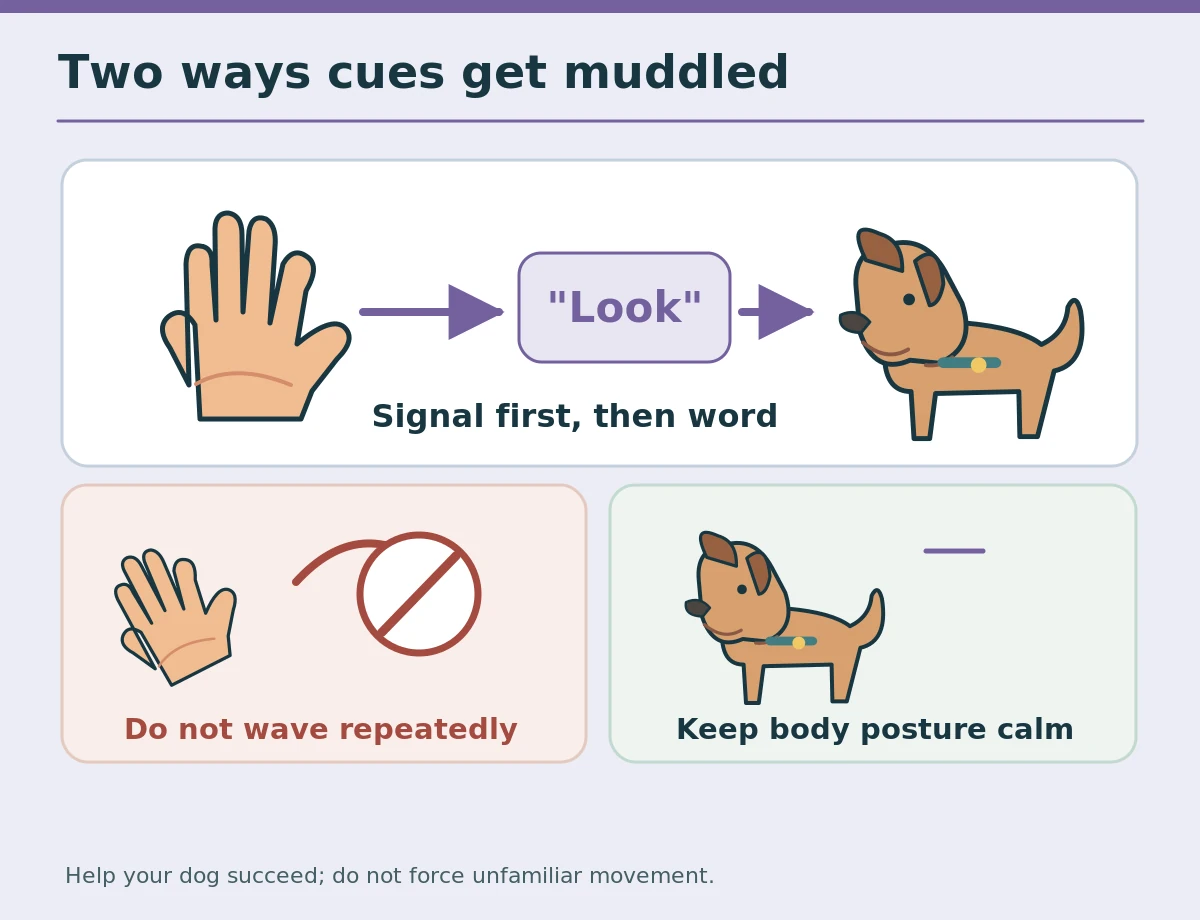
To transfer a known spoken cue to a hand signal, present the new hand signal first, pause briefly, and then say the familiar word. Mark and reward when the dog performs the action. Repeat only a few times before giving the hand signal alone as an easy test. If the dog does not respond, return to the paired sequence rather than adding louder words. Timing matters: when both signals are delivered as a simultaneous blur, the dog may attend only to the old familiar cue and never notice the hand movement.
Separate lure motion from the finished signal
A food lure is a training aid, not necessarily the final hand signal. When dogs follow a treat held over their noses, they may respond to the food’s location rather than to the movement itself. Practice with an empty hand, mark the behavior, and reward from the opposite hand. Make your gesture smaller over several sessions if it began as a big lure. Do not yank a dog’s head up with food or ask for a position that causes slipping. A good visual cue should be readable without having to show the dog a snack first.
Check whether your body language changes the result
Dogs may notice your shoulders, feet, gaze, and distance as much as your chosen hand signal. If a gesture works only when you bend forward, practice with a neutral stance and reward easy successes. Some dogs find leaning over them uncomfortable, so keep posture inviting. Try the same signal while seated if it is safe and visible, or from a slightly different angle. This reveals accidental extra cues before they become habits. Do not assume disobedience when a dog gets confused by a new picture of your body.
Make signals visible without startling the dog
Face your dog where they can reasonably see your hand. A dog looking away cannot respond to a purely visual instruction unless they first notice you; use a trained name-attention cue before showing the hand signal. Avoid suddenly waving hands near the face or trying to train across busy traffic. A visually cued skill is not reliable emergency safety control by itself. If a dog has vision or hearing limitations, work with a veterinarian and qualified trainer to select accessible cues adapted to that individual.
Practice in a gentle progression of settings
Begin in the same familiar room until the dog succeeds with the new hand signal alone. Then change to another quiet room or stand a small step farther back, keeping reward quality high. Add only one mild distraction at a time. Avoid testing several unfamiliar signals rapidly like flash cards; reward calm, accurate responses and insert a break. If a visual cue suddenly stops working outdoors, reduce distance and distraction before assuming the hand movement must become bigger. Training is a process of generalizing a picture across contexts.
Prevent cue clutter in a multi-person home
Make a small household chart with the behavior, hand movement, verbal cue, and reward method for everyone who handles the dog. Keep signals for wait, sit, and down distinguishable. Ask children to use gestures only when supervised and the dog is comfortable. Do not punish a dog because different people accidentally used one gesture for conflicting tasks. If you replace a confusing signal, teach the replacement deliberately and stop using the old one. Consistency preserves the dog’s confidence more effectively than commanding louder or more often.
Know when spoken and visual cues are both useful
A hand signal can support an existing spoken cue, or eventually work independently when the dog can see the handler. A verbal cue may be preferable when the dog is looking elsewhere, provided it has been taught. Using both signals together is not automatically more precise; the dog can become reliant on whichever one predicts the reward most reliably. Practice them separately after teaching. Give a cue once and allow processing time. If the dog hesitates, make the next trial easier instead of repeating a cloud of words and motions.

A two-cue practice plan that stays clear
For a short session, work on one familiar behavior with one new gesture. Pair new signal then old cue, reward a few times, and try a single gesture-only repetition. End with an easy, known behavior and stop when enthusiasm drops. Note whether the dog responded to the new hand alone or only after your spoken backup. Wait for fluency before adding a second gesture. A consistent family reference card and occasional maintenance rewards do more than learning a long list of hand positions in one afternoon.
How We Research
We used AKC advice about visual communication, cue sequencing, and consistent body language, together with AVSAB humane-training principles. Gesture illustrations are examples—not an official or universal canine sign language—and are not substitutes for individualized sensory evaluation. Learn more about our approach at About HubPet.
Sources
American Veterinary Society of Animal Behavior: Humane Dog Training Position Statement and 2025 clarification: Read source. Reviewed October 27, 2026.
American Kennel Club: Dog Training Hand Signals and Communication: Read source. Reviewed October 27, 2026.
American Kennel Club: When and How to Use Verbal Cues: Read source. Reviewed October 27, 2026.
American Kennel Club: Expert Dog Training Tips: Read source. Reviewed October 27, 2026.
No. People choose different gestures, and each dog must learn what those movements predict. Consistency within the household matters more than following a universal-looking chart.
When transferring a known verbal cue, show the new visual signal first, pause briefly, and then give the familiar word. Reinforce the response and gradually test the hand signal alone.
Yes, once each visual cue has been taught and the dog can see you. Do not assume a dog looking away can respond to a gesture without first getting attention.
Practice the movement with an empty hand and reward afterward from your other hand. Reduce a large lure into a consistent smaller signal over short sessions.
Visual cues may help some dogs with hearing loss, but individual ability and comfort vary. Ask a veterinarian and qualified reward-based trainer how to adapt communication safely.