
An automatic cat feeder can deliver measured meals when a person is busy, but a motor, timer, or phone app does not guarantee that food arrives. Kibble may jam, a power supply can fail, and another cat may take the portion. A feeder should support a feeding plan, not replace daily checks on the animal. See the HubPet veterinary disclaimer for health and safety limits.
This guide compares dry-food dispensers and timed wet-food trays, then explains how to test reliability at home. If your cat follows a prescription diet, needs medication with meals, or has a serious feeding problem, review the schedule with your veterinarian first.
Begin with the cat’s established daily food plan
Determine the correct daily ration and meal frequency before choosing a machine. Cornell explains that feeding patterns depend on age, health, and preference. Automatic scheduling can distribute meals, but it cannot decide an appropriate calorie target for your cat.
Write down who fills the hopper, when portions should arrive, and how uneaten food will be handled. A cat with special dietary needs may require direct supervision. Avoid switching a fragile feeding routine solely because a device advertises convenience.
Know which feeder style fits the food
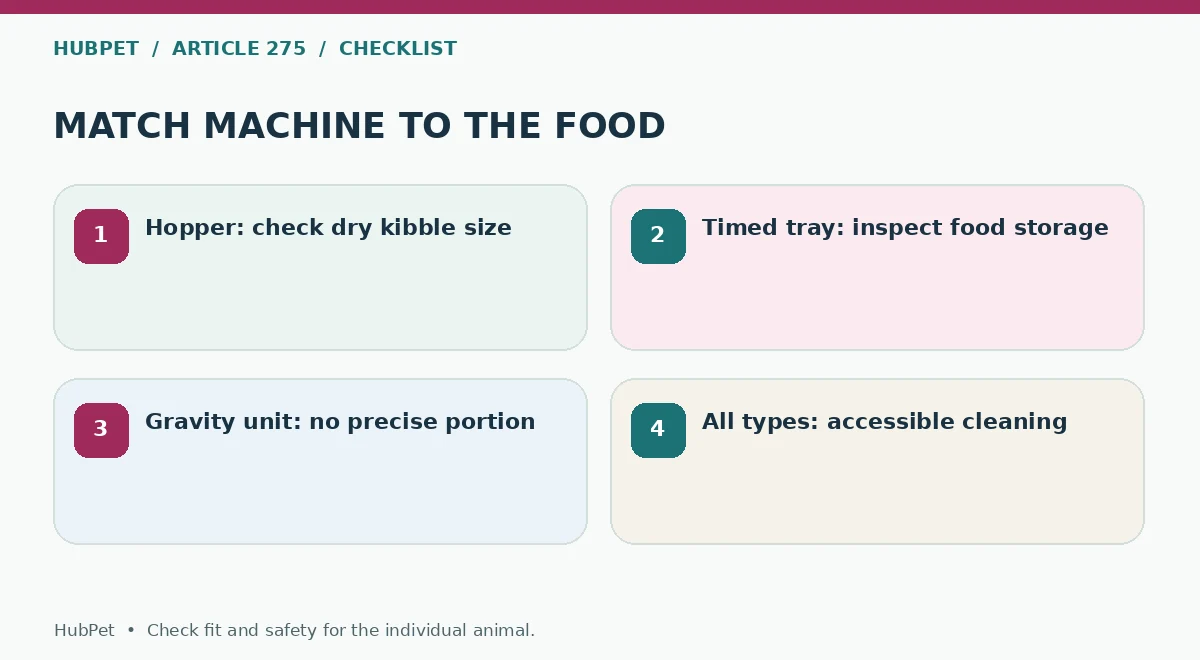
Gravity feeders keep dry food available rather than delivering strictly measured meals. Rotating tray models open prefilled compartments, sometimes suitable for wet food with manufacturer-approved chilling arrangements. Hopper dispensers typically release dry kibble at scheduled times.
Check the exact food type, kibble dimensions, moisture requirements, and tray capacity. Do not assume a dry-food chute supports moist food. For wet-food devices, evaluate how they manage temperature and safe holding time according to the maker and food label. Food safety should outweigh automation features.
Verify portion amounts through repeated tests
A portion setting on an app may represent motor turns rather than a fixed weight. Different kibble sizes can produce different amounts. Measure dispensed servings using a kitchen scale over several trial cycles before leaving the feeder unattended.
Compare output after a refill, as the hopper empties, and after a normal scheduled cycle. Keep a manual feeding plan ready if portions drift or jams occur. Never treat a manufacturer’s serving icon as a substitute for measuring food and monitoring the cat’s intake.
Plan for jams, empty hoppers, and power loss
Look for clear low-food indicators and a design that allows you to see the outlet. Some models use batteries, some plugs, and others provide a backup supply. Find out whether the schedule and clock survive an outage, not merely whether the screen turns on.
Test recovery by safely disconnecting and restoring power according to the manual. Confirm the feeder actually dispenses a portion afterward. Keep replacement batteries or an alternative feeding method accessible. A low-battery notification is helpful only if someone can respond.
Inspect cleaning access and daily food hygiene
Food dust and oils collect inside chutes, lids, and removable trays. Choose a unit with accessible food-contact parts and explicit cleaning instructions. Electronic housings may require wiping rather than soaking, while detachable bowls may permit washing.
CDC recommends cleaning dry-food bowls daily and wet-food bowls after each use. Follow maker directions for the hopper and all washable parts. Rinse and dry them before reassembly where instructed. Do not assume that a sealed lid prevents stale residue or pests indefinitely.
Separate control of feeding from camera or app features
A Wi-Fi app can change schedules and show notifications, yet the feeder still needs a dependable local clock, motor, and food path. Check whether the device works without internet, how it indicates errors, and whether multiple household members can access alerts.
Consider privacy settings and software support before connecting an unnecessary camera. Smart branding does not measure a cat’s health or verify it ate the dispensed meal. Keep human observation central: a camera view of kibble on the floor is not evidence that the right animal consumed it.

Protect access in a multi-cat household
One cat may eat both scheduled portions. A timed hopper without individual identification cannot ensure fair access. If cats need different diets, consider separate rooms or a design that restricts access to a known animal, followed by careful supervised testing.
Place feeding stations where cats can move away without confrontation. Observe meal-time behavior and leftover food. A feeder that increases guarding or anxiety is not solving the household’s feeding problem. The Feline Veterinary Medical Association emphasizes separated resources and individualized feeding routines.
Introduce the sound and motion without fear
Start with the machine switched off near the familiar bowl. Allow exploration without trapping the cat beside the feeder. Next, run a small scheduled portion while you watch from a distance. Keep the regular feeding option available during the change.
Motor noise can surprise a cautious cat. If it withdraws or will not approach, move more slowly instead of forcing a meal at the machine. Use familiar food and a relaxed location. The goal is reliable voluntary eating, not immediate adaptation to a new sound.
Decide what the owner still must do every day
Automation does not replace checking food consumption, water availability, the cat’s condition, and the cleanliness of equipment. A vacation plan requires dependable human care and emergency contact, even if a feeder supports regular meals.
Establish a daily confirmation routine: inspect the tray, confirm actual food movement, look for uneaten portions, and refill safely. Also test manual dispensing before depending on schedules. If a cat stops eating or becomes unwell, seek veterinary help rather than relying on missed-meal notifications.

Use a home acceptance test before trusting the schedule
Before buying, compare portion adjustability, compatible food types, removable parts, power behavior, error alerts, and multi-cat access. Read the current manual instead of assuming an advertised feature works the way you expect.
Once installed, test normal cycles while someone is present for several days. Record the portion, whether the right cat ate, and any jams. Keep a familiar manual feeding option ready. A successful automatic feeder supports an observed routine; it never removes the need to care for the animal directly.
How We Research
We checked this guide against the authoritative sources listed below on October 26, 2026. We reviewed practical differences, safety limits, and relevant home conditions rather than drawing conclusions from brand advertising. Specifications, warranty policies, and device capabilities change; check the manufacturer’s current manual. We did not purchase, laboratory-test, rank, or endorse individual products. Where a pet has pain, skin concerns, or fear, seek individual veterinary advice. See our approach at About HubPet.
Sources
Cornell Feline Health Center: How often should you feed your cat?. Accessed October 26, 2026.
VCA Animal Hospitals: Using Food to Increase Your Young Cat’s Activity Level. Accessed October 26, 2026.
Feline Veterinary Medical Association: Feline Feeding Programs: Addressing Behavioral Needs. Accessed October 26, 2026.
CDC: About Cleaning and Disinfecting Pet Supplies. Accessed October 26, 2026.
No. It can support scheduled feeding, but a cat still needs regular human checks on food intake, water, welfare, and equipment failures.
Accuracy depends on food size and dispenser design. Test several servings with a scale and monitor actual daily intake.
Some compartment-style devices can accommodate wet food within their specific storage instructions. A dry-food hopper should not be used for wet food.
Behavior varies by model. Check backup power and schedule retention, test recovery, and maintain a manual feeding option.
Not by itself. Separate feeding areas or suitable individual-access equipment may help, but owners should still monitor each cat’s intake.