
This guide offers general training and safety information, not individualized veterinary care. If a puppy seems injured, ill, or persistently distressed, contact your veterinarian. See our veterinary information disclaimer. A puppy will eventually need routine grooming, vet exams, collar adjustments, and paw checks. Handling becomes easier when the puppy learns that a human hand predicts something pleasant and that they can move away during practice. This does not mean a puppy must accept every touch, and it does not replace medically necessary care performed by a veterinarian. Start where your puppy is comfortable, with a few seconds of gentle contact and a reward after the hand moves away. Protect sore ears, injured paws, and any sensitive area; consult a veterinarian instead of practicing through apparent pain.
Set up a choice-based training spot
Pick a quiet non-slip surface where the puppy can sit or stand without restraint. Keep a small bowl of regular food or suitable treats nearby and invite the puppy onto a mat. Do not block the exit with furniture or your body. A helper may observe posture but should not pin the puppy in place. Train after the puppy has rested and chooses to approach. If they walk away, pause and try a simpler interaction later. Dogs Trust recommends paying attention to body language and reinforcing comfortable handling rather than increasing contact through visible worry.
Start with predictable shoulder contact
Present your hand where the puppy can see it, gently touch an area the puppy already accepts, lift the hand away, and reward. Keep the sequence easy to read: hand approaches, brief contact, hand leaves, reward appears. If the puppy leans away or stiffens, do not follow the body with your hand. Increase time only after several relaxed repetitions. Begin on the chest or shoulder rather than immediately reaching for toes or ears. Your objective is a familiar, voluntary routine that can later support practical health checks.
Introduce a paw check in tiny parts
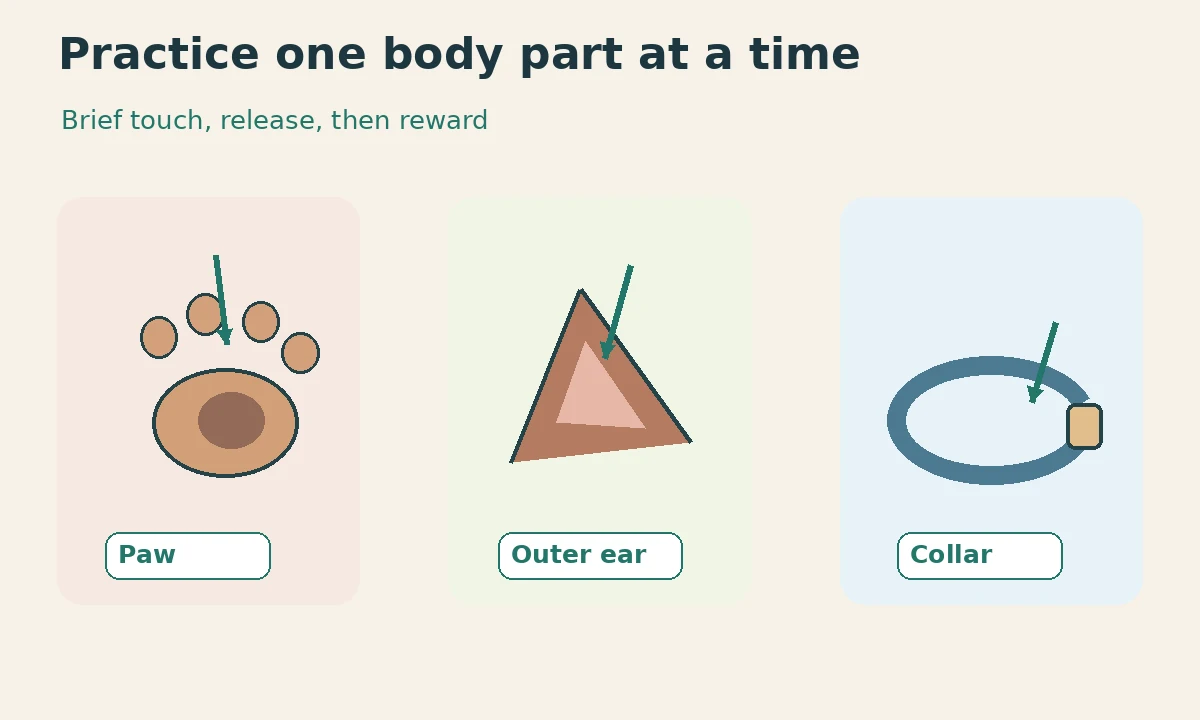
First reward the puppy for calmly noticing your hand near a front leg. Then touch the lower leg lightly and remove the hand before rewarding. Eventually you may briefly cup a paw while it stays supported near the floor. Never pull a leg outward or flip a puppy onto their back for practice. Examine the pads visually for debris without prying between toes. A puppy who repeatedly withdraws the paw is asking for an easier step. When you encounter nail trimming or a painful problem, use appropriate veterinary or professional handling instead of escalating pressure.
Make ear checks gentle and visible
Move your hand toward the outside of an ear, briefly touch the ear flap, release, and reward calm cooperation. Avoid inserting fingers, cotton swabs, or objects into the ear canal. Do not tug an ear open while a puppy resists. You can practice lifting the outer flap briefly once that movement is comfortable. Redness, unusual odor, head shaking, discharge, or obvious pain calls for a veterinary check rather than more handling practice. Keep the exercise separate from cleaning products so a training session remains predictable and low pressure.
Practice collar touch without a tight grip
A collar can be a useful ID holder, but a sudden grab can alarm a puppy. Start by briefly touching the fabric, then let go and reward. Later, you can gently place fingers near the buckle to check fit while the puppy remains relaxed. Never lift the dog by the collar or hold it tight to prevent escape during training. Remove the collar for unsupervised situations where snag risk exists, following your usual safety setup. Check growing-puppy fit frequently so a previously comfortable collar does not become restrictive.
Recognize the difference between consent and stillness
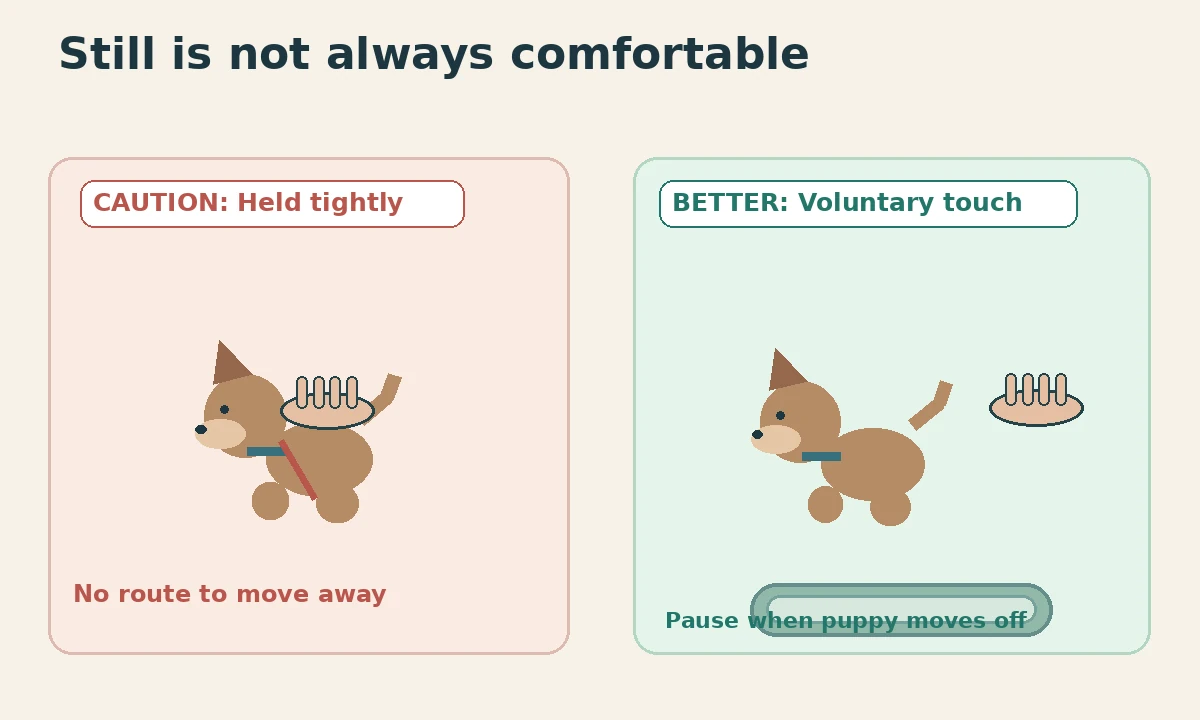
A relaxed puppy can shift position, sniff, look around, or voluntarily offer the same body part again. A worried puppy may freeze, lick lips repeatedly, move backward, tuck the tail, growl, or mouth the hand. Stillness without a choice to leave is not proof of comfort. Stop contact before discomfort grows and return to a simpler step next time. Do not punish a growl or use repeated restraint to show that the puppy must tolerate handling. This protects trust and makes future real examinations less stressful.
Connect home practice to vet visits
Ask the veterinary practice whether they offer calm introductory visits and explain which body areas your puppy already tolerates. Practice standing on a secure mat and accepting brief contact without trying to imitate injections or other medical procedures. Veterinary teams may need safe clinical restraint in an emergency, which is different from a voluntary home exercise. Tell staff if your puppy struggles, and follow their professional advice. A positive preparation plan is a way to communicate and build familiarity, not to guarantee a completely stress-free medical appointment.
Finish with three small actions
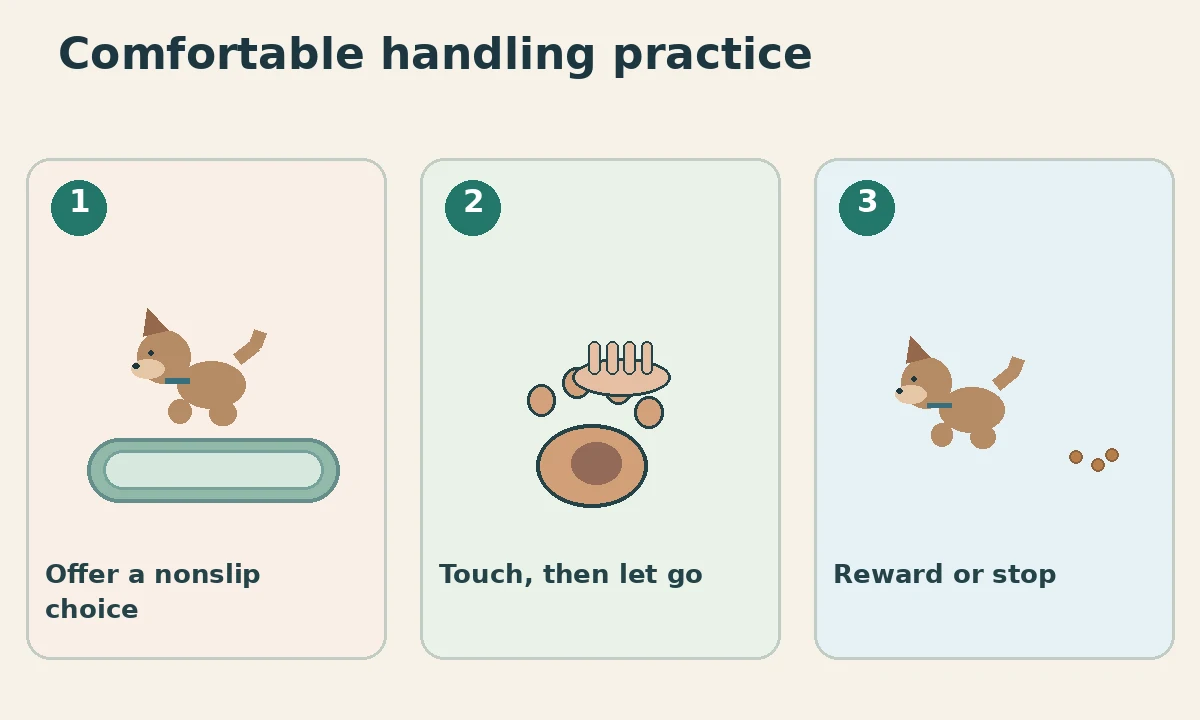
Prepare a nonslip mat and a few small rewards. Offer a one-second shoulder, paw, or outer-ear touch that the puppy already accepts, then remove your hand and reward. Finally, let the puppy choose whether to repeat or end the session. Stop sooner when signals change. Keep notes about which contact was comfortable and whether the puppy stayed in the space voluntarily. Practice one body part at a time; long multi-step handling sessions can become exhausting for a young dog. Build trust through predictable endings rather than by completing a fixed checklist at any cost.
How We Research
We review veterinary and animal welfare guidance on puppy learning, stress signals, and safe household management. We distinguish general preventive practice from treatment for serious fear or distress and describe actions owners can observe rather than promising certain results. Our illustrated scenarios depict concepts, not endorsements or medical procedures. Read more about our editorial approach.
Sources
Dogs Trust — Comfortable Puppy Handling — Guidance on puppy learning, animal welfare, and comfortable practice.
Dogs Trust — Puppy Vet Visits — Guidance on puppy learning, animal welfare, and comfortable practice.
VCA — Desensitization and Counterconditioning — Guidance on puppy learning, animal welfare, and comfortable practice.
No. Use a comfortable non-slip setup and let the puppy disengage during training.
No. Only practice gentle outer-ear contact; ear symptoms or cleaning questions belong with your veterinarian.
Pause and simplify the exercise. Do not punish mouthing or keep forcing contact.
No. Never lift a puppy by the collar; it can injure the neck.
No. It builds familiarity, while veterinary staff determine safe medical handling for each visit.