
This guide offers general training and safety information, not individualized veterinary care. If a puppy seems injured, ill, or persistently distressed, contact your veterinarian. See our veterinary information disclaimer. The doorbell, moving shoes, new voices, and reaching hands can overwhelm a young dog before the visitor even enters. A good introduction gives the puppy room to observe, make choices, and leave. It does not require a stranger to touch the puppy or a puppy to sit still while several people gather around. Plan the entry and waiting space before asking someone to visit. This article focuses on ordinary, low-pressure home introductions rather than treatment for severe fear or aggression. A puppy who growls, lunges, or cannot recover from fear needs individualized professional advice.
Set the doorway before the guest arrives
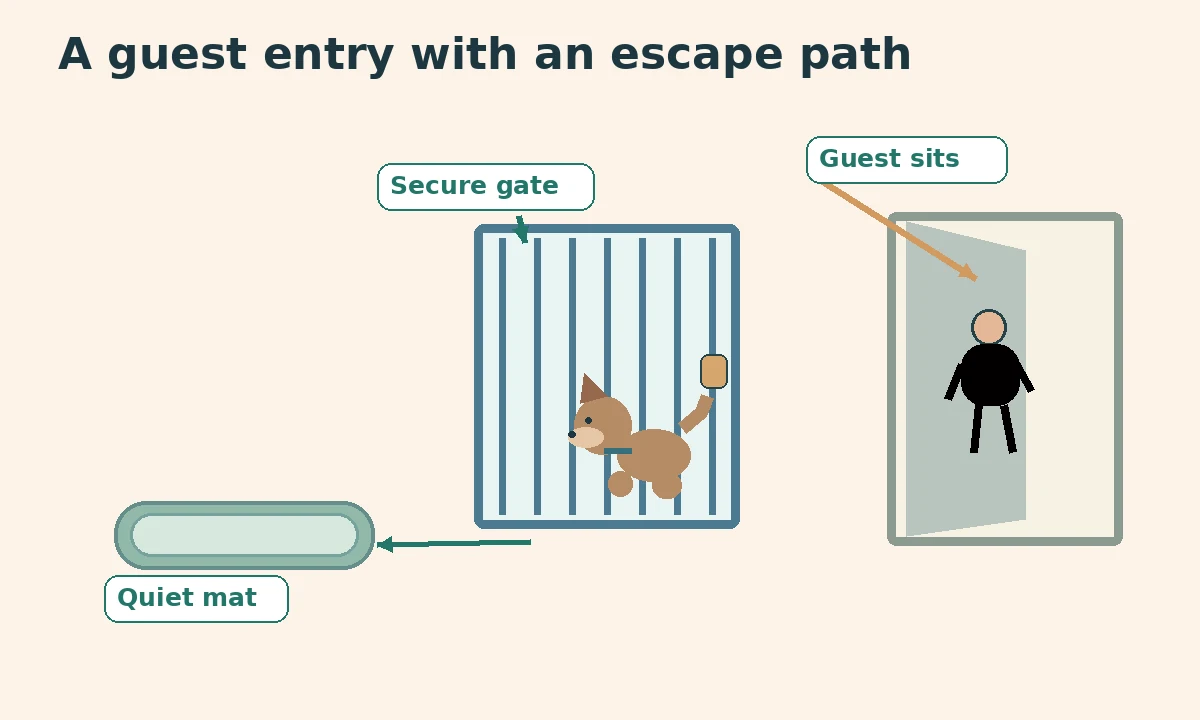
Place a secure, puppy-appropriate gate or closed interior door between the main entrance and the puppy’s quiet zone. Check that no paws can slide beneath or between bars, and keep the entry path clear of leashes, shoes, and bags. Do not position the puppy where a visitor must pass directly over the resting area. Set a mat or bed several steps away from the door where the puppy can retreat. Give the guest clear instructions in advance: enter quietly, ignore the puppy initially, and avoid leaning over, cornering, or reaching through the gate.
Treat the doorbell as a separate exercise
Practice low-intensity door sounds before an actual busy visit. A helper can tap lightly or make a quiet doorbell sound while you scatter a few pieces of regular puppy food away from the door. If the puppy startles, reduce the sound or distance and stop. Do not ring a loud bell repeatedly to make the puppy get used to it. Dogs Trust and veterinary behavior guidance emphasize gradual, positive exposure. Let the puppy rest between rehearsals. The goal is not a motionless dog; it is a dog who can notice a normal sound and return to comfortable activity.
Keep greetings optional
Ask the visitor to sit sideways or stand relaxed and let the puppy approach at their own pace if you decide to open the barrier. Avoid carrying the puppy toward the person or putting the puppy on someone’s lap. A visitor may toss food onto the floor away from their own feet rather than using a hand as bait. The puppy should be able to accept or decline that interaction. If the puppy circles, sniffs briefly, and moves away, that is a complete greeting. Adults should supervise every interaction with children, who may struggle to read subtle signals.
Know when petting is not welcome
Watch for lip licking without food, turning away, tucked tail, stiff posture, flattened ears, backing up, or attempts to hide. An excited wriggly puppy can also be too aroused for comfortable handling. Ask guests not to pat the top of the head or hold the collar to keep the puppy in place. If the puppy solicits touch, choose a brief gentle stroke on the side of the body, then pause to see whether the puppy requests more. End contact at the first sign of discomfort. Treat growling as communication; do not punish it.
Prevent jumping without scolding
Manage the distance first rather than letting the guest become the target for repeated leaps. Reward four paws on the floor, a turn toward the mat, or calm sniffing. Do not push the puppy down, yank a leash, knee the chest, or ask visitors to shout. Some puppies are not ready for a greeting at all when the door opens. It is fine for the puppy to stay behind a gate with a suitable chew and later meet the visitor quietly. Keep training periods short, especially after a busy day or before a normal nap.
Create a quiet end to the interaction
Decide where the puppy will rest after a brief hello. A familiar bed, water, and an undisturbed route to a quiet area help avoid the puppy feeling trapped among moving feet. Let guests know not to follow a retreating puppy. Close the gate or door before people move bags, open the front door, or leave. A tired puppy may mouth hands or rush about rather than simply falling asleep. That is a cue to end the session, not to demand more greetings. Calm transitions matter as much as the initial approach.
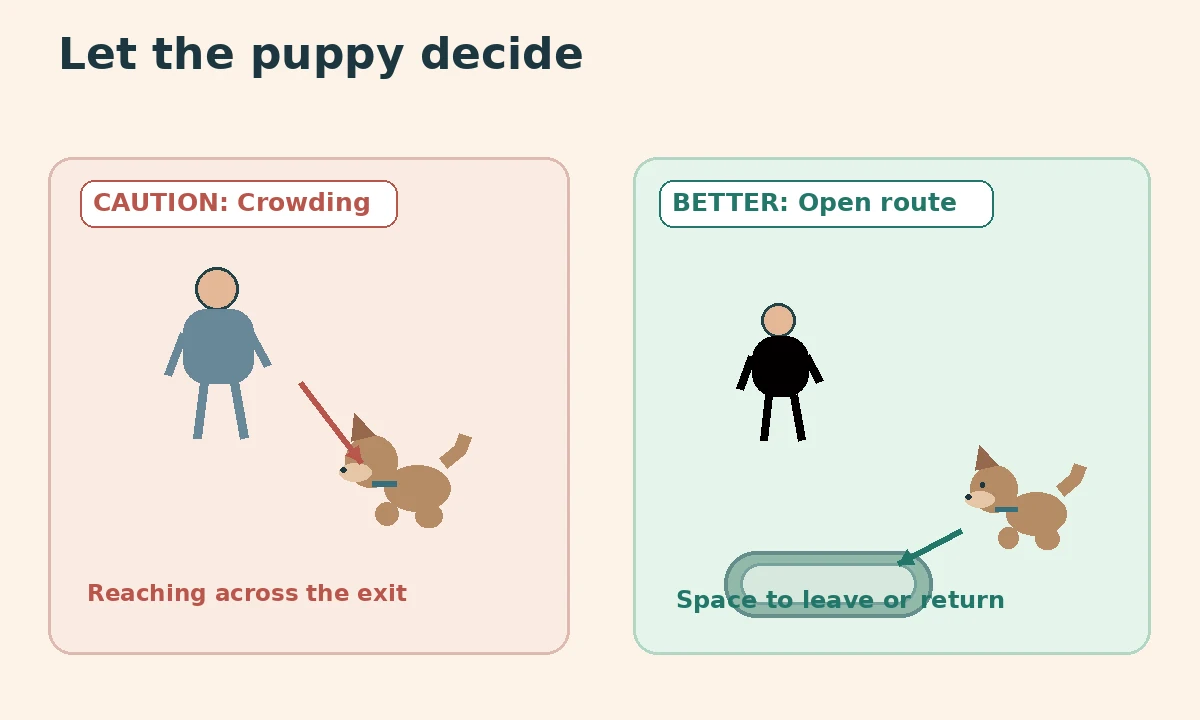
Compare a crowded greeting with an open path
In one common mistake, a guest stands in the doorway, bends over the puppy, and holds a hand near the face while another person blocks the hall. In the safer arrangement, the visitor has entered and settled, the puppy has a clear route back to their bed, and interaction is brief and optional. The difference is the available space and the puppy’s ability to leave, not whether the person claims to be friendly. The right setup can prevent a startled escape through the front door and reduce accidental pressure to interact.
Rehearse three predictable steps
First, secure the entrance and place the puppy behind a suitable barrier. Second, have the visitor enter and sit while the puppy observes from a comfortable distance. Third, offer a short optional greeting, then reopen the route to the quiet area. Record whether your puppy ate, explored, relaxed, or sought distance. Repeat easy visits with cooperative adults before involving noisy groups. If the puppy stays frightened, do not stage repeated greetings; speak with your veterinarian or a reward-based behavior specialist about a plan that matches their needs.

How We Research
We review veterinary and animal welfare guidance on puppy learning, stress signals, and safe household management. We distinguish general preventive practice from treatment for serious fear or distress and describe actions owners can observe rather than promising certain results. Our illustrated scenarios depict concepts, not endorsements or medical procedures. Read more about our editorial approach.
Sources
Dogs Trust — Puppy Socialization — Guidance on puppy learning, animal welfare, and comfortable practice.
Dogs Trust — Puppy Training Tips — Guidance on puppy learning, animal welfare, and comfortable practice.
ASPCA — Barking and Visitor Practice — Guidance on puppy learning, animal welfare, and comfortable practice.
No. A puppy can learn about visitors by watching them calmly without being touched.
Increase distance or use a gate, then reward four paws on the floor; avoid physical correction.
Only with close adult supervision and a puppy who is comfortable; children should never corner or chase the puppy.
No. Give the puppy space and consult a qualified professional if defensive behavior continues.
Only as long as the puppy stays relaxed; a few seconds of voluntary contact may be plenty.