
This guide offers general training and safety information, not individualized veterinary care. If a puppy seems injured, ill, or persistently distressed, contact your veterinarian. See our veterinary information disclaimer. A puppy who follows you between rooms is not being stubborn. New surroundings and social separation can feel unfamiliar, even when the home is safe. Alone-time practice is not a test of how long a young dog can tolerate distress. It is a sequence of small, pleasant experiences in which the puppy remains comfortable while you briefly move away. Start while you are still at home and can watch the response. Plan supervision or help for necessary errands rather than leaving a puppy beyond what they can handle. This guide separates a safe physical setup from the gradual behavior training that follows.
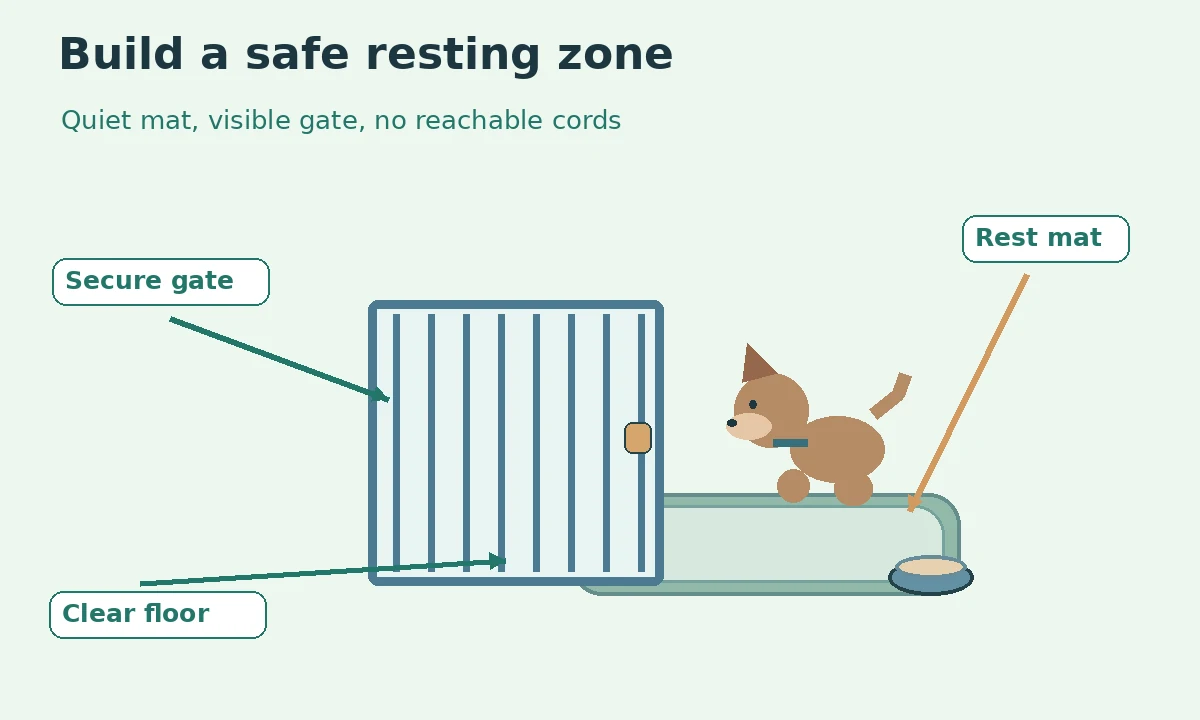
Build one genuinely comfortable resting area
Choose a quiet room corner or supervised pen where the puppy can lie down, turn around, reach appropriate water, and move away from the doorway. Remove loose electrical cords, small swallowable objects, hanging strings, and chewable bedding if your puppy has begun pulling it apart. A gate can allow visual contact without a closed-door surprise. Check the gate from the puppy’s side for gaps and sharp connections. A crate is an option only when it you have introduced positively; do not use a closed crate to force a frightened puppy through a separation exercise.
Practice while you are still visible
Sit near the resting spot while the puppy explores or settles with a safe, age-appropriate chew. Stand up, take one step, return, and quietly reward relaxed behavior. If the puppy gets up and follows, this is useful information, not a failure. Shorten the movement or give more support. Aim for repeated calm moments rather than counting increasingly large time blocks. Dogs Trust suggests practicing distance behind a suitable baby gate before extending absences outside the house. Do not lock the puppy away, bark a command, or scold vocalization; those responses can make the area feel less predictable.
Choose a reward that does not create a hazard
A small portion of the puppy’s normal food or a suitable food-dispensing toy can make the area inviting. Check the toy for loose lids, fragile seams, or parts a puppy might swallow. Supervise first and remove anything the puppy starts dismantling. Do not depend on a long-lasting chew if you cannot confirm it is appropriate for unsupervised use. Use part of a regular meal rather than adding unlimited treats. The goal is a positive context, not an object that keeps a distressed puppy silent. Water and a comfortable floor remain important regardless of whether you offer a food toy.
Move out of sight for a moment
Once brief steps away seem ordinary, pass through the doorway for only a very short interval and return before the puppy becomes distressed. Do not jump from one calm trial to a long trip. Avoid dramatic goodbye rituals or sudden repeated door slams. You can practice carrying keys separately so the sound does not always predict a major absence. A stationary camera may help you observe behavior without relying on guesses. Check the camera cable and position so the puppy cannot reach or chew it. If a puppy cannot cope even with a brief door movement, go back to visible-distance practice.

Read stress rather than just sound
Look for pacing, repeated attempts to climb the barrier, persistent vocalizing, panting when the room is cool, refusal of familiar food, or frantic scratching. A brief change in position is not the same as panic, and quietness alone does not prove comfort. Observe the whole puppy. If signs appear, return to an easier step, change the environment, and ask a qualified positive-reinforcement professional or veterinarian for help when needed. Never leave a puppy to cry until they stop as a substitute for assessing distress. A baby gate is a management tool, not a treatment for separation anxiety.
Separate practice from unavoidable errands
Training sessions are different from real obligations. If you must leave longer than the puppy can manage, organize a trusted caregiver or an appropriate supervised arrangement. Plan elimination breaks, meals, sleep, and age-related needs before departing. Do not assume an adult dog’s alone-time recommendations apply to a young puppy. One afternoon of excessive distress can set back several easy sessions. Keep daily records of the setting, your distance, the puppy’s response, and what happened just before the session. This makes it easier to find a comfortable starting point for the next day.
Compare calm independence with shutdown
A comfortable puppy may rest on their side, sniff a toy, and freely change position. A worried puppy may stand frozen by a closed door, claw at a gate, or track your every movement. Those scenes require different responses even if neither puppy barks. Reward moments of voluntary relaxation. Never hold a puppy down or block escape with your body to make the picture look calm. If your puppy keeps refusing the rest area, check heat, noise, discomfort, and accessibility. Comfort and choice are prerequisites for skill building, not rewards a puppy must earn.
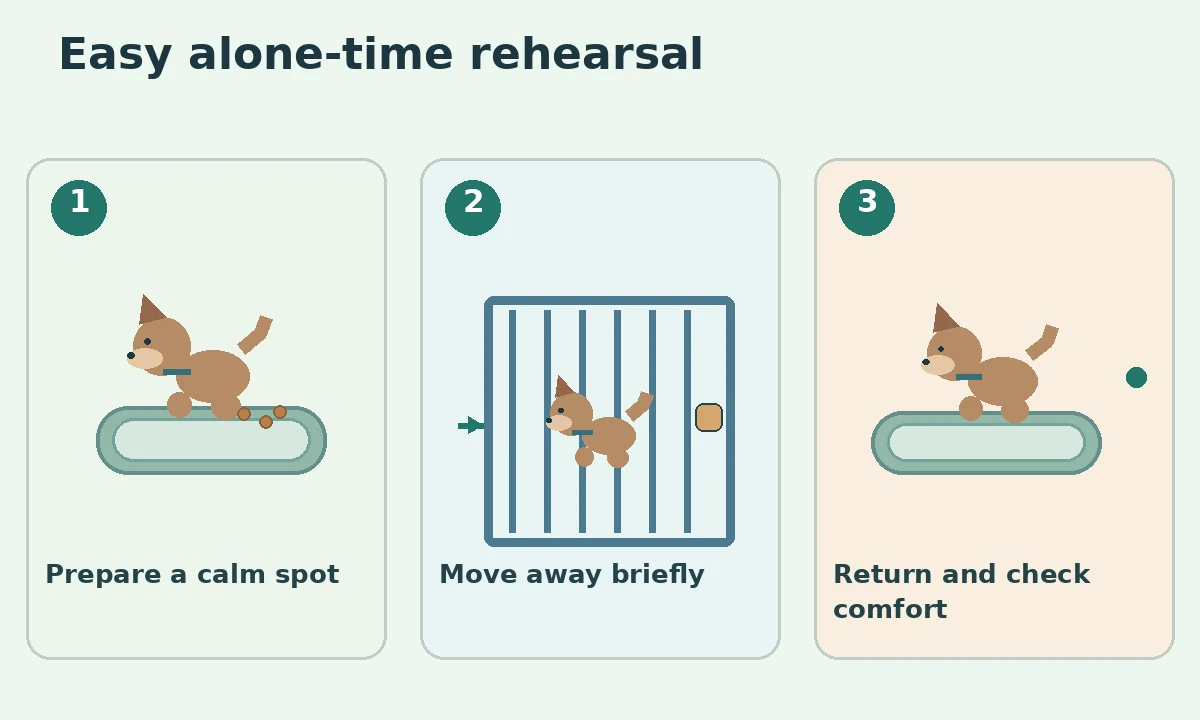
Use a repeatable three-part session
Prepare the space and wait for a naturally calm moment. Make one tiny departure, then return quietly and observe the puppy before offering another trial. Finish while the puppy still looks comfortable; longer does not always mean better. The next session can repeat the same easy step rather than always becoming harder. Vary ordinary household movements so your puppy learns that standing, opening a door, and putting on shoes do not consistently mean a difficult separation. Everyone in the household should follow the same calm routine and respond to stress by making the next practice easier.
How We Research
We review veterinary and animal welfare guidance on puppy learning, stress signals, and safe household management. We distinguish general preventive practice from treatment for serious fear or distress and describe actions owners can observe rather than promising certain results. Our illustrated scenarios depict concepts, not endorsements or medical procedures. Read more about our editorial approach.
Sources
Dogs Trust — Time Alone Training — Guidance on puppy learning, animal welfare, and comfortable practice.
Dogs Trust — Puppy Training and Settling — Guidance on puppy learning, animal welfare, and comfortable practice.
VCA — Socialization and Fear Prevention — Guidance on puppy learning, animal welfare, and comfortable practice.
No. Persistent distress is a sign to reduce the difficulty, increase support, and seek professional help when necessary.
No. A safe pen or puppy-proofed resting area can work; use a crate only after the puppy is comfortable with it.
Check for stress, discomfort, or lack of interest. Do not increase separation until the puppy can settle comfortably.
A secure, out-of-reach camera can help observe behavior but cannot replace supervision or a caregiver.
Seek veterinary or qualified behavior support if the puppy panics, injures themselves, or cannot cope with tiny separations.