
This guide offers general training and safety information, not individualized veterinary care. If a puppy seems injured, ill, or persistently distressed, contact your veterinarian. See our veterinary information disclaimer. A vacuum cleaner, hair dryer, doorbell, or coffee grinder can surprise a puppy even in an otherwise quiet home. The aim of household-noise practice is not to make the puppy tolerate the loudest possible sound. It is to help the puppy experience ordinary equipment at an intensity that remains comfortable, with freedom to move away and recover. Begin with the object turned off and separate the sight, movement, and sound when possible. A puppy with strong fear, panic, or sensitivity that worsens needs veterinary or qualified behavior guidance rather than a more intense do-it-yourself drill.
Choose a low-pressure starting location
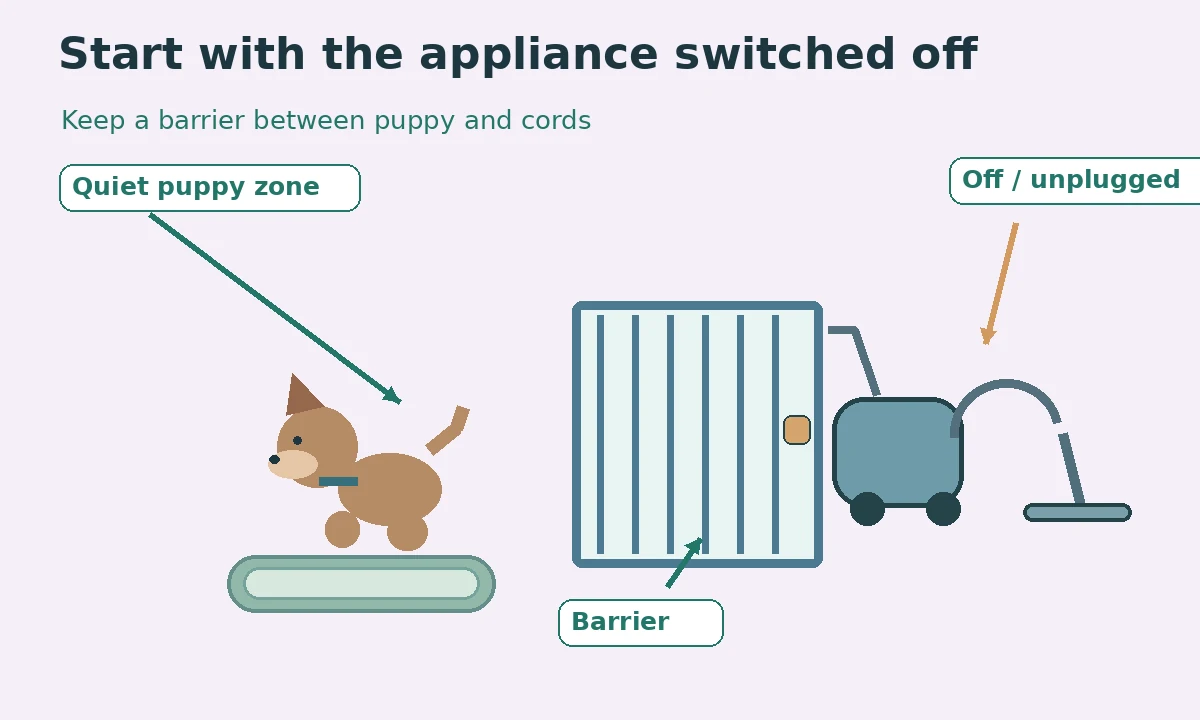
Set up in a room where the puppy can see a doorway or quiet retreat and cannot reach cables or moving appliance parts. Put the vacuum behind a barrier after switching it off and unplugging it. Allow the puppy to investigate from a distance if they wish, but do not lure them into contact with the nozzle. Offer a small reward for comfortable observation and end the session if the puppy avoids the area. Never trap the puppy between the machine and a closed door. Check that a startled puppy cannot dash outside through another entrance.
Separate the object from its sound
A stationary, silent vacuum is a different experience from a running one. Start with the appliance visible but inactive. Later, a helper may briefly turn it on in another room while you stay with the puppy at a comfortable distance. Keep the actual appliance inaccessible. If the puppy remains relaxed and eats normally, you can repeat that easy experience before changing anything. Avoid switching on the motor suddenly right beside the dog. VCA describes gradually increasing exposure only when a puppy remains comfortable; this is not a recommendation to flood a frightened puppy with a full-volume stimulus.
Adjust one variable at a time
Distance, volume, duration, and appliance movement all affect the difficulty of a session. Change only one of them in a small way. A quiet few seconds from far away may be easier than a long, loud session behind a door. If you move the vacuum closer, leave the motor off. If you turn the motor on, keep it stationary and farther away. This helps you understand what the puppy is responding to. After a comfortable trial, pause and allow the puppy to sniff, rest, or choose to leave.
Recognize recovery, not just an absence of barking
Check for loose body posture, normal breathing, curiosity, and the ability to take familiar food. Warning signs include freezing, bolting, hiding, persistent lip licking, trembling, frantic movement, or refusing food that is usually welcome. A silent puppy may still be very scared. Lower the intensity or end the session at the first clear sign of distress. Do not hold the puppy near the machine or block escape to stop hiding. If fear persists after several easy sessions, consult a veterinarian or qualified reward-based behavior professional.
Practice doorbells without an actual visitor
Play a quiet doorbell sound or have a helper tap lightly while the puppy is far from the entry. Immediately provide a small positive experience such as a piece of regular food. Do not pair every practice sound with a crowd arriving, because the busy entry may be a separate challenge. Keep the front door secure and use a barrier so an unexpected guest cannot create an escape risk. If your puppy barks, avoid shouting at the bell or punishing the response. Start at a quieter level and teach a simple return to the resting mat.
Keep grooming equipment out of puppy reach
Hair dryers and clippers have cords, hot surfaces, moving parts, and attachments that a puppy might chew. Introduce the sight and low sound only at a controlled distance. Do not direct hot air at the puppy as part of sound training. Put the tools away before allowing free exploration of the room. The same rule applies to coffee grinders and blenders: practice the sound while a helper controls the equipment in a separate safe area. A young dog should not have to stand next to an operating device to learn that household sounds can be harmless.
Compare gentle exposure with overload
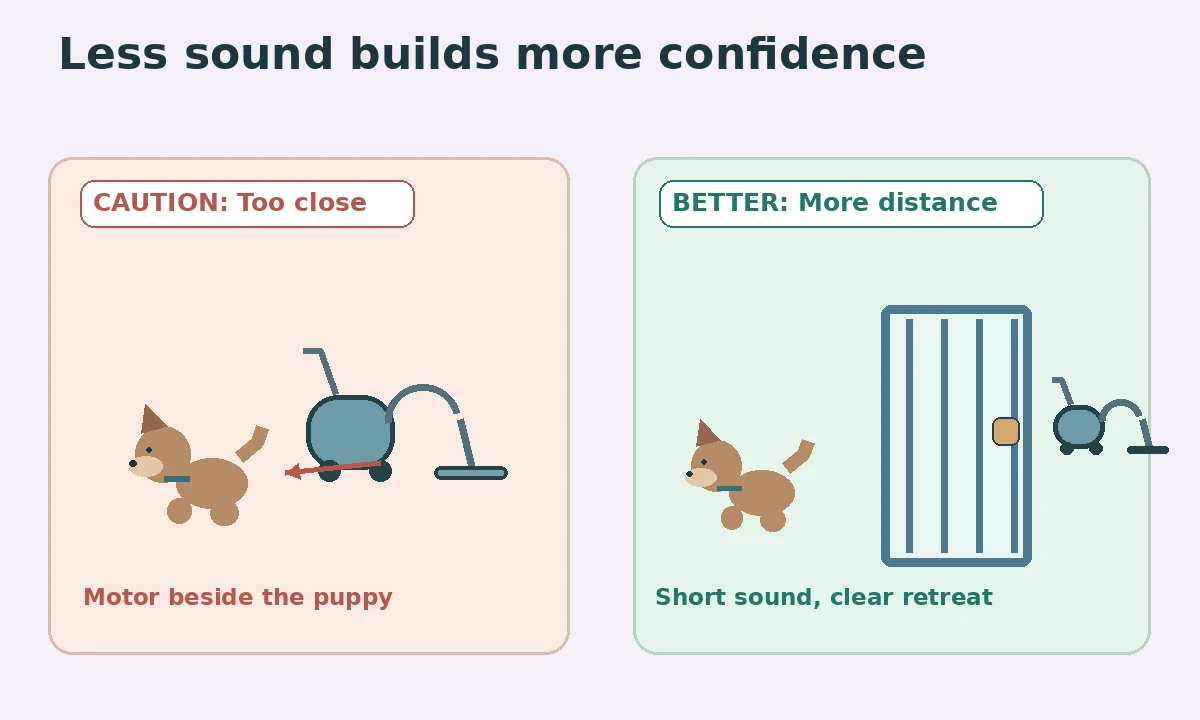
The risky setup places a puppy close to a running vacuum with no escape route and a person repeatedly bringing the nozzle closer. The better scene shows an unplugged vacuum behind a barrier while the puppy explores comfortably on a mat. A later stage may include distant, brief motor noise under adult control. Do not confuse those scenes. The important measurements are the puppy’s body language and the intensity of the experience, not how quickly the human completes a training plan. Make the environment easier whenever the puppy asks for more space.
Use a simple prepare-listen-recover sequence
First, secure cables and give the puppy access to a calm resting area. Second, present one low-intensity sound or a stationary appliance while observing posture and rewarding comfort. Third, switch the sound off and give the puppy a break before deciding whether another repetition is worthwhile. Several easy days are more useful than one exhausting exposure marathon. Keep a short log of equipment, distance, duration, and recovery. Coordinate with household members so someone does not begin full-power vacuuming in the same room while another person is conducting a gentle practice session.

How We Research
We review veterinary and animal welfare guidance on puppy learning, stress signals, and safe household management. We distinguish general preventive practice from treatment for serious fear or distress and describe actions owners can observe rather than promising certain results. Our illustrated scenarios depict concepts, not endorsements or medical procedures. Read more about our editorial approach.
Sources
VCA — Puppy Fear Prevention and Desensitization — Guidance on puppy learning, animal welfare, and comfortable practice.
Dogs Trust — Puppy Socialization — Guidance on puppy learning, animal welfare, and comfortable practice.
VCA — Puppy Training Schedule — Guidance on puppy learning, animal welfare, and comfortable practice.
No. Lower the intensity and preserve a retreat. Silence alone does not prove comfort.
Quiet recordings can be one controlled starting point, but real objects and movement should be introduced separately and gradually.
Only at a distance where they remain comfortable; there is no universal distance.
They may be overwhelmed. End the exposure, allow a break, and restart much more gently.
No. Keep heat and moving parts out of the exercise and introduce sounds safely at a distance.