
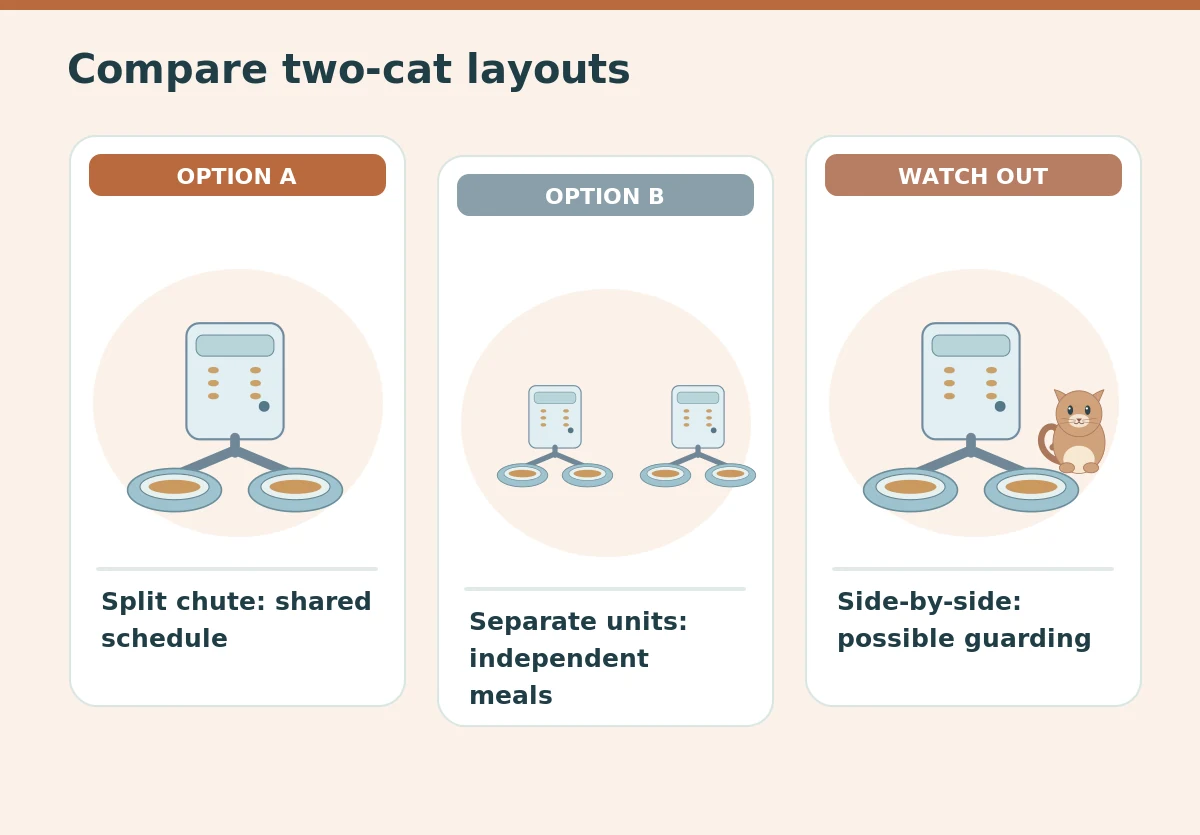
Two cats living together do not necessarily eat the same amount, at the same speed, or in the same place. An automatic feeder marketed for two cats often means one hopper that drops kibble through a Y-shaped splitter into two bowls. It may offer two serving points while still using one schedule and one shared food reservoir. Before buying, write down how each cat currently eats, whether one rushes, and whether either guards the kitchen. If one cat needs a separate food or individually controlled portion, a shared hopper may not meet that requirement at all. Your goal is fair access, not merely symmetrical hardware.
Trace the path from hopper to each bowl
Study an illustration of the internal chute rather than judging the feeder by its product photo. A splitter can deliver uneven amounts when its angle changes, the base sits on a slope, or a particular kibble shape bounces differently. Some designs let you adjust the branch position; others have a fixed path. Ask whether both bowls receive independent servings or only the same portion divided mechanically. A pair of bowls does not prove that each cat can eat undisturbed. During home trials, measure what arrives in each bowl over repeated cycles, not just what the app says was scheduled.
Compare one machine with two independent feeders
A shared hopper is convenient when cats eat the same dry diet and tolerate a common schedule. Two independent timed feeders allow separate schedules and serving amounts, but take more space and require two power checks. A selective-access feeder serves another purpose: it controls which animal may reach a bowl. Consider combinations based on the actual problem. If the cats have different diets or one eats the other’s food, independent stations or access control are often more useful than a dual bowl splitter. If finances or floor space are limited, closed-door meal times may be simpler and more dependable than a complicated device.

Create visual separation where possible
Cats do not have to fight openly for eating proximity to be uncomfortable. One may wait until the other leaves, eat rapidly, or abandon a meal when approached. Published feline feeding guidance favors dispersed feeding stations and attention to each cat’s relationships. A double-bowl base in a narrow hallway can amplify pressure because one cat can control both sides. If using a dual feeder, provide escape paths and observe both animals at a quiet distance. When rivalry appears, spread the stations apart instead of using a larger divider on the same tiny platform. Food security is partly about location.
Measure output rather than trusting cup labels
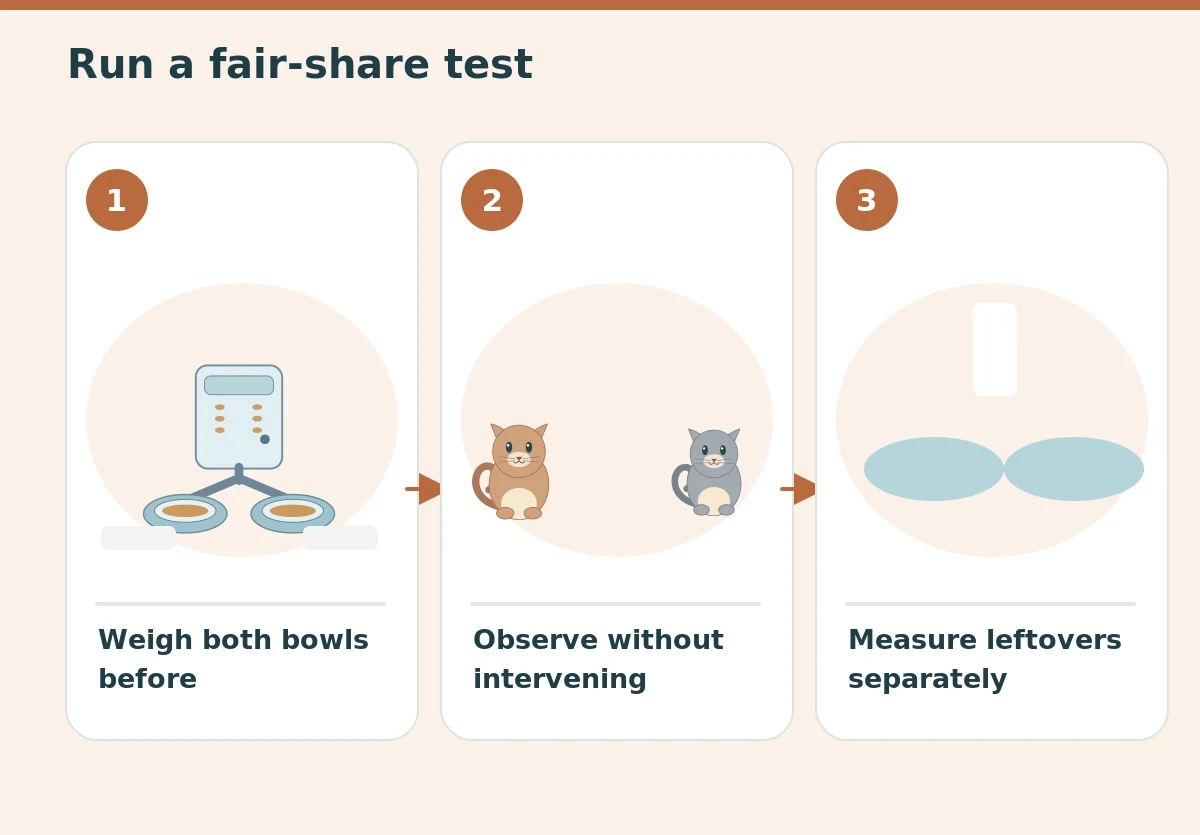
Feeder servings may be defined as rotations, increments, or a nominal volume that varies with kibble shape. Weigh several dry test outputs for each outlet using your own food and a kitchen scale. Compare totals over several runs to detect irregularities, empty drops, or unequal splitting. Make no assumption that identical icons in an app mean identical calories in two bowls. Review the cats’ overall food plan with a veterinarian if weight or diet restriction is an issue. Cornell’s feline health guidance emphasizes managing body condition and warns against unmanaged free feeding in cats prone to excess weight. Automation should make planned portions reproducible, not obscure them.
Watch a real meal without forcing sharing
For a trial week, schedule meals when someone can watch discreetly. Note which cat reaches the machine first, whether one crowds the other, whether either switches bowls, and whether both have time to finish. Check for food pushed under the feeder or scattered in the tray. Do not lift or reposition a cat at the bowl to enforce ownership. If one cat eats both shares, stop treating the machine as an independent feeding solution. Feed separately or adopt access-controlled stations. The trial is successful only when each animal reliably receives its intended food and remains comfortable, not when both bowls happen to be empty afterward.
Choose stable bowls and a practical cleaning design
Bowls should lift out easily and sit at a comfortable height for the cats. A lightweight double base can slide when a hungry cat nudges its edge. Look for rounded, washable food-contact surfaces and accessible openings below the chute; stale crumbs accumulate where pellets fall. Keep the dry-food reservoir clean and dry. FDA advises storing dry pet food cool and dry, preferably retaining the original packaging for traceability. Do not pour new kibble continually over old crumbs. If the manual requires special cleaning steps around sensors or motor parts, make sure they fit your household routine before committing.
Prepare for errors in schedule or power
A dual feeder can fail for both cats at once if a chute jams or power stops. Test an unplug-and-restart scenario as the manual allows, then confirm whether scheduled meals and portion settings persist. Batteries may operate differently from wall power. Keep a simple contingency: a caregiver can provide separately measured meals if the feeder does not dispense. Automatic dispensing cannot detect every instance of another cat eating the output. A camera may help you notice some issues, but does not prove who consumed which bowl. For long absences, arrange a person to inspect food, water, and both cats rather than relying on notifications.
Use separate notes for separate animals
A shared machine can hide a quiet eater’s missed meals. During the first several weeks, track each cat’s served portion, leftovers, and behavior, especially after you change kibble size or move the feeder. A basic written chart is often clearer than an app that only totals food released from the hopper. If one cat is on a veterinary therapeutic food, never assume a two-bowl splitter provides diet separation. Keep the food physically inaccessible to the other cat as advised by the veterinarian. Sudden reduced appetite, vomiting, or weight change calls for professional assessment, not an automatic increase in servings.
Make a decision based on household dynamics
A common-hopper dual feeder may be suitable for friendly cats on the same food and timing when repeated tests show adequate access. Choose two independent devices when schedules or portions differ; add selective access or separate rooms where diets must not mix. Review bowl spacing, stability, cleaning, outlet balance, outage handling, and the cats’ body language before deciding. A solution that looks organized on a kitchen counter but causes quiet food competition is not a real upgrade. The useful measurement is whether each cat can eat in peace and you can verify the meal.
How We Research
We used peer-reviewed feline feeding behavior guidance and veterinary nutrition information to separate mechanical food splitting from verified individual intake. We did not assume any unnamed splitter has laboratory-tested portion equality. See About HubPet for general editorial information.
Sources
Journal of Feline Medicine and Surgery — Feline Feeding Programs: Read the source. Accessed October 27, 2026.
Journal of Feline Medicine and Surgery — Feeding Cats for Optimal Mental and Behavioral Well-Being: Read the source. Accessed October 27, 2026.
Cornell Feline Health Center — Obesity: Read the source. Accessed October 27, 2026.
U.S. FDA — Tips for Safe Handling of Pet Food and Treats: Read the source. Accessed October 27, 2026.
Safety note: Feeders cannot replace observation of eating and drinking. Ask your veterinarian about changes in appetite, weight, behavior, or a medically restricted feeding plan; see the HubPet veterinary disclaimer.
Not necessarily. Splitters can dispense unevenly depending on the chute and kibble. Weigh several actual outputs from each bowl during testing.
A single shared reservoir cannot serve two different foods independently. Use separate stations or an access-controlled arrangement recommended for the situation.
Move feeding locations farther apart, offer supervised separate meals, or consider selective access. Do not assume the two-bowl layout prevents food theft.
No. Many cats prefer visually separated feeding locations, even if they do not hiss or fight at mealtimes.
Yes. Check each cat’s eating behavior and actual leftovers, particularly after changing food, schedule, or room layout.