
This article is general information, not veterinary advice. If your pet seems unwell, is in pain or may have eaten something harmful, contact your vet or an animal poison control line right away. Read our vet disclaimer.
Are some pets just stubborn by nature? Individual animals do differ in temperament, motivation, learning history, genetics, and sensitivity, but “stubborn” describes an impression rather than a mechanism for one specific behavior. A better approach is to ask what the animal understands, wants, fears, or physically can do in that moment.
Are Some Pets Just Stubborn by Nature? The Myth Is Too Simple
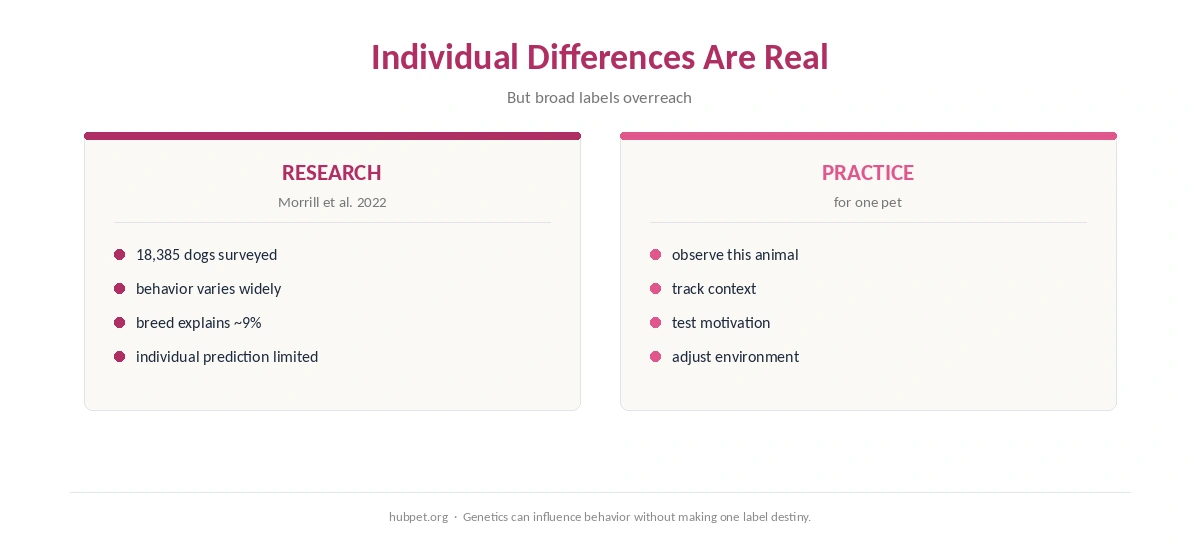
Behavior can have inherited components without becoming destiny. A 2022 Science study of 18,385 dogs found that breed explained about 9% of individual behavioral variation in that dataset, while substantial variation remained within breeds. That finding supports our breed-stereotype guide: broad labels are poor substitutes for observing the individual.
Learning history matters too. AVSAB’s 2021 humane training position recommends reward-based training and warns against aversive methods. So, are some pets just stubborn by nature? That question is less useful than testing clarity and reinforcement with positive reinforcement basics.

Are Some Pets Just Stubborn by Nature, or Is the Setup Failing?
A dog may respond in the living room but not outdoors because the environment changed. A cat may ignore a target because the reward is not valuable enough. Therefore, common training mistakes and short practice sessions are useful checks before adding a personality label.
- Review the cue. Has the animal actually learned this exact cue in this environment?
- Consider the reward. Is the consequence valuable enough to compete with what is happening nearby?
- Lower the difficulty. Distance, duration, distraction, and novelty can make a known behavior harder.
- Check stress. Fear, conflict, or high arousal can reduce the animal’s ability to respond.
- Check physical comfort. A sudden reluctance to move, jump, sit, or accept touch deserves medical attention.
- Check the alternative. Make the wanted behavior easy and reinforce it instead of only interrupting the unwanted one.
This is also why scolding can mislead the person doing the training. It may suppress behavior without teaching the desired response. Our scolding evidence guide and dominance-theory review explain why force-based stories often obscure the actual learning problem.
What Research Says About Individual Differences
Genetics can influence behavior, but behavior is complex and environment still matters. Morrill and colleagues reported in 2022 that many dog behavioral traits had heritable components, yet breed ancestry had limited predictive value for an individual dog. Again, are some pets just stubborn by nature? The study does not support that as a complete explanation for an individual animal.
The same caution applies to motives. Our spite myth explains why evidence does not justify assigning a human-sounding motive without proof. Instead, redirection focuses on observable behavior and a useful alternative.
| Label | What to ask instead | Practical next step |
|---|---|---|
| Stubborn | Does the pet understand the cue here? | Reduce difficulty and reinforce success |
| Defiant | What outcome is competing with me? | Improve the reward or environment |
| Lazy | Could movement be uncomfortable? | Check health if the change is new |
| Dramatic | What signs show fear or high arousal? | Create distance and lower pressure |
| Bad | Which behavior should happen instead? | Teach and reward that behavior |
Fear can especially look like refusal. Use fearful-dog confidence work for dogs, and cat stress signs when a cat disengages. If the problem is mainly distraction, basic dog training at home gives an easier place to rebuild the response.
When to Get Professional Help
If reluctance appears suddenly, especially with movement, touch, appetite, sleep, or elimination changes, contact a veterinarian. Merck Veterinary Manual guidance updated in 2025 and 2026 says veterinarians should rule out medical causes when behavior changes. See signs a pet may be in pain for observation points, not a diagnosis.
For aggression, severe fear, or persistent behavior problems, ask your veterinarian about a qualified behavior professional. Keep methods reward-based, as AVSAB’s current position continues to support. For cats learning household skills, scratching-post training shows how reinforcement can replace punishment.

How We Research
HubPet reviewed sources on October 11, 2026. We used the AVSAB humane dog training position, Merck Veterinary Manual behavior guidance, and the 2022 Science study Ancestry-inclusive dog genomics challenges popular breed stereotypes. Read our method on How We Research.
Pets differ as individuals, but “stubborn” does not explain why a behavior happens. Check learning history, motivation, environment, stress, and health.
Genetics can influence behavioral traits, but the 2022 Morrill study found large variation within breeds and limited breed-level prediction for individual behavior.
Lower the difficulty, confirm the animal has learned the cue in that setting, and use a reward the animal values. Then build distractions gradually.
AVSAB recommends reward-based methods and advises against aversive training. Teach the behavior you want rather than adding fear or discomfort.
A sudden refusal to move, jump, eat, accept touch, or perform a previously easy behavior can accompany pain or illness, so contact a veterinarian.
Are Some Pets Just Stubborn by Nature? Bottom Line
Are some pets just stubborn by nature? The evidence supports individual differences, not a single stubbornness explanation. Describe the exact behavior, make the task easier, improve reinforcement, reduce stress, and check health when the change is new. That approach gives you something practical to change instead of a label.