
This article is general information, not veterinary advice. If your pet seems unwell, is in pain or may have eaten something harmful, contact your vet or an animal poison control line right away. Read our vet disclaimer.
Why dogs bark at some dogs but not others can have more than one possible explanation. An AAHA review published in 2026 describes distinct reactive behavior patterns, while the Merck Veterinary Manual notes that fear, anxiety, conflict, genetics, and previous learning can contribute to aggressive behavior. The trigger can also change with distance, movement, location, and the dog’s state that day.
Therefore, barking at one dog does not prove that your dog “hates” a type of dog. The Merck Veterinary Manual behavior overview, updated 2026 describes inter-dog aggression as a category with different motivations. It also warns against diagnosing the cause from a single event.
Why Dogs Bark at Some Dogs but Not Others: Short Answer
Why dogs bark at some dogs but not others can reflect a particular combination of trigger and context. One dog may approach directly, stare, move fast, or appear at a difficult distance. Another dog may pass farther away and never push the same emotional response. Start by using reactive-dog walk management rather than testing closer greetings.
Also watch the behavior before the bark. Freezing, staring, slowing down, pulling forward, trying to retreat, or losing the ability to respond can reveal the buildup. The fearful-dog confidence guide explains why giving space early is more useful than waiting for an explosion.
| Possible pattern | What you may notice | Safer response |
|---|---|---|
| Fear or uncertainty | Dog tries to create distance | Increase space and leave |
| Frustrated greeting | Dog pulls toward the other dog | Prevent rushing and reward reorientation |
| Overarousal | Dog cannot settle or respond | Move to a quieter area |
| Learned pattern | Same setup predicts barking | Change the route or setup while retraining |
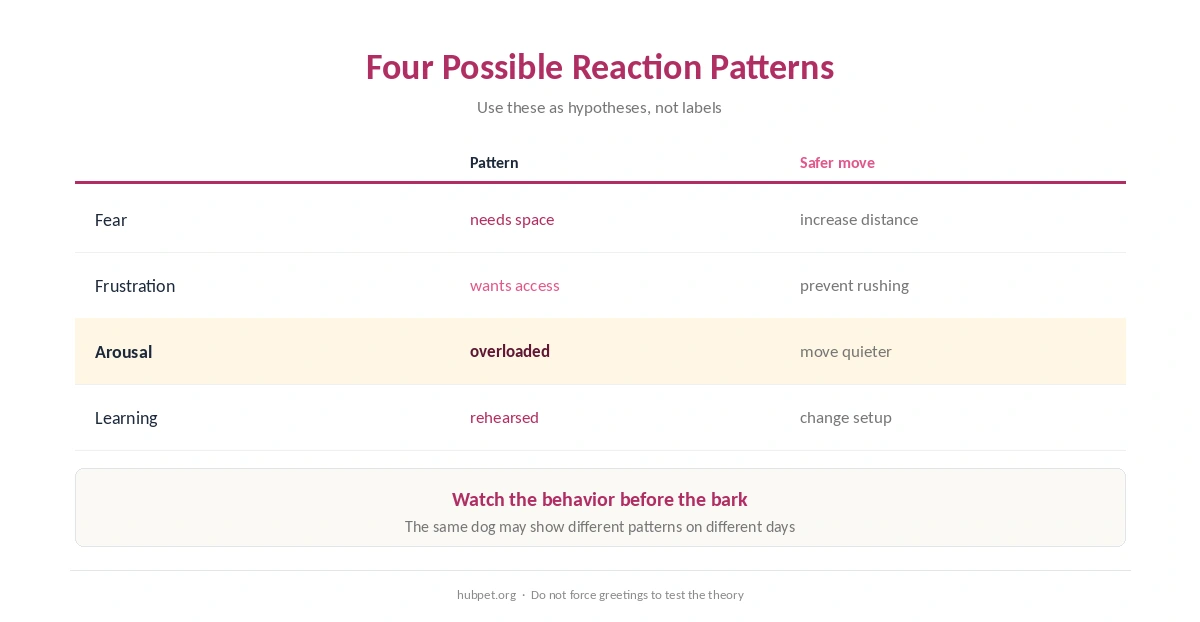
Why Dogs Bark at Some Dogs but Not Others on the Same Walk
Distance can matter. A dog may stay calm across a wide street yet react on a narrow path. In practice, use enough space for the dog to notice another dog and still think. The doorbell-training guide uses the same principle: start at a level where the dog can still respond. The delivery-driver guide shows how context and repetition can also shape a response.
Movement can matter too. A running dog, a dog that stops and stares, or an unexpected dog around a corner can create a different picture. However, do not turn those patterns into permanent labels. The article on breed and aggression myths explains why breed alone does not predict an individual encounter.
Past learning can strengthen the response. If barking reliably makes the other dog move away, the behavior may become easier to repeat. Therefore, reduce rehearsal with distance and route choices. The redirection guide can help you reward an easier alternative before arousal peaks. This is another reason why dogs bark at some dogs but not others even when the dogs look similar to us. For a closer look at the related behavior pattern, see why Dogs Bark at People Walking Past.
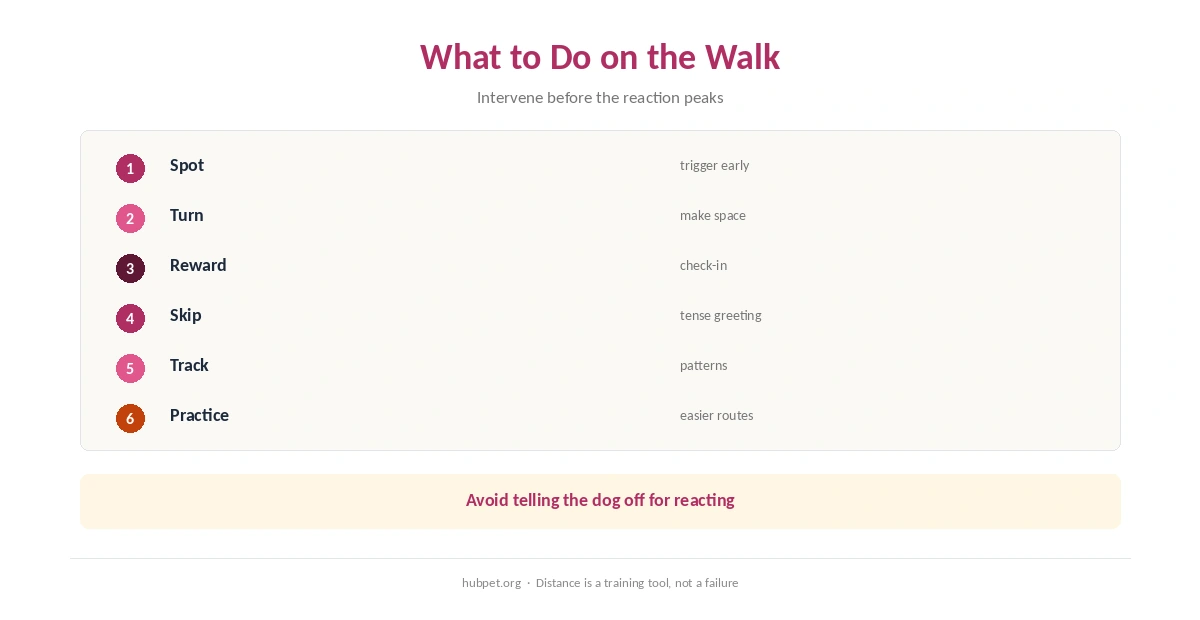
What to Do When Your Dog Reacts to Another Dog
First, create distance instead of tightening into a confrontation. Dogs Trust advises moving far enough away for the dog to begin relaxing, then rewarding that change. Also avoid telling the dog off, because added stress can worsen the moment. If barking continues after the dog has space, the barking guide can help separate trigger management from quiet-skill practice.
- Notice the trigger early and choose a wider path or turn away.
- Reward the dog for checking back with you before barking starts.
- Use a simple practiced cue or scatter game only if the dog can still engage.
- Skip greetings when body language is tense or the dog is already overwhelmed.
- Keep a short trigger log so patterns become easier to see.
- Practice in easier places before returning to busier routes.
If leash tension is part of the setup, build calmer walking separately. The loose-leash guide can reduce conflict between the handler and dog. Meanwhile, practice recall training away from difficult dog encounters before you expect it to work under strong distraction. Also practice short calm-skill sessions from mat-settle training away from other dogs.
Do not force face-to-face greetings to prove the dog is social. Likewise, do not flood the dog with repeated close passes. The reward-based principles in positive reinforcement basics and common training mistakes favor achievable setups over punishment or overwhelming exposure. After a hard outing, balanced play and rest can support a lower-arousal recovery period.
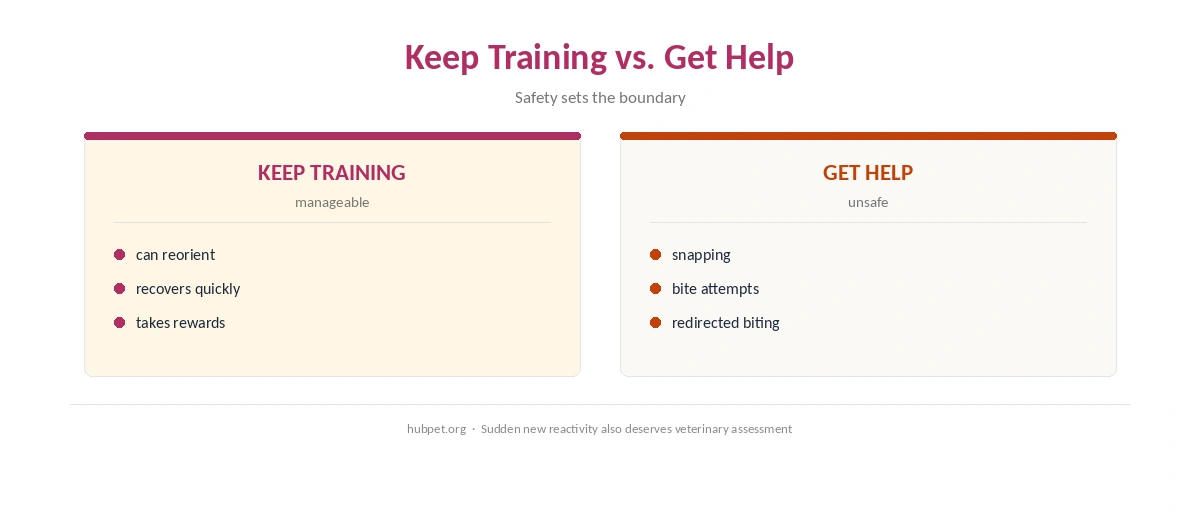
When to Get Professional Help
Seek a reward-based behavior professional if reactions involve snapping, attempts to bite, redirected biting toward the handler, or repeated episodes that you cannot manage safely. Use distance and avoid close encounters while the professional builds a plan.
Because sudden behavior change can have a medical contributor, contact your veterinarian if a normally tolerant dog abruptly becomes reactive or seems physically uncomfortable. This article cannot diagnose that cause. The pet pain-sign guide explains why behavior change sometimes deserves medical assessment.
How We Research
HubPet reviewed these sources on October 11, 2026: the AAHA reactive-dog review, 2026 and the Merck Veterinary Manual behavior overview, updated April 2026. Read more about our research process.
The response can depend on distance, movement, prior experience, fear, frustration, excitement, and the context of that specific encounter.
Not necessarily. Barking and lunging can occur with fear, frustration, excitement, or overwhelm as well as aggression.
Not while the dog is tense or overwhelmed. Create distance and skip the greeting.
Punishment can add stress. Use distance, management, and reward-based training instead.
Get help when reactions create bite risk, are hard to manage safely, or suddenly change in a way that may have a medical contributor.
The Bottom Line on Why Dogs Bark at Some Dogs but Not Others
Why dogs bark at some dogs but not others is a context question, not a simple personality label. Watch distance, movement, body language, history, and the dog’s ability to recover. Manage the trigger first, reward easier responses, and seek professional help when safety or sudden behavior change is a concern.