
Claw marks on a wall corner or door frame are easy to mistake for deliberate damage. For many cats, these are visible, well-traveled surfaces where a long vertical stretch and scent marking feel natural. A wall may also be where a scratching post is missing, unstable or too short. The first useful question is not how to make the cat dislike the wall, but why this particular corner works better than the options nearby. This guide maps scratching to room layout and suggests safer ways to protect plaster, wallpaper and trim. It does not diagnose compulsive behavior. See HubPet’s veterinary disclaimer for advice boundaries.
Read where the claw marks begin
Look at the height and shape of damage. Long downward marks near a prominent corner suggest a vertical reach; low repeated marks may reflect a smaller cat, a different posture or a favorite route. A damaged doorway near the cat’s bed can be a stretch point after a nap. Marks at an entrance may also help establish familiar scent cues. Photograph several areas and note which cat uses each location. Avoid interpreting these marks as dominance or revenge. The pattern can guide the type of scratcher and where it must stand.
Offer a vertical replacement that passes the wobble test
Choose a stable post or scratch panel long enough for the cat to extend upward without running out of surface. A wall-mounted board needs secure fasteners placed according to the wall material and the product instructions. Check that the panel cannot fall or swing into the cat. Frayed sisal, rough cardboard or another appealing material may work, but preference varies. Put the replacement immediately beside the damaged edge. A cat may ignore a short freestanding post because it tips when pulled; sturdiness matters more than decorative appearance.
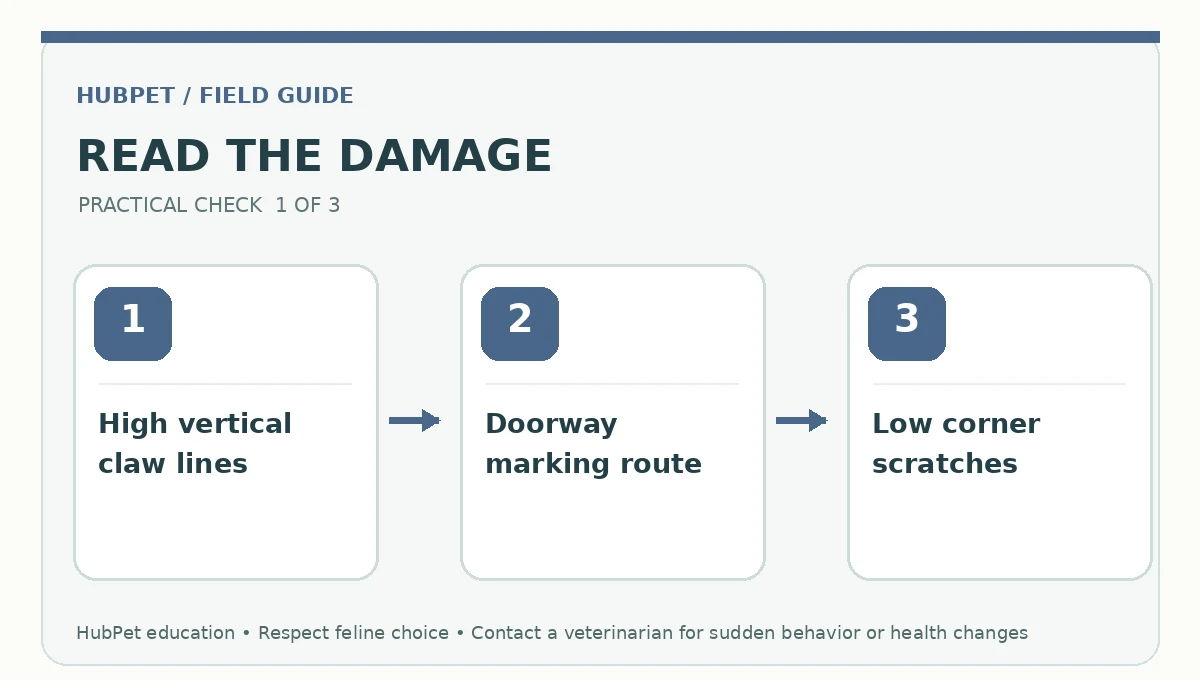
Treat door frames as important travel locations
Door jambs are narrow landmarks, often at routes between resting areas, food and family activity. If scratching happens at a passage rather than at a closed door, placing a scratch panel on a nearby wall may fit the behavior. Leave enough clear width for people and pets to pass without catching clothing or fur. If the cat scratches only when locked out, examine the access routine instead; the best scratcher may not address frustration. Repeated scratches next to another cat’s room can also suggest a social pressure point in a multi-cat home.
Protect paint, plaster and wallpaper safely
A removable, smooth guard can shield fragile finishes during retraining. First check wall material and test any adhesive on an inconspicuous area; wallpaper and some paints can tear during removal. Avoid small hooks or exposed screws where claws might catch. Do not attach a scratch board to crumbling plaster or thin trim that cannot carry its weight. If a wall is already flaking, repair loose pieces before a cat can lick or swallow them. Protection should not cover an emergency exit or create a tight pinch point behind a door.
Make the new surface an easy first choice
Put the scratch panel directly on the usual approach path, not behind a decorative plant or chair. Encourage investigation with a brief supervised toy game and reward the cat for scratching the allowed surface. Some cats like a little catnip on the scratcher, but it does not work for every animal. Never hold a cat upright or rub its paws against a post to demonstrate the motion. This can feel frightening and make the new object less attractive. Focus on giving the cat a safe opportunity to discover what already feels natural.
Consider a mix of heights and angles
An adult cat that reaches high on a door frame may need a tall fixed panel. A kitten may use a lower board now and a taller one later. Some cats switch between upright and horizontal surfaces depending on mood or room. Offering a flat pad near the doorway can prevent a second damaged area. The Ohio State and Cornell guidance describes matching the scratching orientation a cat already chooses. Do not assume a single scratcher can meet every cat’s needs in a large home or in a busy multi-cat household.

Look for sudden changes or signs of distress
Ordinary scratching tends to occur alongside familiar routines, but an abrupt shift to frantic activity, fear or unexplained agitation deserves attention. Watch for injuries around claws, limping, hiding, reduced appetite and changes in elimination. If a cat repeatedly attacks a wall while vocalizing or appears disoriented, do not label it stubborn. Seek veterinary assessment rather than escalating deterrents. A change in nearby furniture, a new household pet or a blocked route can also alter where a cat leaves marks. Consider both health and environment.
Use the right plan in each room
For the living room, place a prominent post near a sofa arm or entry. A bedroom needs a quiet scratching option close to a resting place. Hallways benefit from slim fixed panels that do not obstruct movement. For a bathroom entrance, keep scratchers away from wet or slippery floors. Map the cat’s routes before purchasing several identical posts; different layouts benefit from different formats. Keep the cat’s litter tray, resting areas and other essentials accessible while you rearrange the space. Redirection should reduce inconvenience for everyone, not create a new obstacle course.
Follow a measured replacement sequence
Start by recording damage and locating the target. Install a suitable alternative next to that target and protect the wall without frightening the cat. For several days, reward spontaneous use when you happen to see it; do not stand guard waiting to interrupt normal scratching. Once the cat uses the replacement reliably, consider whether the board can move a small distance without losing its appeal. Some posts may need to stay near the doorway permanently. Mark success by the cat’s comfortable use of the new surface, not just a clean wall.
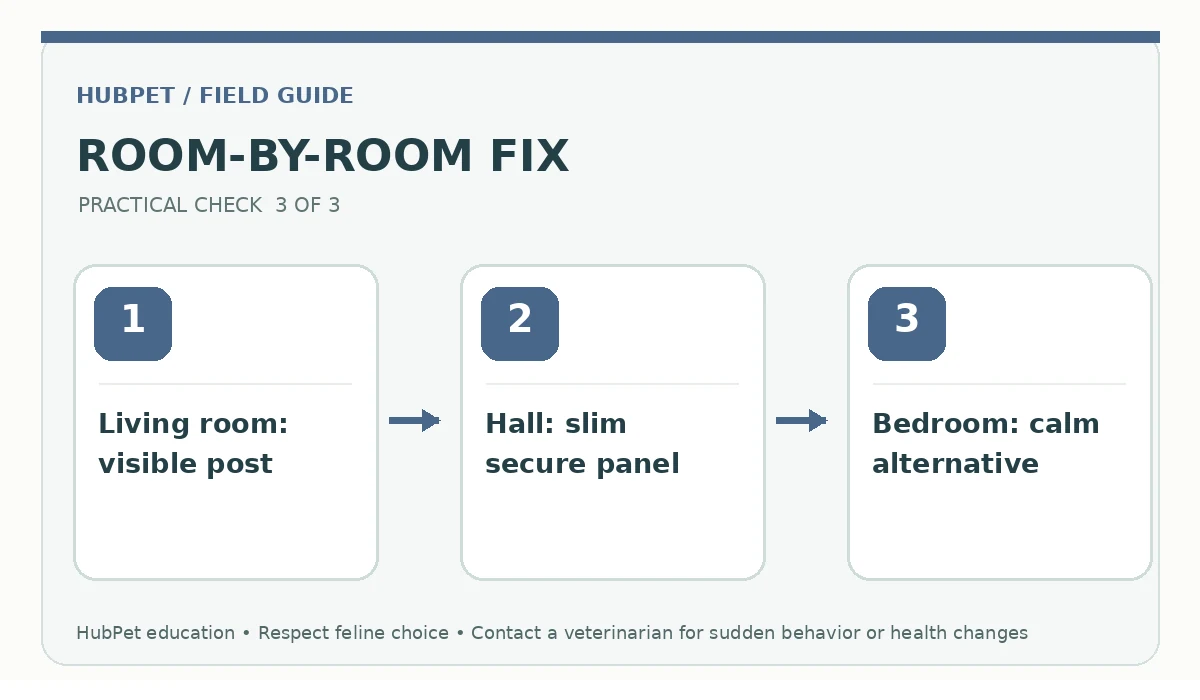
Know when to involve a behavior specialist
If several cats are competing at a doorway, or scratching continues with fear and territorial conflict despite good resources, a veterinarian can help you decide on qualified behavior support. Do not introduce essential oils, punitive sound devices or painful surfaces as a shortcut. A professional can consider the cat’s full environment rather than the damaged paint alone. Damage associated with a suddenly closed room or separation pattern may need a different plan than ordinary scent marking. A scratch panel solves the surface issue only when it actually meets the cat’s behavioral need.
How We Research
Our editorial review compared veterinary and animal-welfare guidance on feline scratching behavior, scratching-surface preferences, safe environmental redirection, household stress signals, and gentle training. We used published feline guidance as the basis for practical behavior guidance and contrasted it with the limitations of quick-fix marketing claims. We did not run controlled behavior trials, conduct product tests or endorse brands. Surface preference, behavior and household arrangements vary by cat and home; ask a veterinarian about persistent behavior changes. We last reviewed the sources on October 27, 2026. Read about our editorial process on the About HubPet page.
Sources
Ohio State Indoor Pet Initiative: Scratching and suitable surfaces. Accessed October 27, 2026.
Cornell Feline Health Center: Destructive behavior in cats. Accessed October 27, 2026.
San Francisco SPCA: Scratching posts and preferences. Accessed October 27, 2026.
ASPCA: Destructive scratching. Accessed October 27, 2026.
Door frames are prominent routes and may feel sturdy and tall. A nearby vertical post of the right height and material may be more attractive than a distant or unstable one.
Yes, if it is securely fixed, tall enough and placed close to the chosen corner. Check the fasteners, edges and wall material regularly.
Not by itself. Stretching, claw maintenance and scent marking are normal explanations. Watch for other signs of stress or sudden behavior changes before drawing conclusions.
Probably not if the hallway is the cat’s preferred marking route. Place a safe alternative in the same well-used area and only consider moving it slowly after regular use.
Discuss sudden, intense or compulsive-looking behavior, injury, disorientation or scratching alongside new appetite, mobility or toileting changes with your veterinarian.