
This is general cat-welfare information, not veterinary advice. Read our veterinary disclaimer. Follow the manufacturer’s instructions and seek qualified structural advice when a support system is uncertain.
Wall-mounted cat shelves offer elevated resting places in homes with little floor space. But a cat lands dynamically, changes direction and may leap from one platform to another. The key questions are whether the wall and brackets can support that motion, whether the shelf offers enough real landing space, and whether the cat has a comfortable way down. This guide separates product selection from installation decisions that need the correct hardware and, when uncertain, qualified help.
Plan the shelf for resting as well as climbing
Draw where the cat could sit, turn and stretch. The AAFP and ISFM feline environmental guidelines recommend that resting perches be long and wide enough to let the cat fully stretch. For many homes, one generous landing shelf is more useful than several narrow decorative strips. Include a low route to the first shelf and a landing surface that remains free of vases, cables and swinging blinds. Do not choose a height just because it looks impressive on a photograph.
Identify what is inside the wall
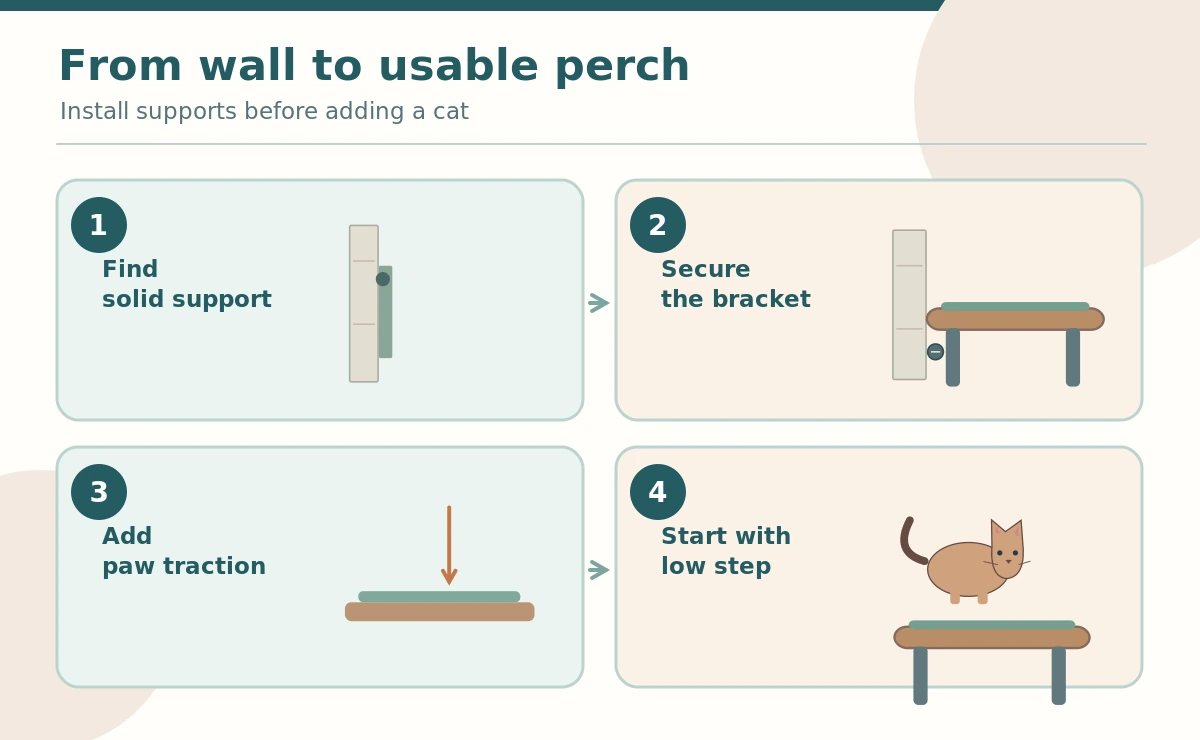
Drywall, masonry, wood framing and hollow partitions require different mounting systems. A screw that seems tight in a soft wall can still pull out under sudden load. Locate solid structural fastening points using an appropriate method and follow the actual bracket instructions for that material. Never assume a screw, stud spacing or anchor capacity is universal. If the wall has unknown construction, water pipes, wiring or damaged surfaces, consult a qualified installer rather than experimenting while a cat’s safety depends on the result.

Match bracket geometry to shelf depth
Look under the shelf before judging the picture from above. A deep board needs supports that control forward tipping and twisting, not merely a decorative peg beneath the back edge. Consider where the brackets attach to both the wall and shelf. If a kit includes a specified bracket spacing, follow it. Do not swap screws or extend the shelf beyond the supported span without engineering guidance. Inspect whether exposed metal corners can contact a leaping cat, and prefer hardware with smooth accessible edges.
Choose surfaces that paws can trust
Smooth lacquer can be slippery when a cat lands from a jump. A fixed, low-profile traction cover provides more reliable footing than a loose towel draped across the platform. Check that the covering cannot bunch, shed strings or detach at a paw swipe. Round accessible corners and inspect for burrs or splinters. A padded hammock-shaped depression can be comfortable, but its frame and fabric still need the support specified by the maker. Comfort features should not conceal loose fasteners during inspections.
Keep an unobstructed landing zone
Treat every shelf as both a destination and a place where the cat might need to change direction. Leave clear space at the approach and departure sides, avoiding door swings, shelves with hard pointed decorations and dangling blind cords. Provide enough depth for all four paws, not just the front pair. Plan what happens if two cats meet on a narrow path. A second descent or alternative resting place can help one cat avoid another blocking the route.

Install without using the cat as a test weight
Follow the product’s installation instructions and the wall-material requirements. After assembly, check level, bracket stiffness, screw heads and contact surfaces while the cat is elsewhere. Use only the maker’s approved empty-platform checks. Do not force a cat onto a new shelf to test whether it holds. Block access if a bracket creaks, wobbles or shifts, and inspect it before reuse. Where a mounting method is unclear, professional installation is preferable to an improvised attachment.
Start lower for cats with different mobility
Not every cat wants a tall vertical course. The feline environmental guidelines identify accessible lower platforms and ramps as useful for kittens and older cats who cannot reach high places comfortably. Watch for hesitation, missed steps or a preference for furniture instead. Rather than pushing the cat higher, reposition the first shelf or add a stable alternative route. An elevated refuge is valuable when the cat can choose whether to use it and can descend safely.
Separate the shelf from window and electrical hazards
A shelf beside a sunny window may offer good enrichment, but it must not create a launch point through an unsecured opening. ASPCA warns that cats can fall from windows while distracted by outdoor movement. Keep windows properly secured and inspect screens independently. Do not install shelves above uncovered outlets or allow the route to cross lamp cords, curtain loops or fragile wall decorations. Place shelves where routine cleaning and emergency access remain possible.
Inspect weekly and after unusual activity
Look for new gaps between brackets and wall, spinning fasteners, damaged traction coverings or a board that has begun to sag. Check after moving furniture that was used as the first step. If a cat starts avoiding one shelf, investigate the surface and route rather than assuming disobedience. Periodically clean the platform with pet-appropriate methods and let it dry before use. A lasting installation depends on how it is maintained as much as how it looked on installation day.
Choose a freestanding alternative when needed
If a wall cannot provide known reliable anchor points, a stable floor-standing cat tree may be the safer and more reversible option. A low bench, protected window seat or floor-level hideaway can also provide enrichment. Wall shelves are not mandatory for a fulfilled indoor cat. Cats Protection recommends opportunities to climb and explore, while the type and height should fit individual abilities and a home’s constraints. The best solution is one you can use and inspect confidently.
How We Research
Our research separates feline-welfare guidance from mounting claims. Published veterinary and animal-welfare recommendations establish the general needs; product-specific instructions establish attachment limits. HubPet does not test bracket loads or certify particular products. Sources reviewed October 28, 2026. Read How HubPet works.
Sources
AAFP and ISFM Feline Environmental Needs Guidelines. Read source.
Cats Protection, Our Guide to Indoor Cats. Read source.
ASPCA, High-Rise Syndrome: Lifesaving Tips for Cat Parents. Read source.
Safety note: Do not allow access to a loose elevated surface or an unsecured window. Seek veterinary help if a cat shows signs of injury, new difficulty moving or discomfort.
Do not assume ordinary drywall screws provide safe support. Choose a mounting method specified for the wall and shelf load, or consult a qualified installer.
It should provide usable space for a cat to settle, turn and stretch; compare the specific cat with the actual unobstructed platform.
Only if their concealed structure, intended wall and manufacturer-approved installation are appropriate. The hidden support still needs inspection.
No. Secure windows independently against falls and escapes; a climbing shelf may make an opening easier to reach.
Offer lower steps and a familiar resting place. Do not force use or assume that more height is always better.