
A cat watching you across a room may be tracking an interesting movement, anticipating dinner, or resting with open eyes. The same fixed gaze can feel different when the cat is rigid, crouched, or blocking another animal. Cats Protection advises reading eyes together with ears, whiskers, posture, and the situation. Use this guide to observe what happens before and after the look, rather than assuming every stare means either affection or aggression.
Attention is often the simplest explanation
Cats monitor people who move through their territory, open doors, handle food, or start a play session. A cat may look at you because you are the most interesting object in the room. If the stare happens at the same time each evening, check the routine: perhaps you usually feed or play then. Cats can learn which human behaviors predict desirable events. A look is not proof of manipulation or a demand. Watch what the cat does when you move away. Does it follow, stretch, settle, or return to its own activity? That next action helps establish context.
Soft eyes are different from a rigid stare
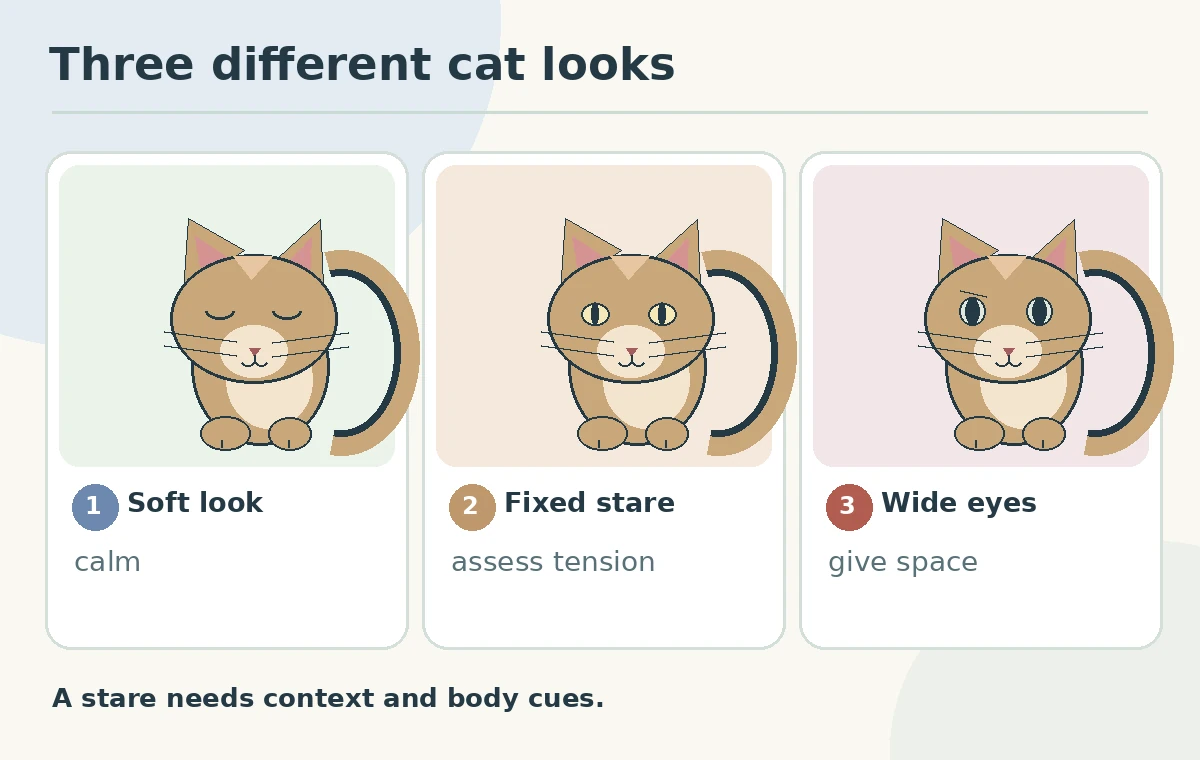
A relaxed cat may look at you with loose muscles, naturally positioned ears, and partially closed eyes. Slow blinking can be part of a calm social exchange. A tense cat may stare without much blinking while its body stays rigid, its tail flicks, or its ears rotate sideways or back. A widened pupil can occur for several reasons including lighting and arousal; no one should use it alone as a fear detector. Compare body signals before approaching. If the animal stiffens, gives it space and do not lean over it. Some cats prefer to observe while people keep their hands to themselves.

Slow blinking is an invitation, not a command
Cats Protection notes that a slow blink in a relaxed cat often accompanies comfort and trust. You can narrow your eyes gently, blink slowly, and angle your head away. Do not move closer as you blink or force your face near the cat. A cat that looks elsewhere or walks away is making a normal choice. Not all cats slow blink, so do not score your relationship by how many blinks you receive. The goal is calm interaction rather than eliciting a trick. Pair your response with relaxed posture and the option for the cat to leave.
Staring around meals can become a learned routine
If you always fill a bowl after your cat sits watching near the kitchen, the behavior may become an efficient request. This does not mean the cat is hungry every time it looks at you. Keep meals appropriate to your veterinarian’s feeding guidance and avoid adding extra food every time eye contact occurs. Instead, use a predictable schedule and provide play or gentle attention at other times. An automatic feeder can reduce associations between a specific human movement and mealtime, but it cannot replace monitoring the cat’s intake or health. Check that other pets cannot block access.
Watch for social tension in multi-cat households
A stare aimed at another cat may serve a different function from looking at a trusted person. In a tense household, one cat may block a passageway without a hiss or swat. When the gaze concerns another animal, note whether the watched cat freezes, lowers its body, retreats, or avoids a doorway. Separate resources and provide alternate routes. Never punish one cat for staring; focus on reducing the pressure and creating enough space. If either animal regularly hides, stops using a litter box, or appears frightened, seek help from a veterinary professional familiar with feline behavior.
Do not respond with a prolonged human stare
People often consider eye contact friendly, but sustained direct staring can feel confrontational to a cat. Cats Protection advises avoiding prolonged staring at a worried animal and using soft blinking with a gentle turn of the head instead. This is especially important when greeting a shy cat or a visitor’s pet. Sit at a comfortable distance, avoid looming over the cat, and let it approach first. If the cat moves away, stop trying to attract its gaze. Children should learn not to put their faces close to cats to provoke a reaction or test friendliness.
Environmental changes can explain a new pattern
A cat might watch one corner because it hears a pipe, sees a moving shadow, or notices an insect. A new household routine, pet, or piece of furniture may also hold its attention. Record whether the cat looks toward you, another animal, or a particular place. Try to identify changes without creating more noise or stress. If the cat remains relaxed and otherwise behaves normally, you may simply continue observing. However, sudden disorientation, repeated abnormal behavior, or persistent changes in vision or alertness warrant veterinary assessment.
Look for medical red flags instead of decoding everything
A newly fixed or unusual stare in an older cat, changes in vision, bumping into objects, abnormal pupils, one eye partly closed, or persistent squinting needs professional attention. Sudden confusion, collapse, or seizure-like behavior requires urgent care. Never assume a behavior is simply attention seeking if eating, mobility, or litter habits also change. Do not use flashlights to test a cat’s pupil responses at home or apply eye drops without veterinary instruction. An article about body language cannot identify eye disease or neurologic problems; explain the timeline of changes to your veterinarian.

Use a three-part check whenever your cat looks at you
First, note the setting: feeding time, play, stranger, resting place, or another cat nearby. Second, check the body: relaxed or rigid muscles, ears, tail, whiskers, and movement. Third, observe the response when you look away, offer quiet space, or resume your routine. Write down recurring patterns rather than inventing a translation for a single glance. A soft stare with easy movement may be an ordinary social interaction; a fixed gaze and tense posture calls for more distance. Let your cat decide whether attention becomes interaction. Calm observation builds a better relationship than guessing.
How We Research
This guide draws on published information from veterinary professionals and established feline welfare organizations, including Cats Protection, Ohio State University, and VCA Animal Hospitals as relevant. We compared normal explanations with alternative interpretations and safety warning signs, then focused on observable behavior, freedom to choose contact, and practical home setup. No single gesture reveals every cat’s state, and these observations cannot diagnose an individual animal. The illustrated scenarios are educational examples, not clinical examinations. Review About HubPet for our editorial approach.
Sources
Cats Protection: Why does my cat stare at me?: Read source. Reviewed October 27, 2026.
Cats Protection: Cat body language: Read source. Reviewed October 27, 2026.
Cats Protection: Why do cats slow blink?: Read source. Reviewed October 27, 2026.
Safety note: Behavior can change with stress or illness. If your cat has a sudden change in activity, appetite, breathing, movement, toileting, or awareness, seek veterinary advice. This guide is not a diagnosis or treatment plan. See our veterinary disclaimer.
Yes. Cats often track familiar people or routines. Read a calm gaze alongside body language and what is happening around the cat.
Slow blinking together with relaxed posture commonly accompanies comfort, but cats communicate in many ways and not all will return a slow blink.
Avoid a long direct stare, especially if the cat looks worried. A brief soft blink and looking away is usually less intrusive.
Cats may learn that your presence predicts feeding or play. Keep routines predictable and assess actual needs rather than offering extra food automatically.
Contact a veterinarian if it starts suddenly or comes with confusion, vision changes, squinting, abnormal pupils, mobility changes, or other illness signs.