
Puppy nail clippers should match tiny nails and your own ability to see and control the cutting edge. The wrong tool can hide the tip, twist in your hand or make you rush through a wiggly session. This is a buyer’s guide to practical fit and handling rather than a list of untested products. Even an excellent clipper cannot make an unsafe cut safe, and a puppy that fears paw handling needs training before grooming. If a nail is injured, inflamed or painful, call your veterinarian; see HubPet’s veterinary disclaimer for the limits of general guidance.
Begin with the size and shape of the nail
Look at the puppy’s paw while it rests naturally on a non-slip surface. Also, some puppies have fine translucent nails, while others have thick dark ones even at a young age. Compare the clipper opening with the nail tip rather than buying according to age alone. A giant plier-style head can block your view when you need only a tiny cut. A compact tool should allow the tip to sit in front of the blades without pulling the toe awkwardly. If your puppy’s nails are already overgrown or heavily curved, ask a professional to show you the right approach first.
Compare scissors and plier-style options
Small scissors-style pet clippers offer an unobstructed view on many fine nails and need only a brief closing motion. Next, compact plier-style designs may offer a familiar grip and more mechanical leverage, though they can feel bulky around tiny toes. Both rely on clean, sharp blades. A guillotine mechanism is not automatically wrong, but it can be harder to position accurately when a puppy twists. Try the opening and closing action in your hand before presenting any tool near the dog. The most useful choice is the one you can operate slowly and confidently with a clear sightline.

Prioritize blade condition over marketing extras
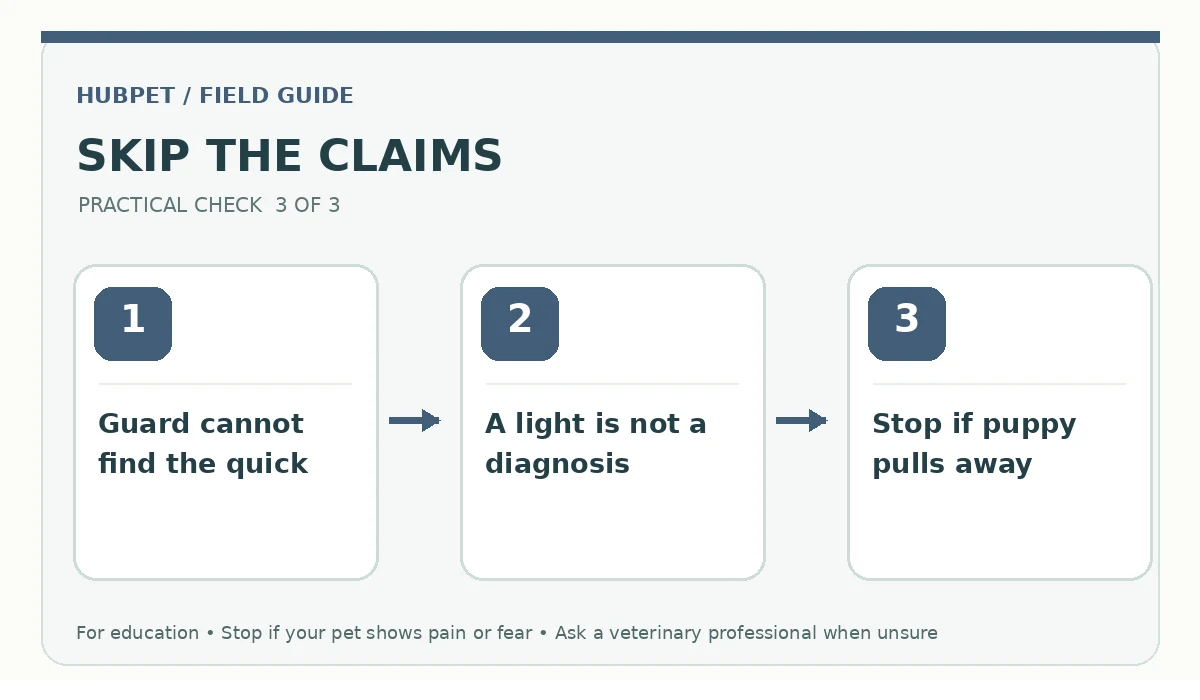
Inspect whether the blades meet neatly without a gap, wobble or visible nick. As a result, blunt or poorly aligned blades may squeeze a nail rather than making a clean cut. A lock for storage can help keep the clipper closed, but it must stay clear of the moving blade during a trim. A built-in guard can limit travel in some models; it does not reveal where the puppy’s quick begins. Lights and so-called quick sensors should never replace your own conservative inspection. Avoid any promise that a device can locate living tissue perfectly in every dark or curved nail.
Check your grip with an empty practice run
Hold the clipper while seated near the surface where grooming will occur. By contrast, your wrist should stay neutral, and your fingers should not slide when you squeeze the handles. Test the tool on a harmless practice material, never on a puppy’s nail until you know the motion. A short, precise action beats a powerful clipper that shifts at the last moment. Check whether left-handed handling changes your view of the blade. If the tool feels awkward when the puppy is not present, it will probably feel worse during a moving-paw session. Return it or choose another design.
Introduce the tool without a real cut
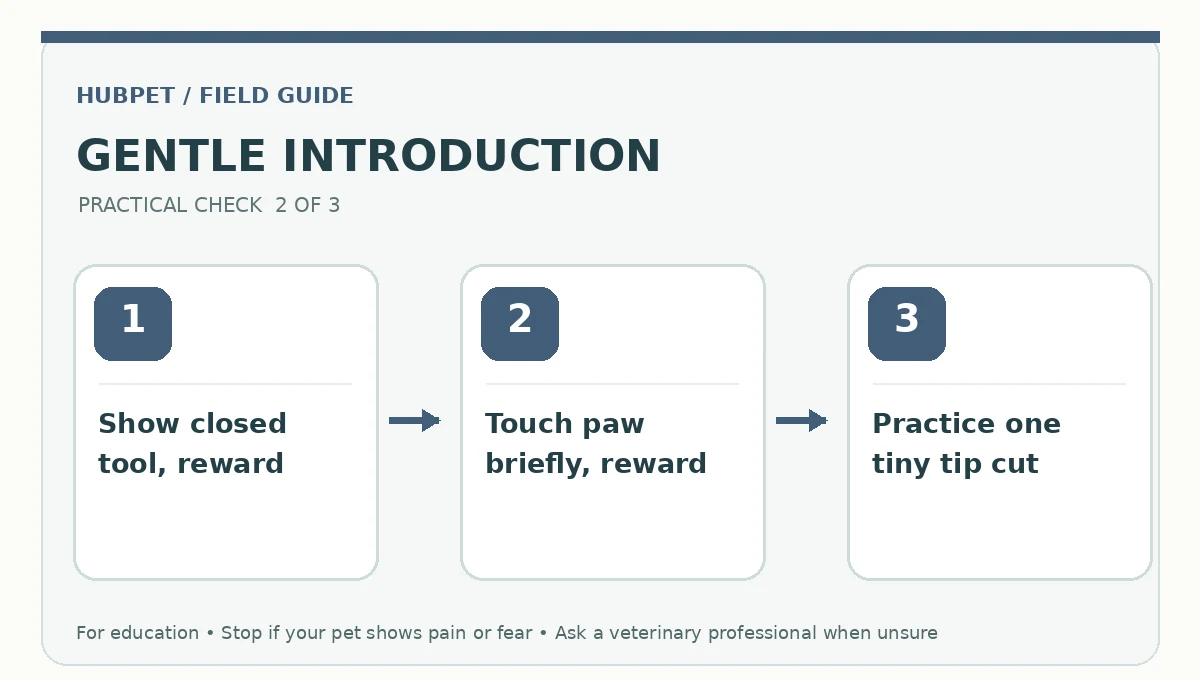
Show the closed clipper briefly and drop a small treat nearby. For example, put it away before the puppy loses interest. Later, touch a relaxed paw, reward and release. Make a soft clipping sound away from the dog, then reward again if the puppy remains comfortable. Move to touching the closed tool near a toe only after the earlier steps are easy. Do not hold the puppy’s leg out in an unnatural posture to get a better view. The learning sequence is about voluntary comfort and predictable handling, not making the puppy submit to an unfamiliar object.
Use a conservative first trim
When your puppy stands or rests calmly and the nail boundary is clear, extend one toe gently. However, on a pale nail, avoid the pink quick; on a dark nail, remove only the smallest obvious tip rather than guessing at depth. One clean cut may be all you do that day. Reward promptly and let the puppy step away. Never trim while the puppy is thrashing or while you cannot keep the blade steady. If you need a professional demonstration, that is a sensible purchase-related decision too: a suitable tool and correct technique work together.
Consider a grinder, but not as a universal upgrade
A grinder can remove very small amounts of nail and may appeal to owners who dislike a closing blade. In addition, it introduces noise, vibration and heat, which some puppies find more upsetting than clipping. Long fur can also catch in rotating parts if it is not kept safely out of the way. Choose a lower-stimulation training session before using a powered tool, and follow its own instructions. Many owners keep a small clipper for easy tips and seek professional help for difficult claws. Do not combine loud grinding and firm restraint just to finish the job.
Plan maintenance without chasing a fixed schedule
Check nail tips and gait regularly; wear varies with surface, activity and individual growth. Meanwhile, nails that click, snag or nearly press into the floor may need attention, but sudden limping or an injured toe deserves veterinary assessment. Keep the clipper dry, wipe it according to the maker’s directions and inspect blade alignment after storage. Never share a dirty tool between animals with possible skin problems. Over time, the puppy will grow and the clipper opening may no longer suit larger nails. Replace the tool when control or cut quality declines rather than forcing an undersized clipper.
Build a simple buying checklist
Before purchasing, note your puppy’s current nail size, whether the quick is easy to see, which hand you use and what type of closing motion feels stable. Therefore, compare sharpness, viewing clearance, grip security, storage lock and cleaning access. Ignore unsupported claims that every cut will be painless. If you already own a correctly sized sharp tool, a second model may not improve the outcome as much as short cooperative-care practice. Set aside budget for an in-person grooming lesson if nail care is stressful. Confidence and comfort are part of the equipment setup.
How We Research
Our editorial review compared veterinary and animal-welfare guidance on healthy claws, handling tolerance, tools, and reasons to seek professional help. Practical owner decisions took priority over product claims. We did not conduct controlled tool trials, test specific brands, or provide diagnoses. Guidance may vary by age, lifestyle, anatomy, and stress response; ask a veterinarian about individual needs. We last reviewed the sources on October 27, 2026. Read about our editorial process on the About HubPet page.
Sources
American Kennel Club: Preparing puppies for preventive care. Accessed October 27, 2026.
ASPCA: Dog grooming tips. Accessed October 27, 2026.
VCA Animal Hospitals: How to trim a dog’s nails at home. Accessed October 27, 2026.
Some tiny nails can fit a small clipper, but a dedicated sharp pet tool often offers better blade orientation and control. Ask a groomer for a demonstration.
The key distinction is the nail size and how clearly you can position the blades. A puppy may need a smaller cutting head than an adult dog.
No. Guards do not identify the living tissue inside the nail. Inspect the tip in good light and take a very small amount.
Not automatically. A grinder adds sound and vibration. Choose based on your puppy’s tolerance and your ability to use the tool steadily.
Replace a tool if the blades dull, shift, crush the nail or no longer fit the growing puppy’s nail size comfortably.