
This guide offers general training and safety information, not individualized veterinary care. If a puppy seems injured, ill, or persistently distressed, contact your veterinarian. See our veterinary information disclaimer. For an apartment puppy, the elevator can become a daily part of bathroom breaks and trips outside. The doors move suddenly, floors can feel slippery, and a leash creates a particular pinch hazard if puppy and handler end up on opposite sides. Start with a safe route and a relaxed observation at a distance, not a forced ride. Use stairs only when your puppy can navigate them safely and your veterinarian has no mobility concerns; avoid escalators and moving walkways with puppies. Follow building rules and keep a secure, well-fitted harness ready for every practice.

Check the landing and exit path
Before bringing the puppy, walk the route alone. Notice elevator door speed, lobby traffic, puddles, slippery tile, corners where a puppy could turn, and any space where a leash could snag. Find a quieter period to practice and keep the puppy on the same side of the doorway as you at all times. Leave an exit route clear when other passengers step out. If a door is closing, wait for the next car rather than rushing across the threshold. Never count on door sensors to detect a thin leash, a tail, or a very small puppy.
Fit the harness and manage the leash
Use a comfortable, secure harness and a standard leash with a reliable clip. Gather excess length in your hand without wrapping it around fingers, neck, or wrist; the puppy should stay close enough that no loop trails toward the door track. Never let the puppy enter while you remain outside or vice versa. Do not connect the leash to the elevator wall, rail, or handle. The same basic handling matters at every exit. If the puppy stops, do not jerk or drag them across the gap. Move back to the landing and offer an easier practice instead.
Introduce door movement from a safe distance
Begin at a distance where the puppy can notice the elevator opening and closing without freezing or rushing forward. Mark calm observation and offer a little food or gentle praise. You can let the puppy step toward the landing, then turn away together. Do not stand between the moving panels to prolong an exercise. Over several calm sessions, shorten the distance only if the puppy remains comfortable. Watch for hesitating, tucked tail, refusal of familiar food, and attempts to flee. Noise and crowding can be separate training challenges, so avoid increasing everything at once.
Practice entering and exiting as one team
When a lift arrives and the car is clear, use the door-open control as intended and allow enough time to enter together. Take a direct route onto the flat floor, keeping puppy, leash, and handler on the same side of the opening. Move away from the door track so the puppy cannot investigate the seam with a paw. If the puppy is unsure, step away and try later instead of pulling. For a very small or medically fragile puppy, ask your veterinarian whether safe carrying is preferable during specific transitions; still keep the leash and paws clear of the doors.
Choose a quiet place inside
Let the puppy stand or settle close to you with the leash gathered away from the door. The lift may jolt or produce chimes, so provide secure footing and avoid demanding a long sit on a slick surface. Keep the tail clear of the door path. Do not let a puppy approach another dog in the confined car, even if both owners say the dogs are friendly. If another animal enters, maintain distance or wait for a less crowded ride when possible. Offer rewards only when the puppy can take them safely and you can still manage the leash.
Handle setbacks without making them bigger
If the puppy becomes worried mid-trip, remain calm, keep the leash secure, and exit together at a safe stop. Do not force multiple repeat rides to prove success. The next practice can return to simply watching the doors from the lobby. Changes in building traffic, elevator maintenance noise, or unfamiliar smells may explain a temporary setback. If the puppy scrambles or repeatedly refuses to move, stop and seek guidance. A humane training plan protects the dog from overwhelming exposure; it does not use restraint or punishment to suppress visible fear.
Compare an unsafe leash loop with a managed exit
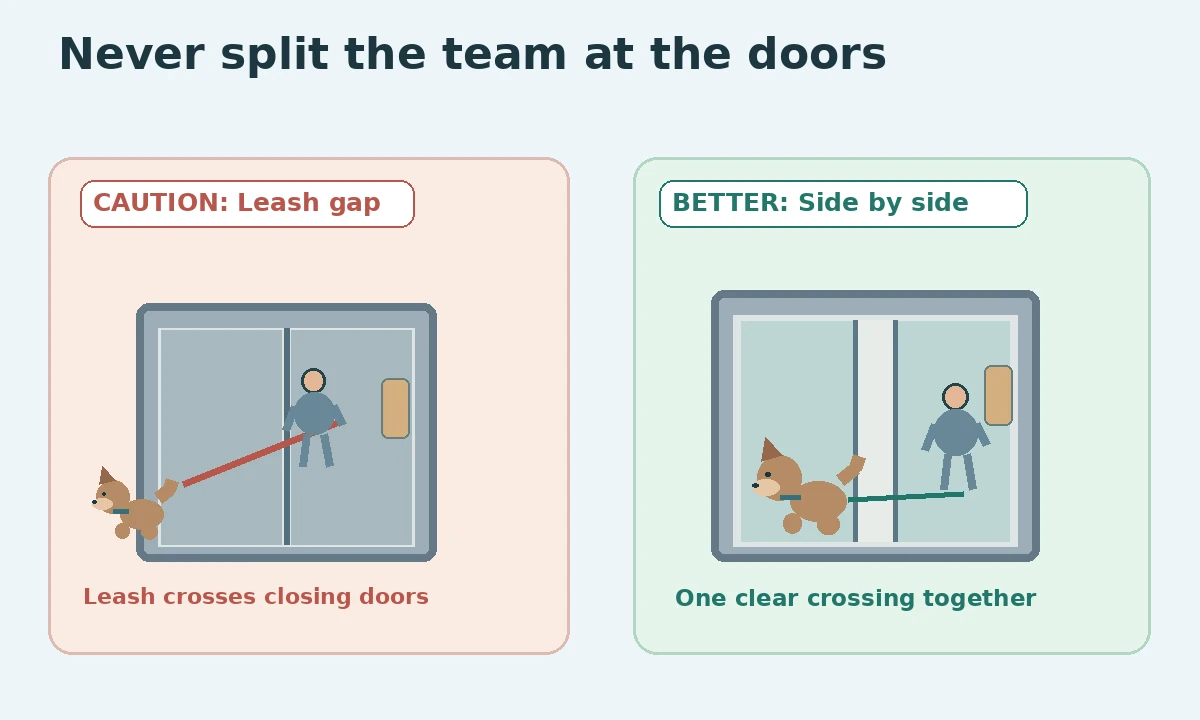
An unsafe example shows the puppy outside the car while a long leash crosses closing doors and the handler has already entered. A safer example shows puppy and handler walking through together, with all slack kept away from the gap. The illustration is a hazard comparison, not permission to test a door sensor. Keep every session short enough that you can pay attention to the actual environment. If people crowd a doorway or movement becomes unpredictable, wait rather than squeeze through. Your best safety equipment is deliberate timing and a fully controlled path.
Use a three-step pre-ride checklist
At the lobby, check the harness clip and shorten the trailing leash. At the opening, pause for other passengers and cross together without rushing. Inside, move clear of the door and reward a relaxed stance, then repeat the same process when exiting. Talk with your building staff if the door behaves unusually or floor surfaces remain slippery. Plan potty trips so urgency does not rush your puppy. After each practice, note the puppy’s confidence and start the next session at a manageable level.

How We Research
We review veterinary and animal welfare guidance on puppy learning, stress signals, and safe household management. We distinguish general preventive practice from treatment for serious fear or distress and describe actions owners can observe rather than promising certain results. Our illustrated scenarios depict concepts, not endorsements or medical procedures. Read more about our editorial approach.
Sources
Preventive Vet — Elevator and Escalator Safety — Guidance on puppy learning, animal welfare, and comfortable practice.
Dogs Trust — Puppy Socialization and New Places — Guidance on puppy learning, animal welfare, and comfortable practice.
VCA — Puppy Fear Prevention — Guidance on puppy learning, animal welfare, and comfortable practice.
No. Never assume a thin leash or tail will activate the sensor. Keep the entire puppy-and-handler team together.
Ask your veterinarian when appropriate for a very small or fragile puppy; otherwise practice calm, fully controlled entry.
Step away and practice observing from a safer distance. Never pull or drag a frightened puppy.
Avoid escalators and moving walkways; use a safer route such as an elevator.
Avoid greetings in the confined space; provide room and choose a quieter ride if needed.