
A portable disc golf basket looks like a stationary target. A curious dog, however, sees swinging chains and tempting plastic discs. Before practicing short putts at home, think about stability and traffic. The target should stand on its intended base over level ground, while the throwing lane stays completely separate from your dog’s play space. Even a gentle practice throw can surprise a pet that darts into the basket area. Use the basket as sports equipment, not as a climbing or enrichment device.
Choose a landing area, not merely an open patch
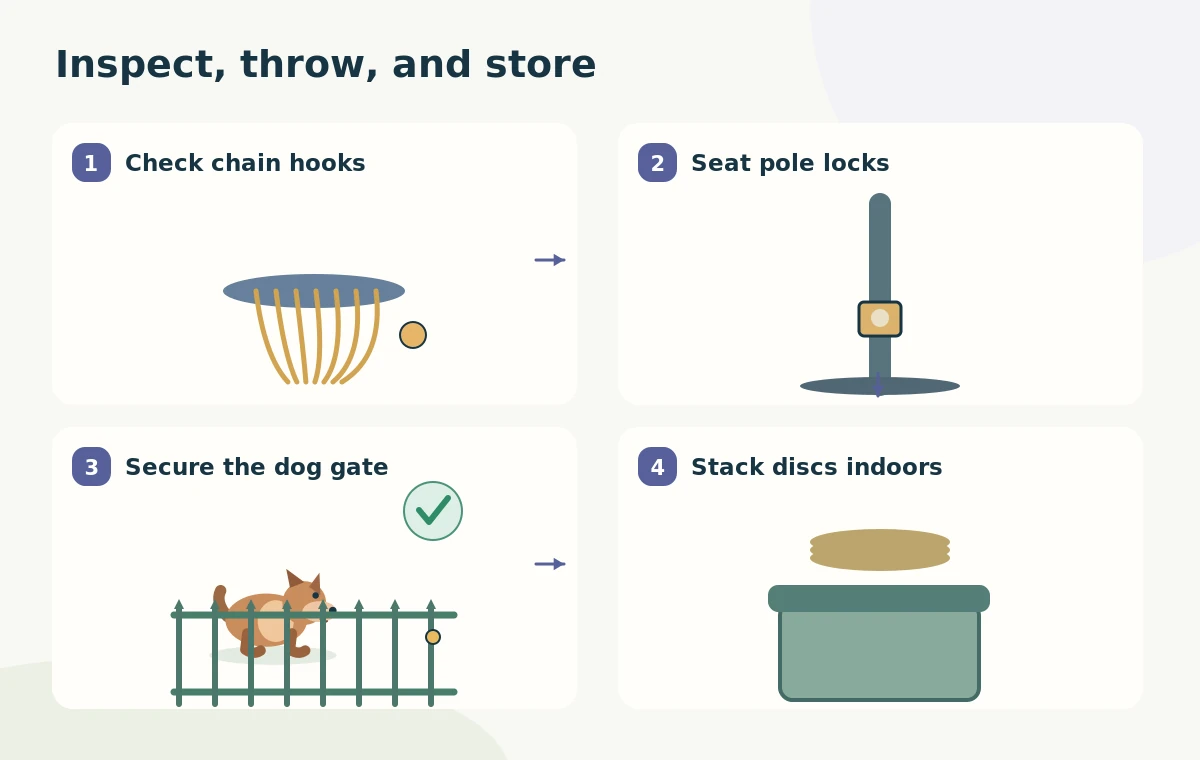
Place the basket where missed discs will land inside a predictable, open space. Check windows, parked vehicles, neighbors, garden tools, and the dog’s usual running route beyond the target. Do not make an entrance to the yard double as a throw line. A soft backyard surface can hide holes or an uneven paver under one base foot. Walk the area before each session and remove loose obstacles. Keep the dog behind a secure gate from the first warm-up throw until everyone gathers the final disc.
Identify the basket parts in the correct order
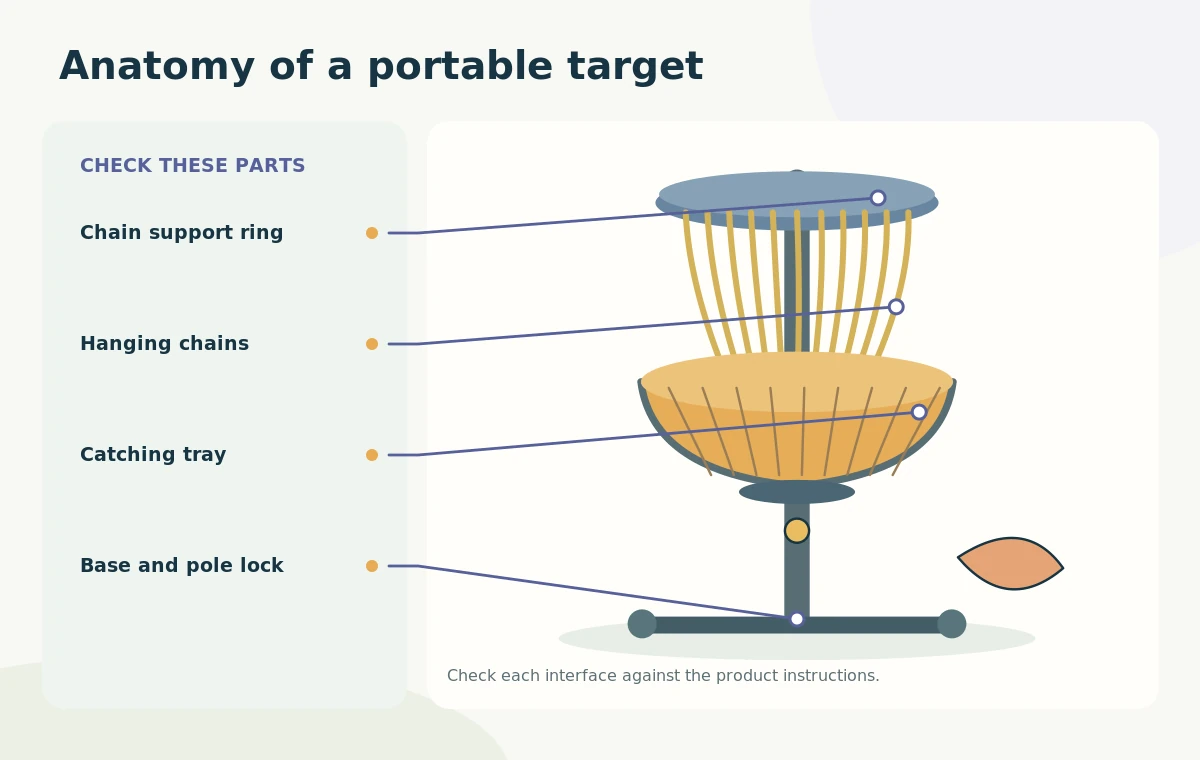
Portable targets normally include a base, lower pole, catching tray or basket, upper pole, chain support, and hanging chains. Some lock with spring buttons; other versions use bolts, washers, set screws, or wing nuts. The illustrated assembly shows these interfaces, not a universal instruction sequence. Read the manual for the exact model and verify each joint after assembly. Keep fasteners, bags, and packaging away from dogs, especially during setup when parts are laid out on the grass.
Check the pole and the tray connection
Look at the lower pole-to-base joint and the junction under the catching tray. Confirm that all lock buttons have emerged fully into their holes or that the specified fasteners are tight. A basket may look upright while the tray wobbles on a partly seated collar. Gently check only in the manner permitted by the manufacturer; never invite a child or pet to hang from the rim as a stability test. A loose connection means no throwing until you fit the correct part.
Inspect chain links without introducing new loops
Chains should hang from their intended support points with no sharp broken link or unattached dangling end. A chain swinging beside a dog’s collar can catch it, even when a throw is not in progress. Do not improvise extra cord or wire to repair a missing hook; the resulting loop may create a second hazard. Replacement chain assemblies should match the target design. Wipe wet metal before storage when the manufacturer recommends it, and keep chain ends folded away from paws and bare feet.
Understand portable bases and anchoring limits
A freestanding practice basket and a fixed course target have different installation assumptions. Some models have ground hooks; others depend on a large, weighted base or a folding tripod. Use only the method specified for the surface and avoid placing a tipped or unstable target on top of bricks. Check for exposed stakes and elevated foot ends in pet walkways. A heavy base can still move if someone hits it with a disc or trips on it; weight alone is not a safety certification.
See the difference between safe storage and a risk
The better layout shows a vertical pole, fully engaged base, balanced tray, and chains hanging inside the target. The caution view shows a visibly tilted pole and a loose chain end near the ground. Never try to reproduce this failure mode during a casual test. Stop, keep the dog away, and rebuild or replace the affected component according to the manual. A cracked plastic base or deformed metal support remains dangerous when you hide the damage under grass.

Prevent disc chasing and swallowing
Disc golf disc manufacturers build their products for flight and target strikes, not for dog chewing. A dog may chase a disc into someone’s putting line, pick up an edge that could chip, or guard a retrieved item. Put discs in a closed bag between turns, and choose separate dog enrichment such as an appropriately sized pet toy during your practice. Never throw toward a pet to demonstrate how the basket works. If an item breaks or disappears, check the yard before the dog returns.
Make weather and storage part of the choice
Ask whether the maker allows the basket to remain outdoors. Moisture can affect fasteners and chain surfaces, and wind can affect lighter portable bases. At the end of practice, count discs, inspect links, and collapse or disassemble the target only after the area is empty. Use the original carrying case and keep folded legs and loose bolts together. Store the setup beyond the dog’s access, particularly if the pet likes to chew rubber end caps or tug on dangling metal items.
Know the signs that end a session
Stop for a leaning pole, incomplete locking button, missing bolt, rust-weakened hook, cracked foot, or chain positioned outside its intended support. Do not continue while a dog is loose near the throwing line, even if the animal has been calm until now. If the dog swallows a broken disc piece, chain-related accessory, or another small item, call your veterinarian promptly. Cornell explains why ingested foreign material can obstruct the digestive tract; no homemade retrieval or induced vomiting is appropriate without veterinary direction.
How We Research
Our editorial research approach evaluates the visible construction of portable disc golf baskets around dogs using the equipment-specific playing rules and assembly guidance cited below. We considered yard traffic, equipment checks, and access to damaged objects. Veterinary and animal-welfare guidance informed that review. The original diagrams explain features rather than measure any particular product. They do not certify a brand or guarantee suitability for your surface. Read the product instructions and local rules. Secure a dog-free playing area before each session. HubPet conducted no independent impact, load, or material tests.
Sources
Professional Disc Golf Association — Disc Golf Safety Manual. Consult the linked source for its original context and model-specific details.
Prodigy — Portable Disc Golf Target Assembly Instructions. Consult the linked source for its original context and model-specific details.
Cornell University College of Veterinary Medicine — Foreign Body Obstruction in Dogs. Consult the linked source for its original context and model-specific details.
Safety note: This article offers general equipment and pet-access information, not veterinary advice. For injuries, choking, suspected ingestion, or sudden illness, contact a veterinarian promptly. See the HubPet veterinary disclaimer.
Avoid placing the target in a freely accessible dog run. The chains, protruding tray, and loose discs create preventable hazards.
Do not improvise anchoring. Use the approved base or ground hook system for your exact target and surface.
Stop using the basket and obtain the correct chain connector or assembly instead of tying an extra loop.
No. Use a dog-specific toy sized to the animal rather than equipment designed for hard throwing and metal targets.
Inspect them during assembly and before every practice session, and repeat checks after moving or storing the basket.