
A stroller liner has a small job with big consequences: it should create an even, cleanable resting surface without sliding, bunching, narrowing the cabin, or interfering with access. Although a fluffy insert may look cozy in a listing but reduce headroom or fold over the door threshold. A removable thin pad can be easier to inspect and wash than an elaborate fitted cushion. Choose material, thickness, and attachment details for your actual pet and stroller, then check the complete setup before a ride. This is equipment guidance, not veterinary diagnosis or treatment; for pain, breathing problems, or persistent stress, consult your veterinarian and read our veterinary disclaimer.
Measure the floor below the usable edge
Remove the existing pad only if the instructions permit it and measure the actual flat floor, including curves, wheel housings, and corner cutouts. A rectangle based on the stroller’s outside width will often be too large. Record the length and width at the narrowest practical points and locate any drainage seam or intended anchor. Compare these measurements with the replacement liner’s real shape. A pad that has to fold up along both sides can trap a paw or make the animal feel less stable. Custom trimming is appropriate only when the manufacturer allows it and no foam or backing will shed pieces.
Favor a flat surface that stays put
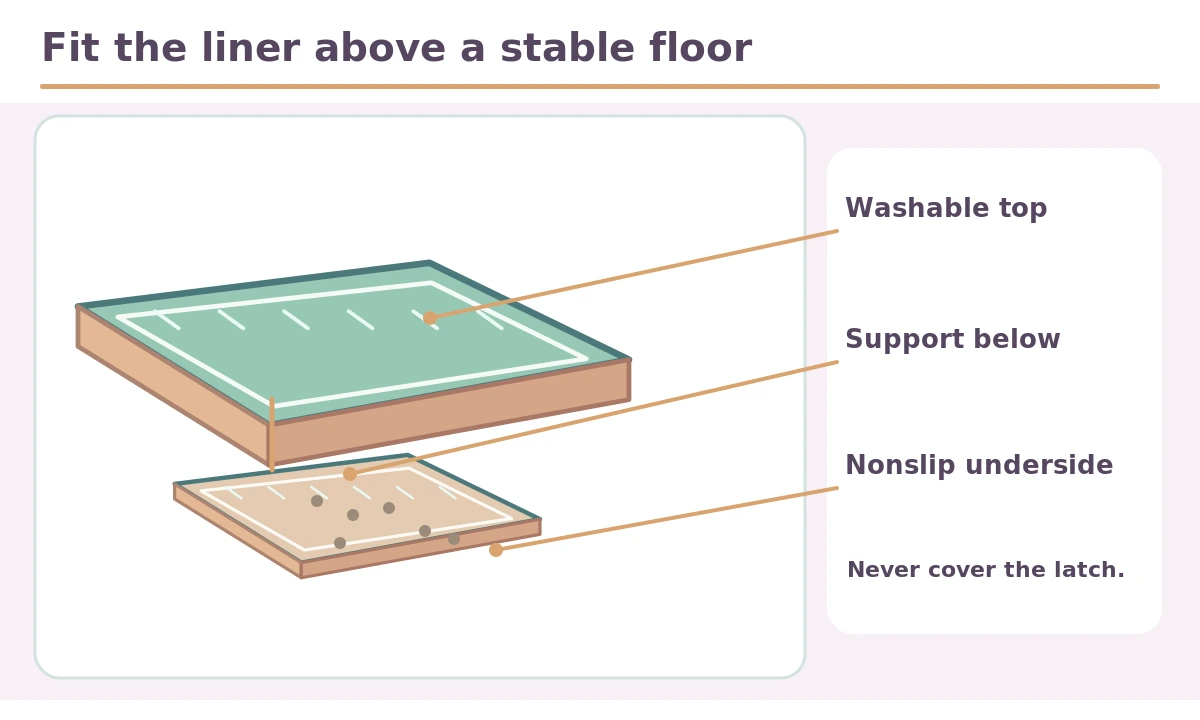
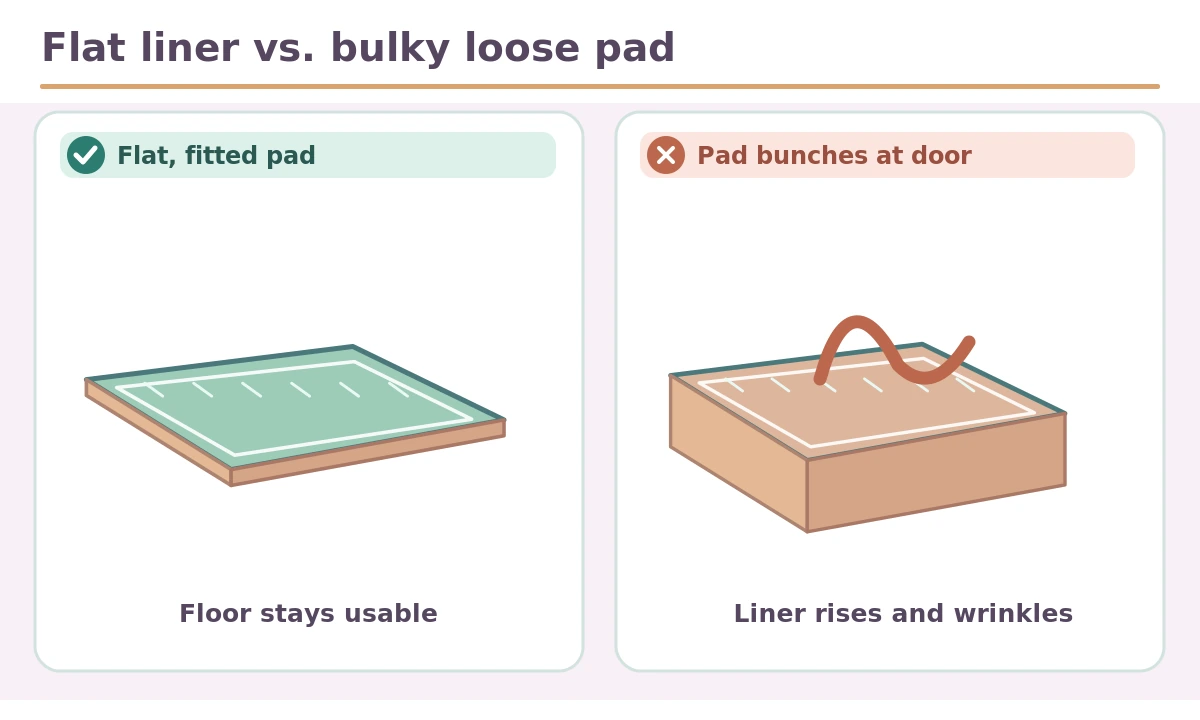
A liner should lie flat when the stroller is parked and remain steady during slow, ordinary steering. Look for a base texture compatible with the stroller floor and for the approved fastening method, if any. Never route a strap around the axle, brake cable, hinge, or seat release. A loose rug can creep toward the front lip when the pet shifts weight. Test the pad empty by pressing and sliding it gently, then observe a calm supervised fit test. If it curls or makes a ridge at the entrance, reject it.
Balance cushioning with usable headroom
Thicker foam is not automatically better. It raises the pet closer to a closed canopy, changes the entry step, and can make turning harder. Support needs vary by the animal; a senior dog with soreness may require veterinary advice about comfortable surfaces rather than an arbitrary thick mattress. The ideal liner fills the floor without lifting the animal into a zipper track. Compare seated and lying posture with the complete canopy closed. Do not use padding to hide a bent floor support or damaged stroller base; repair the equipment first.
Check fabric against paws and claws
Smooth, tightly woven fabrics are often easier to brush clean, while slippery shiny materials can make a dog brace with its paws. Look for snag-resistant seams, firmly attached binding, and no loose decorative buttons, ties, or beads. A cat may knead the pad, so check whether claws pull out threads. Avoid frayed foam, exposed filling, and anything the pet chews or swallows. A waterproof layer may protect the frame but should not create a sweaty, airless bedding surface. The full liner must remain comfortable and breathable in the conditions where you use the stroller.
Keep tethers, vents, and doors clear
Check the path of any interior safety attachment before laying down a mat. Do not conceal a buckle below a thick pad or force a tether through a fabric seam. Keep mesh panels, access zippers, and intended drainage holes free of obstruction. The liner should stop short of parts that rotate or pinch when the canopy closes. A removable insert also should not cover the door latch or a low entry opening. These are stroller-specific checks: verify the maker’s directions instead of assuming a cushion made for a similar model will fit.
Use the care label, not a guessed wash cycle
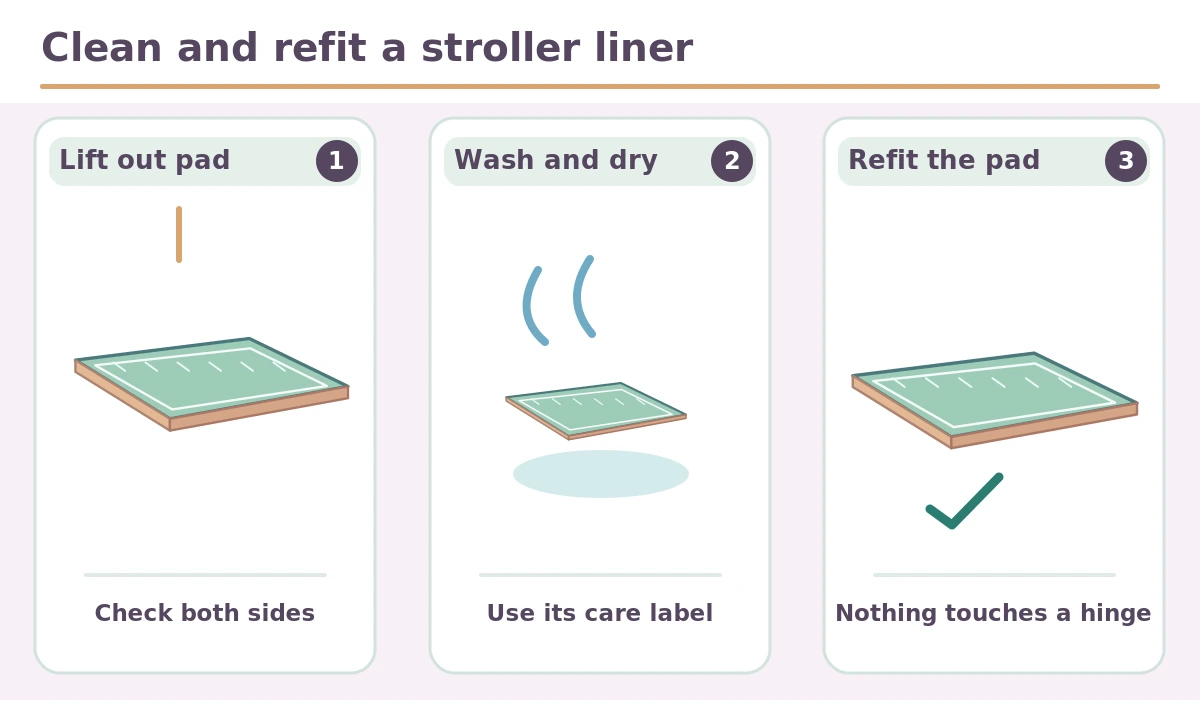
Read the liner’s fiber and foam instructions before washing. Some fabrics are machine-washable while inserts may require spot cleaning or hand washing. Remove loose hair and grit before cleaning, and use a detergent appropriate for the material according to the label. Rinse residues thoroughly and dry every layer as directed. Never put foam into a high-heat dryer unless explicitly allowed. InnoPet notes that removable cushions and washable components vary by model; do not apply one product’s care instruction to a different insert.
Plan for spills and accidents without masking problems
A washable cover is useful for muddy paws or minor accidents, but it does not solve vomiting, repeated incontinence, or heat stress. Stop a ride when bedding becomes soiled and bring the pet to a safe location. Remove contamination while protecting the frame from soaking. Inspect beneath the mat because liquid can hide in creases and metal joints. For repeated bathroom accidents or changes in behavior, talk with a veterinarian rather than relying on a more absorbent pad. A clean, dry cabin should be the default before the next outing.
Inspect the underside after cleaning
The backing often wears faster than the visible top. Look for peeling nonslip coating, cracked waterproof film, loose stitching, and damp trapped underlayers. A sticky coating can also transfer residue to the cabin floor; check a small hidden area if the manufacturer allows that material. Confirm the liner has fully dried before refitting. Store the pad flat or rolled loosely as directed, away from pet access. If the surface feels uneven, smells musty, or sheds pieces, replace it instead of hiding flaws under a blanket.
Test the setup before the next ride
Set the stroller brake, install the clean dry liner, and close the canopy without the animal inside first. Make sure no corner lifts and no edge crosses a seam or zipper. Then allow the pet to investigate and sit naturally while you observe with the stroller still. A dog that keeps digging at a raised corner or struggles to turn may be signaling a fit problem rather than disobedience. Recheck the liner after a few smooth feet on a level indoor surface. Stop and reposition or replace it if it shifts.
Replace with the simplest suitable part
When a liner fails, look first for an official replacement pad that matches the exact stroller model. If none exists, confirm whether a third-party pad meets the floor dimensions, clearance, and approved attachment requirements. Do not modify fixed safety components to accommodate bedding. Keep spare liners simple and easy to dry, especially if you use the stroller often. A durable pad that can be washed correctly and inspected after every outing usually serves a pet better than decorative layers that make the cabin smaller or harder to clean.
How We Research
We compared veterinary and animal-welfare advice about temperature, stress, and secure pet handling with the features and limitations documented by stroller manufacturers. Brand-specific instructions are examples, not universal guarantees; the manual for your exact model controls load ratings, approved accessories, operating steps, and care. We favor practical inspection, secure closure, comfortable fit, and stop conditions over advertising claims. We do not claim to have laboratory-tested individual products. Read more about HubPet and our editorial approach.
Sources
Trixie — Removable Washable Stroller Cushion and Fabric Details.
InnoPet — Cleaning and Maintaining Stroller Fabric.
AKC — Cabin Room and Comfort When Choosing a Stroller.
AVMA — Warm Weather Safety and Pet Comfort.
Only if it fits flat, does not block doors or airflow, and preserves enough headroom and turning space. Many thick dog beds are too bulky.
No. It can raise the pet too high or narrow the usable cabin. Choose appropriate support with veterinary input for pain or mobility concerns.
Use an approved fitted liner or compatible non-slip backing. Never secure loose straps to wheels, folding joints, or brake lines.
Not unless the exact care label permits it. Many inserts need spot cleaning, careful rinsing, and complete air drying.
Replace one that bunches, sheds filling, smells musty after proper cleaning, has peeling backing, or interferes with closures.