
This article provides general vehicle-accessory and pet-care information, not a crash-test certification or veterinary advice. Follow your vehicle and restraint manufacturer instructions. For individual pet health or travel concerns, consult your veterinarian. Read our veterinary disclaimer.
An SUV cargo liner can keep wet paws, fur, and grit away from the vehicle floor and side trim. It cannot by itself protect a dog in a collision. Cargo spaces vary greatly in slope, seatback folds, sidewall shape, and where the vehicle provides approved restraint or cargo anchor points. The key is choosing a removable liner that stays flat and leaves all required travel hardware accessible. These checks help you distinguish a protective floor covering from equipment intended to control movement of a dog or carrier.
Map the cargo area with seats in travel position
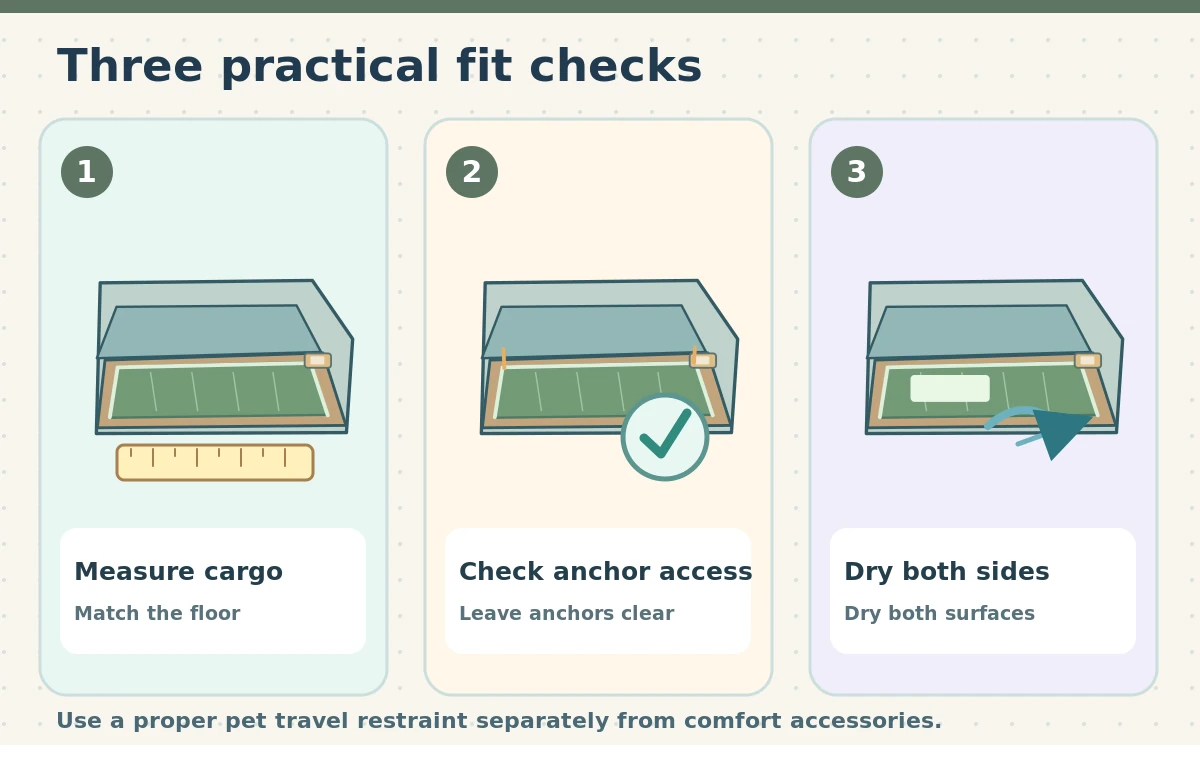
Decide which rear seats will be upright during the trip. With the vehicle parked, measure between the wheel wells, the tailgate threshold, and the back of the upright seatbacks. Measure at both the narrowest and widest points. Record whether the cargo floor slopes or includes raised storage covers. A liner advertised for an entire vehicle class may not match a different model year or seat configuration. Avoid ordering from a rough exterior vehicle width estimate; measure the usable floor itself.
Check traction on top and underneath
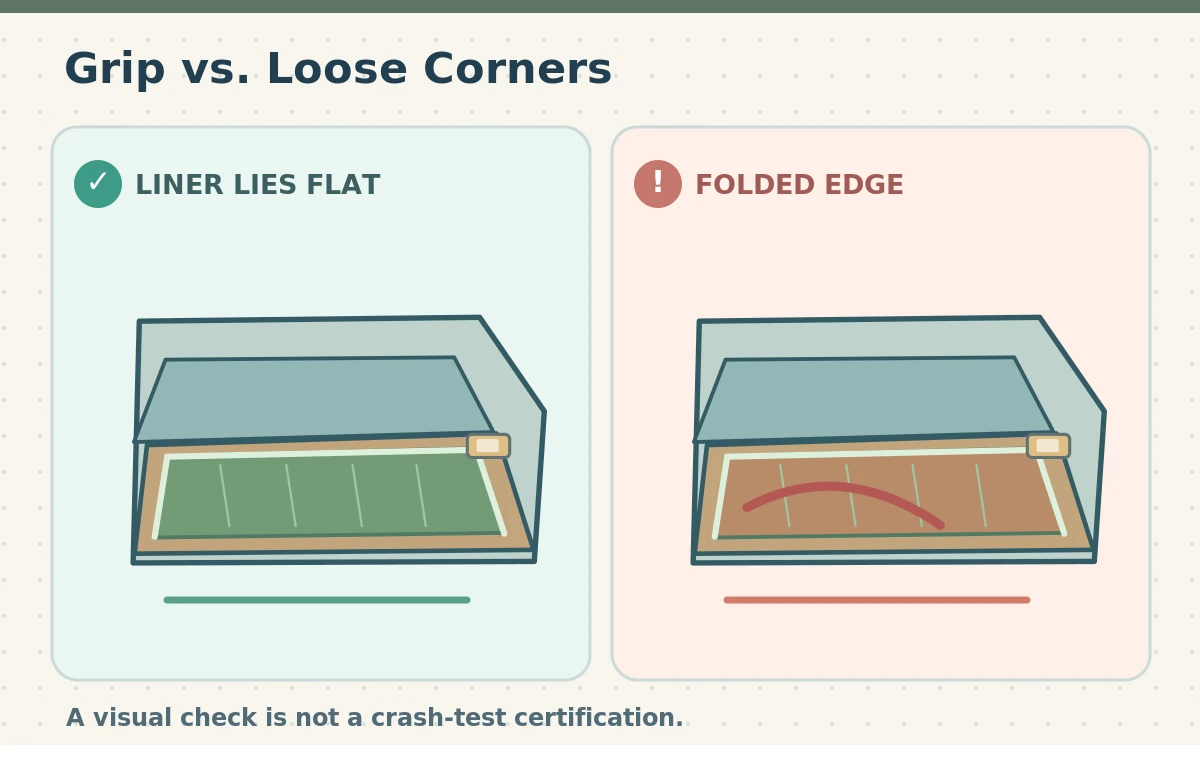
A cargo liner needs enough grip that a covered carrier or other approved cargo does not slide on ordinary turns. Smooth waterproof fabric can become slippery when wet, while a textured rubber top may provide better surface grip. The underside must also sit flat without skating across vehicle carpeting. Do not improvise adhesive that could damage trim or conceal a service panel. Inspect corners for bunching. Even a non-slip liner is not a substitute for securing a travel crate or a dog with an appropriate system.
Match sidewall height to the actual mess
High side flaps can catch mud or protect carpeted wheel-well trim, but oversized flaps may cover vehicle vents, tie-down fittings, or power-liftgate mechanisms. Choose coverage based on where water and grit realistically collect. A low removable tray may clean more easily than a tall fabric shell that folds inward. Check the seam construction because stitched corners may let liquid reach upholstery. Waterproof material slows surface penetration; it does not mean all seams or fasteners are watertight.
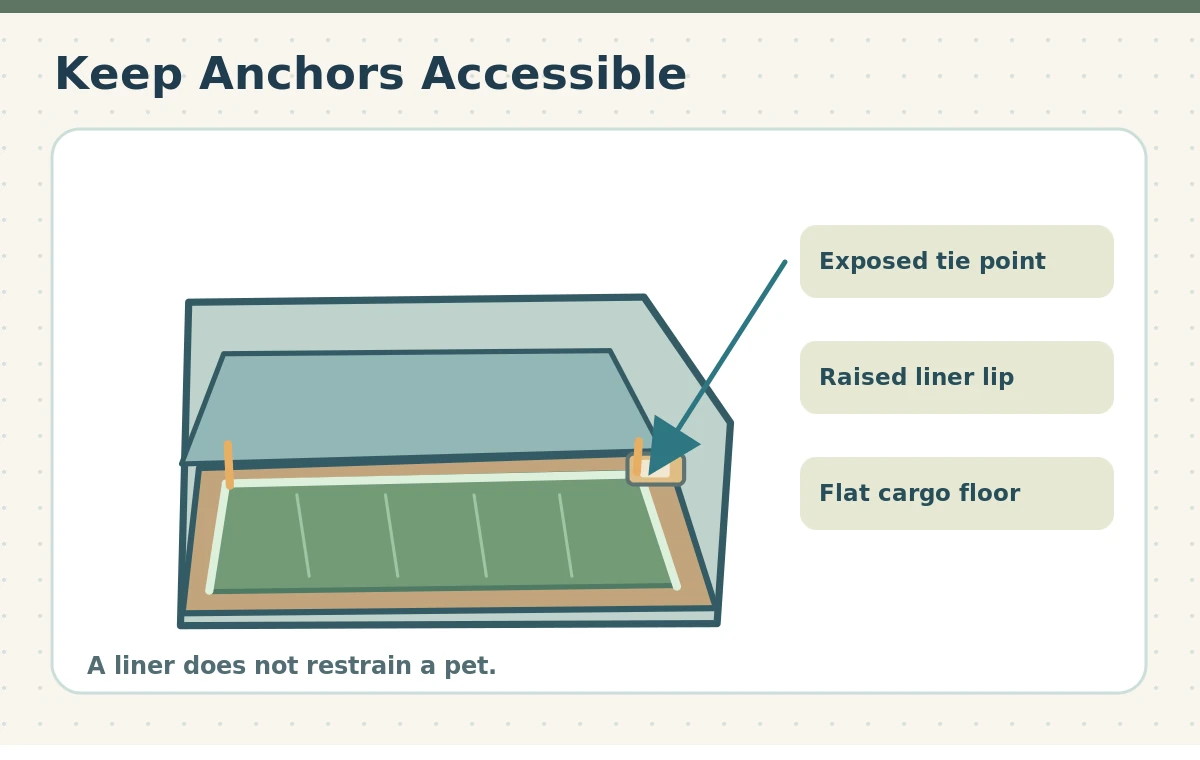
Leave rated attachment points available
Find the manufacturer-designated cargo tie-down points and read the vehicle manual to understand their intended use and ratings. Some anchor loops are designed for luggage, not dynamic restraint loads. A liner opening must not invite you to use a convenient hook as an unverified pet crash anchor. Only use carrier or restraint attachment routes specified by the device and vehicle manufacturer. If a fitted liner covers a necessary access point, choose another liner or cutout model approved for that location.
Inspect the tailgate loading edge
Dogs may step across a metal or plastic bumper lip while entering the cargo compartment. A fold-out bumper flap can help protect paint, but it may also slip or blow under a paw. Check whether the flap folds away fully before the tailgate closes. If a dog needs a ramp, ensure the ramp sits on a stable surface independent of the protective liner. The liner should not alter the hatch latch or seal. Test the closing motion only after the cargo space is empty.
Keep ventilation and climate-control paths open
Some SUVs have rear air vents, battery cooling openings, or cabin airflow passages near the cargo sidewalls. Do not cover them with fabric or stored supplies. Confirm that the dog’s actual secured location receives comfortable airflow. A cargo compartment is not automatically suitable for pet travel; vehicle design and approved restraints determine what is appropriate. PDSA and the American Red Cross emphasize that barriers alone do not necessarily protect a pet in a crash. Safety must be assessed separately from upholstery protection.
Choose a liner that is easy to remove dry
Mud and water can seep under any liner at unsealed cutouts. Pick a design that removes without snagging cargo hooks or tearing delicate trim. After a wet journey, lift the liner and dry both the cargo floor and its underside before putting it back. Use a soft brush for grit, then clean by the care label. Avoid strong fragrances and improvised cleaners near your pet. A liner left sealed over moisture can promote unpleasant odors and make the vehicle difficult to inspect.
Compare trays with quilted fabric systems
A shaped rubber tray is often quick to lift and wipe but may not cover upright seatbacks. Quilted fabric can cover more surfaces and fold for storage, but seams and attachment straps need inspection. For either style, verify that folded backseat arrangements do not change the fit when people ride along. Be wary of loose straps hanging near a dog’s mouth. The best protective design is the one that fits without folding into the passenger area or hiding vital hardware.
Make a safe pre-drive walkaround
Check the tailgate latch, rear seat position, climate vents, liner corners, and any approved restraint device. Secure all travel supplies so they cannot move or strike your pet. The ASPCA advises that carriers should be properly secured and large enough for an animal to change position. Do not place a loose dog on top of a cargo liner and call it restrained. Reassess when cargo is added or a seat row is folded; small layout changes can affect both comfort and access.
Know the limits of a cargo liner
A cargo liner is not a crash-tested harness, kennel, barrier, or anchor system unless independently documented and used for that purpose under explicit manufacturer instructions. Avoid claims that a thick mat will absorb collision forces in a predictable way. Its practical strengths are preserving vehicle surfaces and simplifying cleanup. If you cannot secure the pet appropriately in the cargo location, choose a safer approved rear-seat setup rather than relying on liner grip alone.
How We Research
HubPet compared recommendations from veterinary and animal-welfare organizations, along with principles of vehicle compatibility and ordinary accessory upkeep. We distinguish upholstery protection, sun reduction, and surface grip from devices intended to restrain a pet during a vehicle crash. Specific routing, fit, allowable attachment points, and safety equipment depend on the vehicle and product manuals. This article does not independently crash-test accessories or certify any brand. Our original illustrations demonstrate inspection concepts, not a universal vehicle installation. Read more about our editorial research approach.
Sources
AVMA: Traveling with your dog or cat — source guidance on secure pet travel, ventilation, or restraint limitations.
ASPCA: Travel safety recommendations for pets — source guidance on secure pet travel, ventilation, or restraint limitations.
Merck Veterinary Manual: Traveling by Car With Pets — source guidance on secure pet travel, ventilation, or restraint limitations.
AKC: Dog Car Safety Training — source guidance on secure pet travel, ventilation, or restraint limitations.
American Red Cross: Pet Travel Safety — source guidance on secure pet travel, ventilation, or restraint limitations.
No. Surface traction can reduce ordinary sliding but does not substitute for a restraint or properly secured travel crate.
Keep required manufacturer-approved attachment points accessible and follow vehicle and restraint directions for their proper use.
Not necessarily. Seams, gaps, and folds can allow moisture beneath the liner. Lift and dry it after wet trips.
Not by itself. Some barriers protect occupants from movement but may not prevent injury to the animal.
Only if the crate manufacturer permits it and the crate remains secured according to instructions. The liner must not interfere with attachment.