
This guide provides general educational information, not veterinary diagnosis or treatment. A cat straining to pass urine with little or no output needs emergency veterinary care immediately; do not wait or assume constipation. See the HubPet veterinary disclaimer.
My kitten won’t use the litter box may mean the youngster has not yet found the tray, cannot climb into it, dislikes the litter, may feel overwhelmed by a new home or has a medical problem. Most kittens develop toileting habits quickly when their environment is simple, but an accident is information rather than defiance. Begin with a quiet small home base, a low accessible tray and the litter the kitten already knows. If a kitten strains, appears ill or passes little urine, contact a veterinarian urgently.
Start with a small, welcoming home base
For a newly arrived kitten, place food, water, resting space and a litter tray within one calm room while keeping the tray well away from feeding stations. VCA recommends limiting unsupervised roaming until kittens consistently find and use the litter box. This is not punishment: the room should contain resting places, enrichment, water and safe attention. A large house can be difficult to navigate for a young animal with a short attention span.
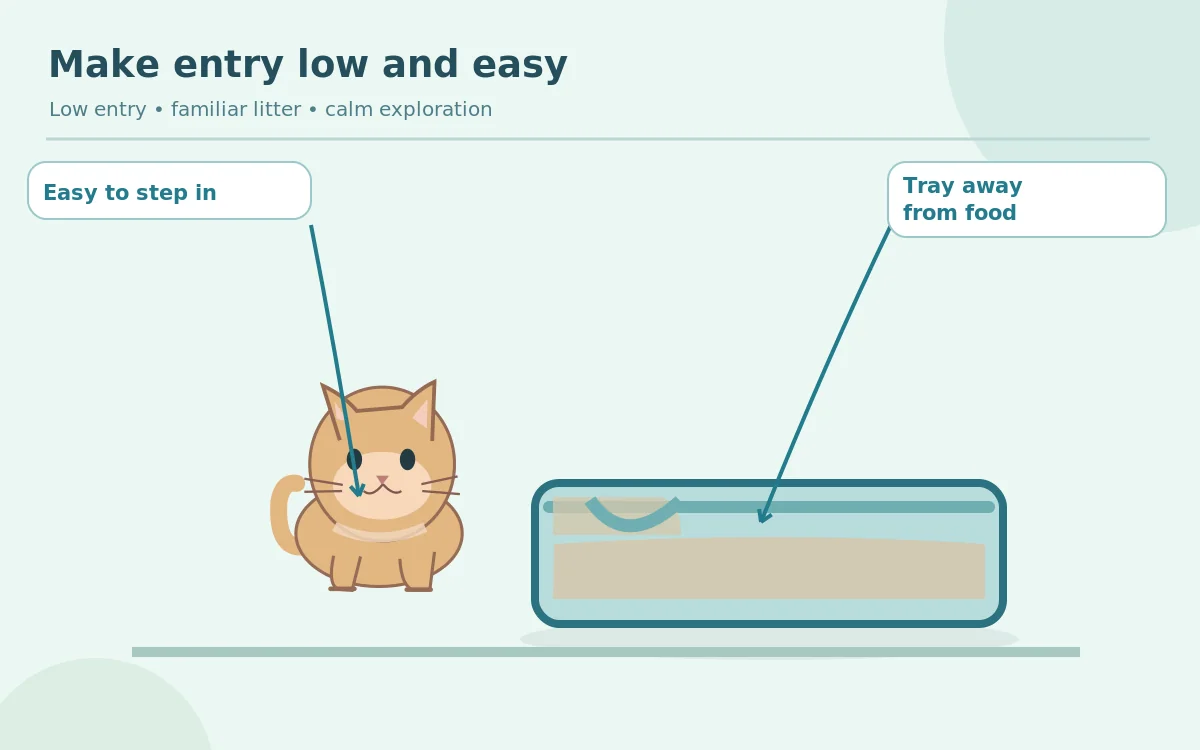
Choose a shallow-entry tray with space to turn; avoid steep-sided storage bins that an eight-week-old kitten must leap into. Place it where the kitten can approach without crossing a dog’s sleeping area or a noisy hallway. Introduce the location calmly when the kitten arrives, but do not pin paws down or force digging. Most kittens investigate litter naturally. Check that any automated unit specifically permits the kitten’s size and age before even considering it.
| Kitten situation | Most useful setup change | Safety check |
|---|---|---|
| New eight-week-old | Low entry in home-base room | Watch appetite and elimination |
| Around three months, exploring | Add reachable trays on each level | No blocked route by other pets |
| Around four months, new accidents | Restore familiar routine | Vet check for sudden changes |
| Kitten avoids scented litter | Offer familiar unscented texture | Use kitten-appropriate litter |
| Box is noisy or self-cleaning | Offer simple quiet manual tray | Check age/weight restrictions |
Use the litter type the kitten already recognizes
Ask a foster carer, rescue or previous guardian which litter the kitten used. Cats Protection recommends keeping that texture initially and changing it gradually if necessary. Young kittens may mouth unusual materials, so follow veterinary advice about age-appropriate, non-clumping options rather than assuming adult clumping litter is suitable. Choose an unscented product and keep its depth comfortable; too much litter can feel unstable beneath small paws.
Scoop daily and gently clean accidents with a pet-safe enzyme product according to the label. Do not use ammonia cleansers, which can leave confusing odors. Keep at least one simple tray available even when the kitten begins exploring other rooms. If a kitten has learned to toilet on soft bedding, protect the area while offering an appropriately textured box near the chosen spot, then move it gradually once use becomes predictable.
- Set up a calm starter room with a low open litter tray away from food.
- Use the familiar, kitten-appropriate litter and scoop waste daily.
- Keep the tray accessible after naps, meals and play without forcing the kitten inside.
- Expand supervised roaming only after reliable use and add trays where needed.
- Contact a veterinarian for persistent accidents, illness, pain or any unproductive straining.

Build a predictable routine without forcing results
When the kitten wakes, after eating and after active play, make the tray easy to reach and allow a quiet opportunity to inspect it. If the kitten uses the box, simply leave the area peaceful. Do not interrupt digging, grab the kitten mid-squat or hold it in the box. VCA notes that many kittens work out the behavior on their own once the box is accessible.
In the first week, gradually expand supervised access to more rooms after consistent tray use. For homes with stairs, add another low-entry tray on a different level so the kitten need not travel far. Keep each box in a quiet, observable location with a free exit. Do not change the litter, tray and room location together; a steady pattern makes it easier to identify what the kitten actually likes.
Troubleshoot by age and ability, not punishment
An eight-week-old kitten may need a lower entry and a closer tray than a confident four-month-old. A three-month-old exploring more rooms may need another toilet route rather than a different litter. A four-month-old that suddenly stops using a previously accepted tray may experience stress or illness; a new accident after reliable training is a reason for veterinary assessment, not a reason to scold.

Watch for diarrhea, constipation, straining, lethargy and changes in drinking or eating. Repeated attempts to urinate with little or no output warrant emergency veterinary care at any age. If accidents persist after basic setup and a veterinary evaluation, ask your clinic about a feline behavior professional. Our box-placement guide covers the longer-term home layout as your kitten grows.
The timing of independent toileting varies with development and history. Very young orphaned kittens require different specialist care than weaned kittens; ask a veterinarian or experienced rescue for age-specific advice rather than applying an eight-week-old routine to neonates. A kitten who was reliably using a tray and suddenly avoids it also needs a closer health check. Keep sessions calm and focus on dependable access, not rewards that distract during elimination.
When to Call Your Vet
Seek immediate emergency veterinary care if the cat repeatedly strains to urinate and little or no urine appears. Contact your vet promptly for sudden house-soiling, blood, pain, abnormal stool, lethargy or a worrying behavior change. Cat behavior guidance does not substitute for veterinary assessment.
How We Research
HubPet checked the specific cat behavior and safety guidance linked below, compared environmental choices with veterinary warning signs, and avoided unsupported product superiority claims. The tables offer decisions a household can observe without diagnosing disease. Read HubPet’s editorial approach for our process. For individual medical concerns, ask your veterinarian to adapt these choices to your pet.
Sources
VCA — How to Litter Train a Kitten — referenced for animal-welfare guidance and safety limits.
VCA — Why a Kitten May Not Use Its Box — referenced for animal-welfare guidance and safety limits.
Cats Protection — Bringing a Kitten Home — referenced for animal-welfare guidance and safety limits.
Cats Protection — Choosing Cat Litter — referenced for animal-welfare guidance and safety limits.
An eight-week-old may be overwhelmed, unfamiliar with the texture or unable to climb in easily. Offer a low-entry tray in a quiet starter room.
A second accessible tray can help when the kitten explores more rooms, uses stairs or cannot reach the first box quickly.
Ask your veterinarian about age-appropriate litter; young kittens may mouth litter and Cats Protection recommends non-clumping options while very young.
You may calmly show the location, but avoid forcing the kitten to remain, moving its paws or frightening it.
Persistent accidents, diarrhea, signs of illness or painful straining need evaluation; repeated attempts with little or no urine require emergency care.