
A dog GPS tracker may help you see a recent location if a dog wanders away, but the technology depends on several separate steps: obtaining a position, transmitting it, and showing it in an app. A convincing map screenshot does not prove the device will work on your usual trail, in your building, or when its battery runs low. This guide covers what to verify before purchase. For pet safety or health questions, read our veterinary disclaimer.
The American Veterinary Medical Association explains that implanted microchips are identification devices, not GPS trackers. A tracker therefore adds a possible location tool; it does not replace a secure leash, visible ID tag, or registered microchip. Our home pet-proofing guide addresses the escape hazards that technology alone cannot prevent.
Understand how a location update reaches your phone
Many pet trackers estimate position from satellite-navigation signals, then use a cellular connection or another communication method to send updates to an app. Those are different capabilities. A tracker may know where it is while having no way to transmit that location immediately. Look for the exact communication method in the official product documentation.
A Bluetooth item-finder works differently: its last reported location may depend on nearby compatible phones. It is not a direct substitute for an outdoor pet-tracking service. Check whether the device reports its last successful location, time of update, and connection status separately. A moving icon with an old timestamp can create false confidence.
Match network coverage to your actual walking areas
Check the provider’s supported countries, local mobile networks, roaming arrangements, and service restrictions. A broad national coverage map is a starting point, not evidence about one park, valley, basement, or vacation location. Ask which communication features continue working when the device has poor cellular service.
List the areas where your dog spends time: home, fenced yard, dog sitter’s address, hiking routes, and trips. Compare service information for those specific places. If the device stores positions while disconnected, find out whether those positions upload later rather than appear live. In an emergency, delayed history and actionable current location are not equivalent.

Examine the age of a location and alert delays
Find out how frequently the device attempts to update in its normal and high-frequency modes. Advertised refresh intervals may depend on battery setting, reception, motion detection, and service. Ask whether the app clearly shows the time of the last successful location rather than only a pin on a colorful map.
Virtual-fence alerts are useful prompts, not a physical barrier. A dog can cross the boundary before a notification reaches you. Test alert behavior in an ordinary, safe situation with the dog on a leash and someone watching it. Do not allow a dog to escape deliberately to verify the feature.
Check battery life for your real schedule
A battery estimate means little without the conditions behind it. Determine whether the stated figure assumes infrequent updates, power-saving mode, or limited outdoor time. More location checks and weak communication signals may change run time. Compare charging time and low-battery warning behavior, not just the longest advertised number.
Build charging into your normal routine and make sure a caregiver knows how to read the device status. Consider whether charging requires removing the tracker from a collar your dog wears for identification. A device that is often left uncharged may have less practical value than a simpler arrangement the household maintains reliably.
Choose attachment and weight for the individual dog
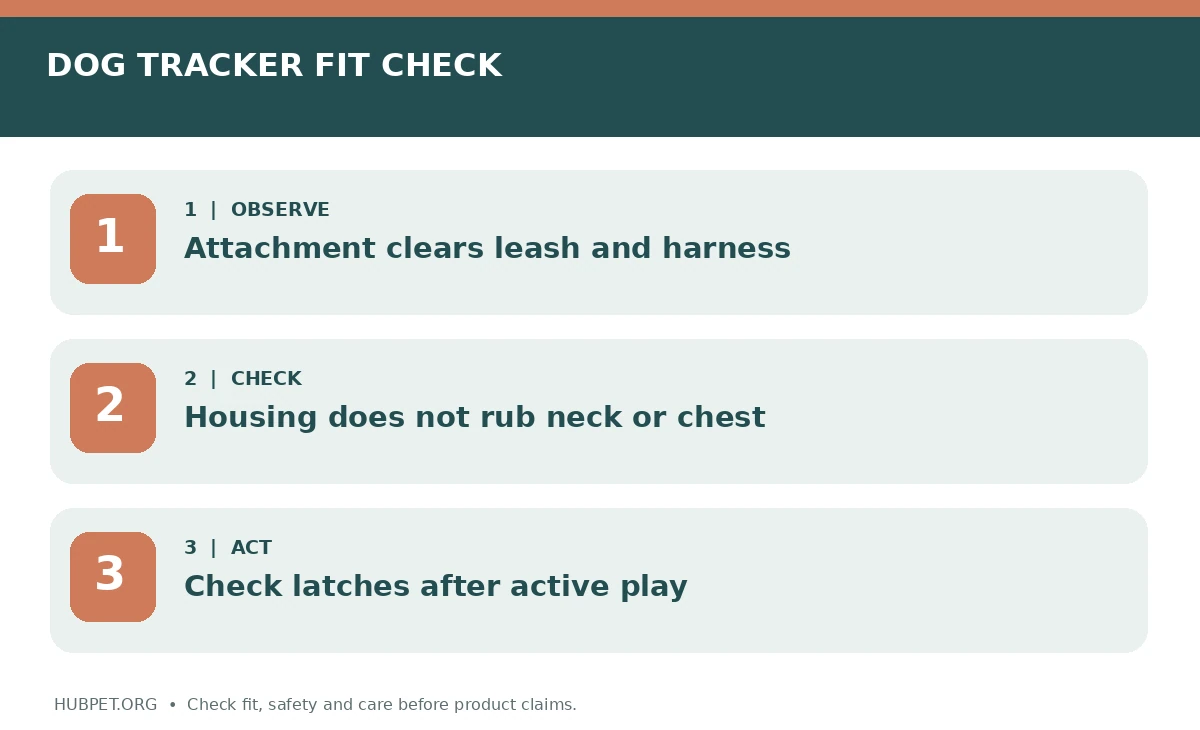
Measure the collar or harness attachment width and confirm that the manufacturer allows the device in that position. Look for a fastener that resists daily play but does not create a sharp edge, dangling strap, or snagging hazard. A unit that feels small in a human hand may still swing awkwardly on a very small dog.
Watch your dog walking, resting, and shaking with the tracker attached. It should not rub the neck, obstruct a harness ring, or interfere with eating. Keep an ID tag accessible and inspect the attachment after active outings. Remove equipment promptly if it causes skin irritation or altered movement, and consult a veterinarian if symptoms persist.
Treat waterproof claims and durability carefully
Read the actual ingress-protection claim and the conditions under which the maker tests it. Resistance to rain is not the same as unlimited swimming, pressure washing, or saltwater exposure. Charging ports, seals, and replacement parts may affect real-world durability. A cracked housing or exposed battery can present an urgent hazard.
Check what a warranty excludes and whether a damaged attachment can be replaced without buying the entire unit. After wet or muddy outings, follow the manufacturer’s cleaning and drying directions. Do not charge a device that shows corrosion, swelling, or water intrusion. Keep loose batteries and cables out of the dog’s reach.
Calculate the full cost instead of the sticker price
A GPS unit may require an activation fee, an ongoing data plan, or paid access to tracking history and alerts. Compare the total expense over the time you expect to use it, including taxes where applicable. Note whether service must be prepaid, renews automatically, or changes with different coverage areas.
A low upfront price may become expensive with a mandatory plan. Conversely, a higher upfront price can still be inappropriate if service fails where you walk. Confirm the return window and cancellation terms before subscribing. Never rely on assumed plan availability from an old review, because service regions and features can change.
Review location history and account privacy
A tracker app can build a detailed record of regular walks, home address, and travel patterns. Read the provider’s current privacy explanation for retention, sharing, account deletion, and access by family members. Use a unique strong password and available multifactor authentication. Remove access for former caregivers or unused devices.
The Federal Trade Commission advises consumers to examine how apps collect and use location information. Keep optional permissions limited to what makes the service work. Think carefully before publicly sharing a map screenshot that exposes where you live or regularly exercise your dog.

Run a controlled setup test before trusting alerts
Charge the tracker, install official updates, confirm the account and plan, then check location timestamps outdoors in a place you know. With your dog safely restrained, test whether the app updates and whether a low-battery warning appears. Repeat where a trusted sitter would use the system. Document any steps that require internet access.
Practice switching the phone to airplane mode to see what information remains accessible; do not mistake a cached map for a fresh fix. Verify how support and cancellation work while you are still in the return period. Treat an unexpected outage as a reminder to use ordinary safety measures, not as a reason to take risks retrieving a signal.
Keep a recovery plan that works without the tracker
Maintain readable ID tags, an accurate microchip registration, recent photographs, and secure gates and leash attachments. Know who to call and where to search if your dog goes missing. A tracker may provide one piece of evidence, but its absence or a delayed map does not establish where the dog is now.
If your dog is fearful, prone to slipping gear, or escaping when a door opens, work on the underlying management and training plan. Our recall training guide helps with everyday practice. The safest buying decision is one that improves your response options without replacing prevention.
How We Research
We prepared this guide using animal welfare guidance and practical questions owners can ask about size, materials, supervision, fit and safe use. We did not purchase or independently test products, and we do not rank brands or claim veterinary endorsement. On October 26, 2026, our editorial review considered these sources. Learn more about HubPet and our editorial approach. This material does not replace advice for a specific animal from its veterinarian.
Sources
American Veterinary Medical Association: Microchipping: FAQs for Pet Owners. Accessed October 26, 2026.
American Kennel Club: Dog Microchip: Why Microchipping Matters. Accessed October 26, 2026.
Federal Trade Commission: Online Shopping. Accessed October 26, 2026.
No. A microchip provides a permanent identification number when a compatible scanner reads it; a tracker attempts to report location and can lose power or attachment.
That depends on the product and transmission method. Some devices may record positions offline, but those records might not reach your phone until connectivity returns.
No virtual fence physically confines a dog. Notifications can be delayed or missed, so use proper fencing, leash management and attentive supervision as primary safeguards.
Many use paid communications or app plans, but terms differ. Check the current official requirements, renewal cost and which features stop if a plan expires.
Follow the actual battery readings and manufacturer guidance. Test location freshness and alerts before relying on a tracker during walks, travel or pet-sitting.