
A cat tunnel can be a hideout, a route between play stations, or a place to pause before pouncing. It does not need lights, dangling attachments, or elaborate claims to be useful. Good choices start with enough room to turn, stable openings, accessible exits, and a fabric your cat tolerates. This guide focuses on practical inspection rather than ranking products. For sudden changes in play or mobility, read our veterinary disclaimer.
The ASPCA includes cardboard tunnels among simple ways to enrich a cat’s home. Cats Protection emphasizes the value of quiet hiding places that a cat can leave voluntarily. A tunnel can contribute to both, but it should not be the only retreat. If you are building a larger activity area, see our enrichment corner guide.
Decide whether the goal is hiding, chasing, or passing through
Observe how your cat uses chairs, boxes, rugs, and open doorways. Some cats want a covered rest spot and dislike crinkling materials. Others enjoy short bursts of chase through a straight route. A tunnel with many branches may be entertaining for one cat and unsettling for another. Choose the shape based on real behavior.
For an anxious newcomer, a calm, low-traffic hideaway can be more useful than a noisy play tunnel in the center of a room. For an active young cat, a tunnel beside a wand-toy play area offers a clear purpose. Remember that the animal should always be free to enter or exit without human interference.
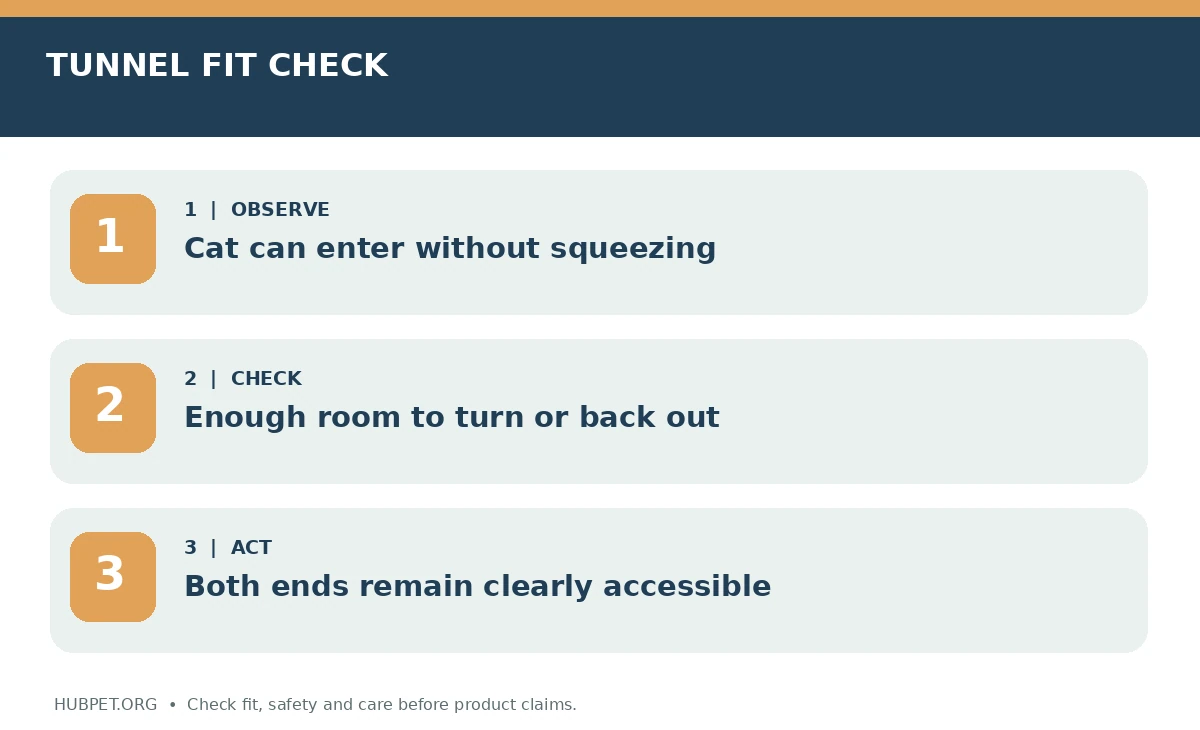
Measure the opening and actual internal width
Product photographs can make a tunnel look larger than its usable interior. Compare opening diameter and clear length with your cat’s body and preferred posture. A long, fluffy-coated cat must be able to move through without pressing its face against fabric. Check for seams that reduce room inside the advertised dimensions.
A tunnel too small for turning can become uncomfortable if a cat meets another animal at the far end. A spacious straight tube with openings at both ends is often easier to assess than a maze with blind pockets. Do not assume a tunnel labeled for kittens will remain suitable as the animal grows.
Make sure there is a clear escape path
Look for two open ends whenever possible, plus side exits on longer or branching tunnels. The entrance should hold its shape so a cat does not have to squeeze through a collapsing ring. Avoid arranging furniture so the tunnel terminates against a wall or is blocked by a door.
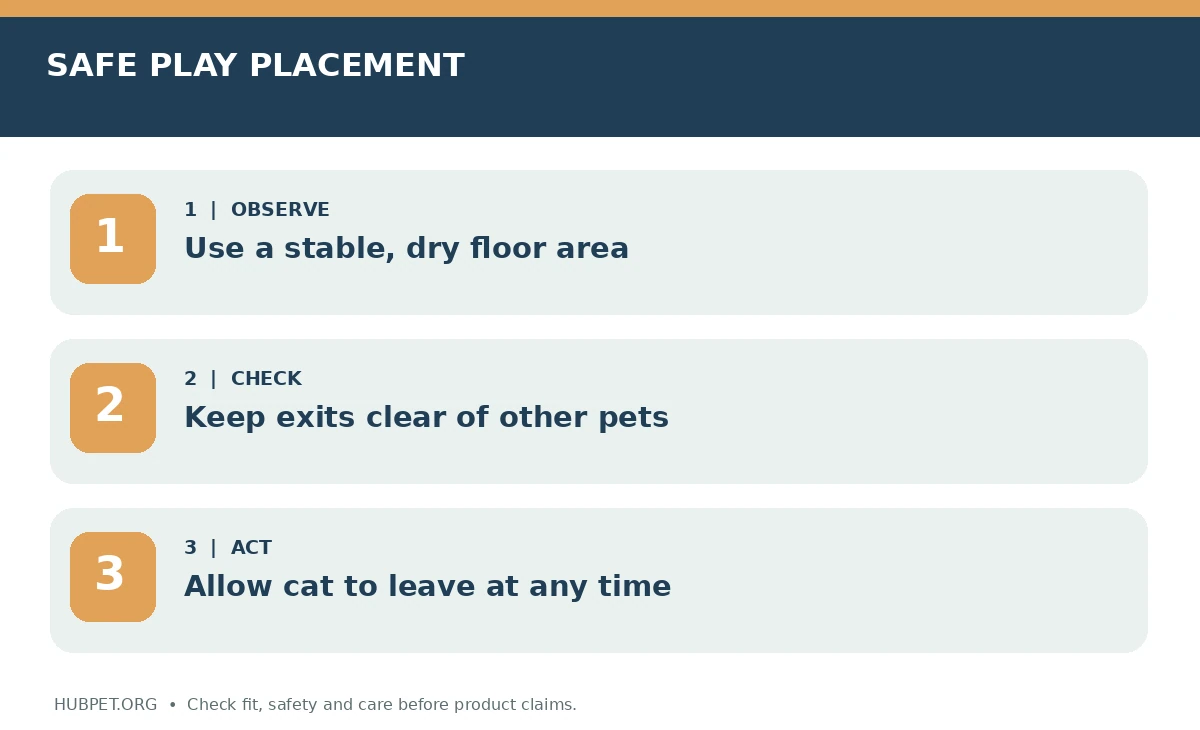
If you have several pets, set the tunnel where one cat cannot guard its only exit. Never reach into a tunnel and pull an unwilling cat toward you. Cats Protection advises leaving a hiding animal undisturbed. A tunnel used for rest should stay a safe choice, not become a trap during handling or play.
Inspect fabric, stitching, rings, and hidden wires
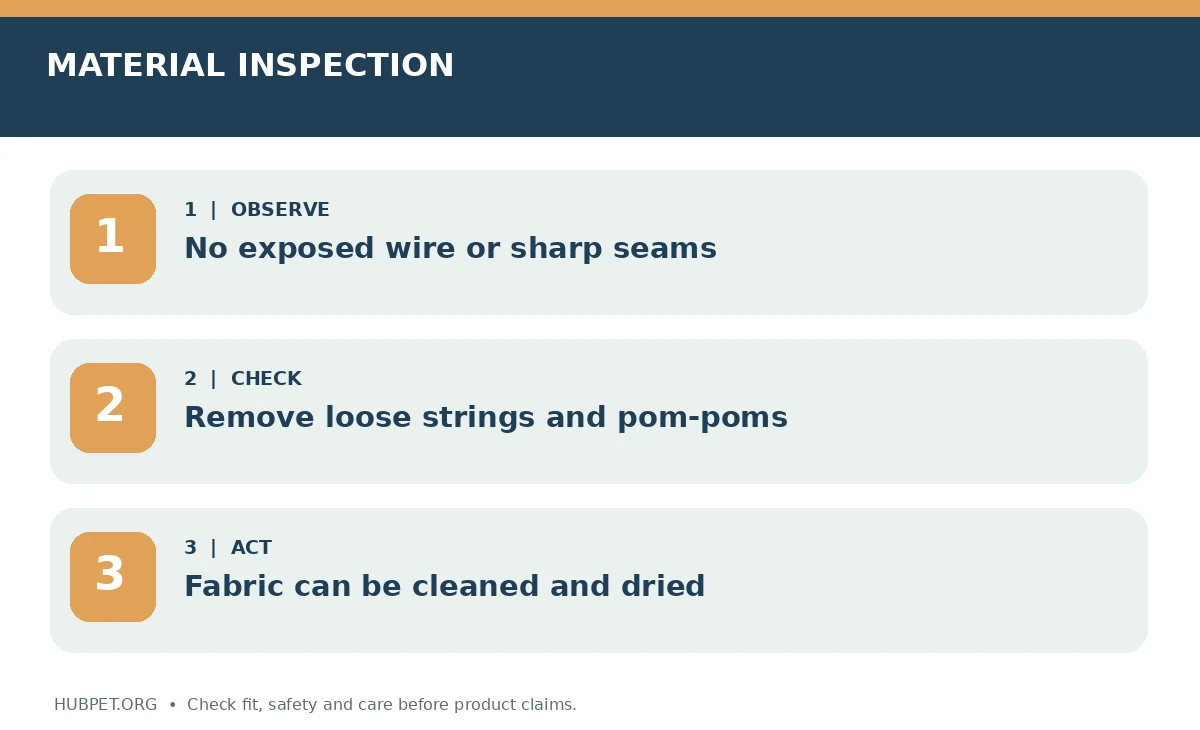
Feel along the full inner seam before first use. No sharp wire tips, exposed staples, loose elastic, or torn lining should touch a cat. Pop-up designs often have spring-like supports inside a fabric sleeve; damage to that sleeve can expose a rigid end. Reject a unit with a wire already pressing through its covering.
Choose surfaces that tolerate routine cleaning and dry completely. A flimsy crinkle layer may be irresistible to a playful cat but can produce fragments if chewed. Remove and replace the tunnel if the cat starts swallowing parts. A safe enrichment object should not require you to ignore evidence of damage.
Assess attached toys as separate hazards
Dangling pom-poms, feathers, cords, and elastic attachments may increase interest during supervised play. They also create a potential entanglement or swallowing risk. Check whether attachments can be removed or secured outside play sessions. The ASPCA recommends active supervision when cats access do-it-yourself enrichment items.
A tunnel remains useful even after a risky toy attachment is taken away. You can place a separate wand toy just outside the entrance during an attended session, then store the wand afterward. Avoid leaving long strings or small detachable objects in a tunnel where they are hard to notice.
Compare straight, crinkle, and branching designs
Straight fabric tubes have a predictable route and are easier to inspect. Crinkle tunnels add sound and texture; start cautiously with noise-sensitive cats. Branching models provide choices but also more concealed seams and potential dead ends. Large exterior openings alone do not guarantee that each branch stays fully usable.
Foldable designs save storage space if their closure system is secure. Verify that ties, loops, and storage straps cannot hang loose while the tunnel is open. A tunnel that snaps upright unexpectedly or folds down during a chase should not remain available. Stability under normal play matters more than decorative features.
Choose a floor location that supports easy play
Lay a tunnel on a dry, level floor away from stairs, exterior doors, heaters, or furniture that may shift. Hard slippery flooring can make a lightweight tube slide during fast play. A low-slip mat beneath the tunnel can help if the mat itself lies flat and cannot bunch into a tripping edge.
Place the tunnel near, not directly across, a regular walking route. Some cats prefer an opening beside a sofa while others favor a quiet bedroom corner. Watch the cat’s first few sessions to learn whether it feels safe moving through both directions. Do not block a litter box or water station.
Use play sessions without overstimulation
Invite the cat to investigate with a familiar toy nearby rather than pushing it inside. During interactive play, move the toy across an entrance and allow pauses between chases. The cat should be able to capture the toy occasionally and end the session. Stop if breathing, movement, or body language suggests distress.
Rotate the tunnel with other enrichment so it stays interesting without crowding the floor. See our toy rotation guide for a simple approach. A cat that curls up in the tunnel instead of running through it may still be using the item exactly as intended.
Check comfort in multi-cat homes
A tunnel can create an ambush point. For cats that play cooperatively this may be harmless fun; for cats in conflict it may intensify blocking or chasing. Observe ear positions, attempts to leave, and whether one cat routinely monopolizes the entrance. Add multiple hiding areas rather than expecting one passage to serve everyone.
Position tunnels so each cat has alternatives away from feeding and toilet spaces. If one animal repeatedly hides from another, address the household relationship, not just the equipment. Keep the option to retreat into a quiet room available and avoid using play sessions to force social interaction.
Plan cleaning and replacement before purchase
Check whether the tunnel can be wiped, vacuumed, or washed according to the maker’s instructions. Hair and dust collect in folds and pocket seams. Let washed fabric dry completely before use; damp hiding spaces can become unpleasant. Regularly inspect the parts of a tunnel that touch the floor or fold for storage.
Compare replacement cost with build quality and your cat’s interest. Cardboard can be a temporary tunnel when it has no sharp cut edges or tape accessible for chewing. However, discard damaged materials promptly. A low-cost product that stays clean, holds open, and provides clear exits can be the most practical purchase.
How We Research
We prepared this guide using animal welfare guidance and practical questions owners can ask about size, materials, supervision, fit and safe use. We did not purchase or independently test products, and we do not rank brands or claim veterinary endorsement. On October 26, 2026, our editorial review considered these sources. Learn more about HubPet and our editorial approach. This material does not replace advice for a specific animal from its veterinarian.
Sources
ASPCA: Feline DIY Enrichment. Accessed October 26, 2026.
Cats Protection: Our Guide to Indoor Cats. Accessed October 26, 2026.
Only leave out a structurally sound tunnel appropriate for your cat. Remove strings and small attachments, inspect seams and wires, and put it away if chewing or damage occurs.
Two clear exits make movement and escape easier, especially where several pets share a room. On longer models, side openings may help prevent another pet blocking access.
Choose an interior wide enough for your particular cat to move comfortably. Check usable measurements rather than relying only on labels such as kitten or large cat.
A covered space may feel sheltered and quiet. If the animal looks comfortable and can leave freely, resting can be a worthwhile use of the tunnel.
Neither is universally better. Some cats enjoy crinkling textures while sound-sensitive cats avoid them. Offer a short supervised introduction and respect your cat’s preference.