
This guide is general education, not individual veterinary advice. If your cat or dog becomes unwell, is injured or may have swallowed a toy component, seek veterinary advice promptly. Read the HubPet veterinary disclaimer.
A feather on stick cat toy may look simple, but the safety of that toy depends on how securely the manufacturer attaches the feather bundle, whether the handle or joint has sharp edges, and whether your cat tends to chew off and swallow pieces. A rigid stick with a short attached feather bundle is not necessarily the same as a fishing-pole wand with a long line. Compare the real connection rather than buying solely on bright colors, and supervise every session. Cornell Feline Health Center advises caution with toys that have detachable feathers and strings; VCA also warns that ingestion can become serious. This guide is for inspecting and selecting a feather stick toy, not a claim that any feather design is safe for unsupervised access.
Choose by construction, not feather color
Look at the point where the feather meets the stick. An exposed wire, sharp metal staple, loose glue blob or tiny plastic bead is a reason to pass over a toy. Gently examine the tip without pulling it apart: the bundle should not shed pieces under normal handling. A firm, comfortable grip helps the person move the toy predictably without putting fingers near claws. The toy should be large enough that a cat cannot readily swallow a detached tip. Some cats shred feathers instantly; for those individuals, a single-piece cloth or sturdy felt lure may be easier to inspect than fragile real feathers. VCA and Cornell both recommend judging the specific cat’s chewing habits, not simply the label “interactive.”
| Construction check | Prefer | Reconsider or reject |
|---|---|---|
| Feather connection | Fully enclosed secure join | Exposed wire, staples, loose beads |
| Shaft | Smooth handle without splinters | Cracked wood or sharp plastic |
| Feather bundle | Intact feathers that withstand light handling | Loose barbs falling onto the floor |
| String or elastic | No long trailing line for stick-style play | Loop that could wrap around a paw |
| Replaceable tip | Secure maker-approved connection | Tiny loose fittings a cat could swallow |

Inspect the feather stick before every session
Make a habit of checking the whole toy while the cat is elsewhere. Roll the handle in your hand for splinters and look down the joint for gaps. Check the feathers against a light background for missing pieces. Clear the floor of cords, breakables, open stair edges and small toys that the cat might accidentally chase instead. Choose a low, open path and let the cat approach. A feather on stick cat toy can imitate prey without making the cat jump straight upward repeatedly. Play is a shared activity: put the stick away in a closed drawer or cabinet immediately afterward so the cat cannot gnaw the bundle or wrap up in any attachment while alone.
- Inspect the stick for cracks, splinters and sharp edges; reject damaged toys before the cat sees them.
- Examine the feather joint and remove any toy with loose pieces, wire or detachable decorations.
- Clear a short ground-level play route, especially for kittens and older cats with limited mobility.
- Move the lure away from the cat in short pauses; allow a controlled catch rather than frantic, endless chasing.
- Count and collect any loose feather pieces after play; store the entire toy out of the cat’s reach.

Which feather-stick style fits the cat?
The difference between a good interaction and a risky one often lies in the cat’s response. A lively adult may enjoy a brisk ground-level chase, but a timid cat may simply watch a slowly moving tip from under a chair. Kittens may mouth and bite everything, so soft but sturdy lure material and close oversight matter more than speed. A senior cat may benefit from a feather lure that moves across the floor or a low blanket, not a high leap. Our guide to low-impact play for older cats explains how to adapt the movement. There is no universal “best” feather material; choose based on actual wear and behavior.
| Cat or setting | Useful adjustment | Stop or change when |
|---|---|---|
| Curious kitten | Short, slow supervised movements | Tip is chewed or parts loosen |
| Energetic adult | Brief ground chase with catch breaks | Frantic collisions or rough panting |
| Older cat | Slow arcs and reachable catches | Stiffness, limping or reluctance |
| Strong chewer | Consider one-piece durable fabric lure | Feathers or fittings break off |
| Multi-cat room | Separate play turns, clear space | One cat guards the toy or corners another |
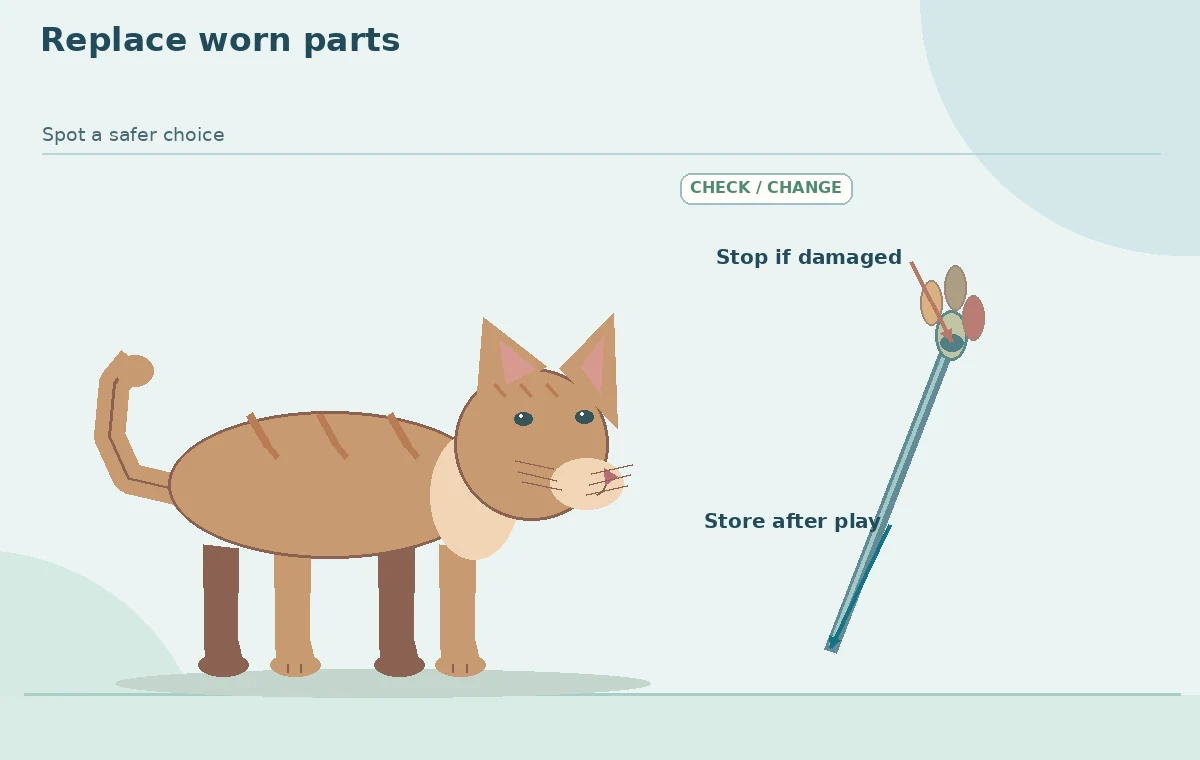
Safer play does not end when the cat catches the lure
Offer a few successful catches, then finish with a pause so the session has a natural ending. Never swing a feather stick close to the cat’s face, jab with the handle, or drag the cat by a lure held in its mouth. Do not deliberately pull against a cat’s teeth or let a small kitten hang from a toy. If the cat starts chewing the feather bundle, trade calmly for an approved treat or another durable toy and remove the stick. Do not punish; prevention and a change of toy are more reliable. Throw a damaged toy away instead of returning it to the toy basket.
If the cat refuses to play, try slower movement or a different texture on another day. Cats often enjoy short sessions and toy rotation; do not pressure an uninterested cat to participate. Watch for signs of overstimulation such as rigid posture, sharply lashing tail or sudden grabbing at your hand, then create space and end the game. For other low-cost enrichment, see indoor-cat enrichment ideas. This buying checklist deliberately separates the safety of the attachment from the actual game: a sturdy toy still requires active supervision.
When to Call Your Vet
Contact a veterinarian promptly if your cat may have swallowed a feather, string or detachable fitting, or develops repeated gagging, vomiting, discomfort or a change in eating. Do not pull visible string from the mouth or rectum and do not induce vomiting at home.
How We Research
We compared the attachment and ingestion warnings published by Cornell and VCA with the feline welfare guidance on supervised predatory play from the AAFP/ISFM guidelines. The criteria describe construction, not endorsement of a particular retailer or claimed product lifespan. Checked in November 2026. For editorial context, learn about HubPet.
Sources
Cornell Feline Health Center — Safe Toys and Gifts; VCA Animal Hospitals — Cat Behavior and Training: Play and Play Toys; VCA Animal Hospitals — Dos and Don’ts of Kitten Toys; AAFP and ISFM — Feline Environmental Needs Guidelines.
No. Put away feather and wand-style toys after supervised play. Loose feathers, strings and small joints can become swallowing or entanglement hazards.
Discard it if a feather detaches, the stick cracks, the join shows wire or the cat can chew off small components. Do not tape damaged fragments back together.
Neither material is automatically safer. Focus on secure construction, individual chewing behavior and a tip that stays intact during closely supervised play.
Yes, some enjoy slow ground-level pursuits and easy catches. Limit jumps, adapt to comfort and discuss sudden reluctance to move with your veterinarian.
Stop play and contact your veterinarian for guidance, especially if string or hardware might also be involved. Avoid trying to make the cat vomit or pulling on a visible strand.