
Cat feather toys are appealing because they flutter, pause, and move like prey. The problem is that a loose feather, broken quill, or dangling connector may also invite chewing or swallowing. The best play starts before the toy moves: check the attachment, choose enough distance for a safe chase, and keep the floor clear. Use feather wands for brief interactive sessions and store them securely afterward. Never assume that natural feathers, brightly colored feathers, or a strong-looking clip make the assembly safe without inspection.

Identify every part from grip to feather
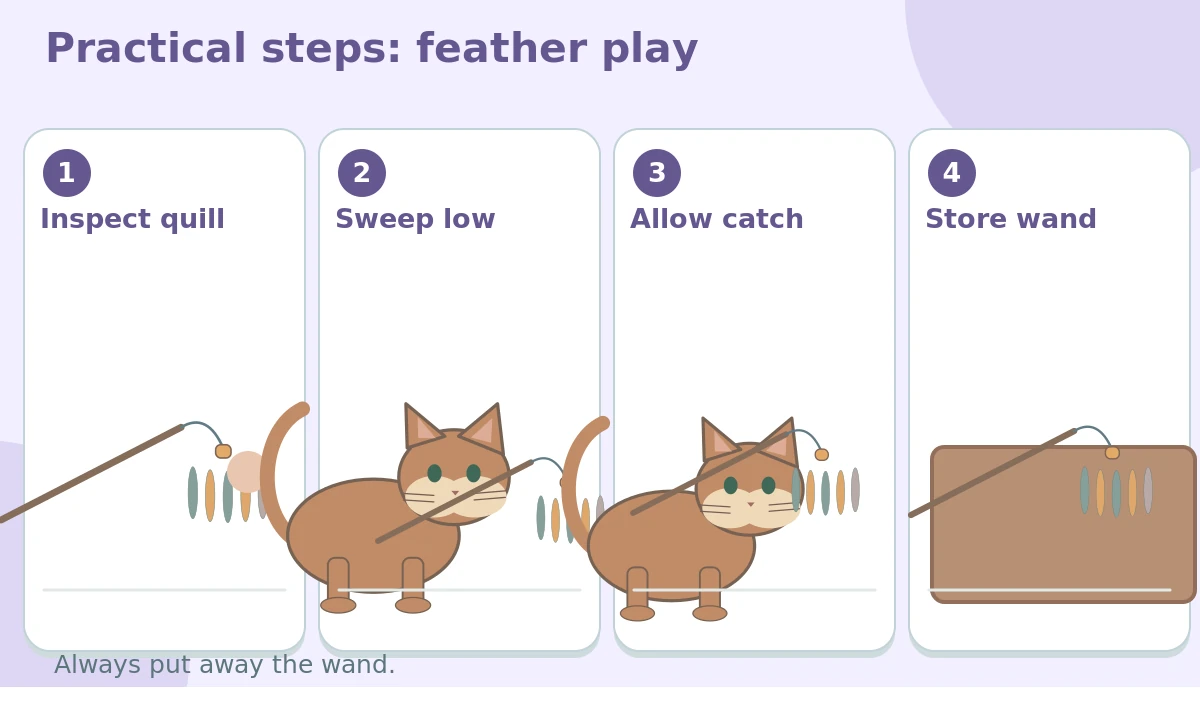
Place the toy on a table away from your cat. Locate the handle, flexible rod, connector, line, swivel, knot, feather bundle, and any decorative bell. Not all toys contain these components, but anything present should be secure. Move the parts gently to look for splitting, frayed line, bent wire, exposed points, or loose adhesive. Test the connection with a gentle hand pull, not a violent tug that damages the product. If feathers already fall out or the clip opens unexpectedly, retire the attachment. Do not hide a weak joint behind new tape that the cat could chew.
Assess feathers and quills up close
Run your eyes along the central shaft and tips. A sharp broken quill can irritate a mouth, while cats may swallow loose small feathers during excited chewing. Some attachments use synthetic fibers that fray into strands. Stop play when the bundle is shedding or damaged. Never purposely invite a cat to chew a hard plastic or metal attachment to “finish the catch.” Choose a soft, intact toy large enough for safe handling, but even good-quality feathers need supervision. Check after every active session, especially when the cat has bitten the lure.
Use the wand to imitate escape and pauses
Move the feather along the floor or around a low, open obstacle rather than shaking it constantly above the cat’s head. Pause behind a chair leg, let the cat watch, then move it across the rug. A few short chases are often more satisfying than endless rapid motion. Allow the cat to catch the lure at intervals, as Cats Protection recommends for prey-style play. Keep the route free of hard furniture corners and do not make the cat leap onto shelves or jump from heights. The wand should guide play, not pull the cat’s body into an awkward position.
Keep a comfortable distance from face and paws
Hold the handle far enough away that claws do not rake your hand when the cat lunges. Never flick the lure into the cat’s eyes, ears, or nose. Avoid whipping a stiff rod around children or other animals. When the cat catches the feather, allow a short hold before gently moving again; do not yank it from the mouth. If the cat bites the line or metal clip rather than the feathers, stop and swap for a safer toy. A long wand can give the cat room to move while protecting human hands, but it requires responsible handling.
Compare feather clusters with other attachments
A compact feather tuft may be easier to inspect than a mix of long strings, bells, and ribbons. Large bundles offer fluttering motion but can conceal a broken connector. Synthetic flutter strips may last differently from real feathers, yet can fray and become another swallowing hazard. Bell attachments add sound but also introduce a small removable component. There is no universal safest material for every cat. Choose an attachment whose entire construction you can see and examine. If your cat compulsively chews feathers, try a different interactive toy without easily detached fibers.

Recognize the point to stop play
Look for normal stalking, soft-bodied movement, and brief pounces. End the game if the cat pants, loses coordination, becomes markedly agitated, or begins tearing pieces off. Older cats or cats with mobility concerns may prefer slow ground-level moves rather than aerial jumps. Do not insist on a full sprint. A cat that watches intently and bats once can still be engaged. The goal is enjoyable, voluntary hunting-style activity, not exhaustion. If activity causes pain or unusual breathing, stop and seek veterinary guidance rather than shortening the string and trying again.
Store string and rods fully out of reach
After play, examine the feather for missing pieces, then put the complete toy in a closed drawer or cabinet. Do not leave a wand dangling from a door, draped over a cat tree, or tucked under a couch with the line exposed. Strings and ribbons can entangle a cat or cause severe harm if swallowed. Cats Protection advises keeping string-like toys out of reach when cats are alone. Store replacements and detached feather bundles the same way. Give the cat sturdy, inspected solo-play choices while the interactive wand is put away.
Clean and replace without unsafe fixes
Read the manufacturer’s cleaning instructions. Some feathers lose integrity when soaked, and adhesives may soften. If the lure becomes saliva-soaked, set it aside to dry where the cat cannot access it, then inspect it again. Do not use strong scents or household disinfectants on a material that the cat will mouth unless the product instructions permit them. Replace a frayed line, loose swivel, or shedding bundle with a manufacturer-approved attachment when possible. Avoid home repairs with exposed wire, staples, or decorative glue. A damaged lure should leave the play rotation, not return because it still looks colorful.
Fit the game into a varied enrichment routine
Cats enjoy different modes of activity. Pair a short feather-wand session with a predictable chance to eat, groom, or rest rather than demanding another sprint immediately. Rotate other safe toys and provide scratching and climbing options that match the cat’s mobility. A household with several cats may need individual sessions in separate rooms to prevent crowding. Do not use a feather lure to provoke a fearful cat out of hiding. Let the animal choose when to participate, and give each cat a route away from the play area. Consistency matters more than buying many attachments.
When a feather incident needs immediate help
If a cat swallows a feather bundle, line, hook, or other part, contact a veterinarian promptly. Do not pull string visible from the mouth or rear, and do not induce vomiting without veterinary direction. Watch for repeated vomiting, drooling, distress, decreased appetite, or abnormal behavior, but do not wait for symptoms if you witnessed ingestion. Save the remaining attachment or a product photo so the veterinary team knows what is missing. Repeated attempts to eat feathers or persistent changes in play may also justify a veterinary consultation. Prevention begins with inspection and secure storage.
How We Research
We reviewed practical play and environmental-enrichment guidance from established animal welfare organizations and veterinary teams. We prioritized direct supervision, safer materials, clear opportunities to stop, and cleaning. These drawings explain handling principles; they cannot establish product certification or suitability for every pet. See our editorial information and veterinary disclaimer. Ask a veterinarian about pain, swallowing hazards, dietary restrictions, or sudden behavior changes.
Sources
Cats Protection — Cats and Play — guidance on practical enrichment, play, welfare, or food safety.
Cats Protection — Going on Holiday Without Your Cat — guidance on practical enrichment, play, welfare, or food safety.
VCA — Behavior Management: Enrichment and Activity Toys — guidance on practical enrichment, play, welfare, or food safety.
Yes. Loose feathers or attached parts may be ingested. Supervise every feather session and retire damaged lures.
No. Store the wand, string, and detachable lure in a closed location that the cat cannot access.
Use short ground-level movements and pauses, with opportunities to catch the lure. Avoid forced high jumps or jerking it from the mouth.
A bell adds a removable small component. Check attachment security carefully and avoid bells for cats that chew them.
Contact a veterinarian promptly. Do not pull visible string or induce vomiting without veterinary instructions.