
General education only, not individual veterinary advice. If your pet appears unwell, is in pain, or may have swallowed a dangerous object, contact a veterinarian promptly. Read HubPet’s veterinary disclaimer.
A 72 inch (183 cm) cat tower sounds like a simple six-foot purchase, but height alone says little about comfort, stability or how easily a cat can reach the highest perch. This height is about 183 cm (72 inches); the maximum width, base dimensions, ceiling clearance and arrangement of steps vary by model. A narrow base with tall isolated perches may work differently from a wider tower with more intermediate platforms, even when both advertise 72 inches (183 cm). Start with your cat’s movement and preferred resting habits, then measure the room and the largest usable perches. This article compares dimensions and safety features rather than declaring a brand winner. VCA and Blue Cross recommend enriched climbing and high resting places, while older or mobility-limited cats may need easy routes with smaller steps.
Read the size label as four separate measurements
For a 72 inch (183 cm) cat tower, ask for total assembled height, footprint at the floor, widest span of the upper branches, and the distance between usable levels. Six feet is the height only; a product can spread far beyond the base because of baskets and side platforms. As a real manufacturer example rather than a recommendation, Globlazer’s S72 specification lists 72 inches (183 cm) of height with a base of 21.6 by 19.6 inches (55 by 50 cm), while the retailer example from Tractor Supply describes a different 72-inch-class tower with a 30 inches (76 cm) of width and 26.7 inches (68 cm) of depth. Those dimensions are model-specific and show why a generic “6 ft cat tower” filter cannot guarantee room fit.
| Check this dimension | Why it matters | How to verify |
|---|---|---|
| Overall height: 72 inches (183 cm) | Must fit beneath ceiling | Measure clear height of assembled tower |
| Base width and depth | Stability and walking-space footprint | Get actual product base measurements |
| Widest upper spread | May interfere with doors or furniture | Check overhangs beyond base |
| Perch usable surface | Cat must sit and turn comfortably | Look at internal perches, not outer trim |
| Vertical step gaps | Affects kittens and stiff older cats | Review complete side view and movement needs |
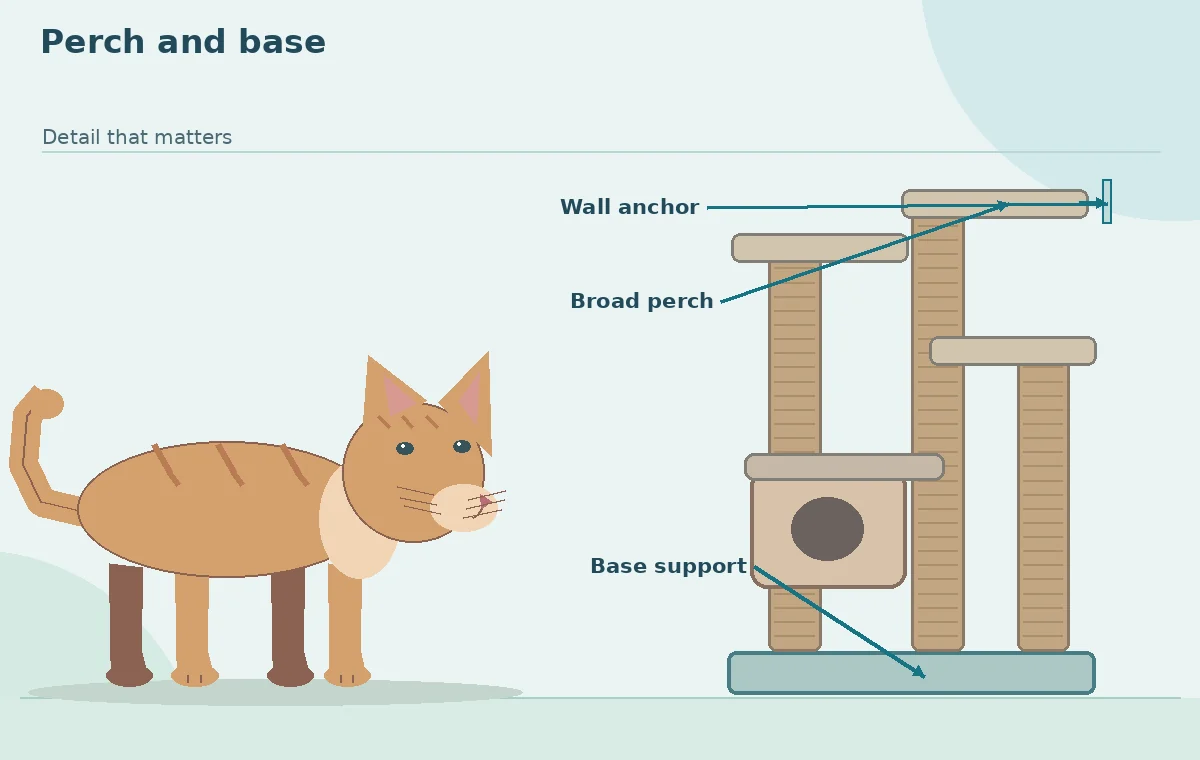
Choose stable supports, usable perches and an approved anchor
Taller structures have more opportunities for leverage when a cat jumps sideways onto a high platform. Examine how the base connects to the posts, whether high perches have one or multiple supports, and whether the product includes an anti-tip or wall-anchor kit. Follow the maker’s exact mounting instructions for the correct wall type; do not improvise adhesive hooks as a safety anchor. Place the tower on a stable level floor, recheck all fasteners after assembly, and keep it away from unstable shelves, open stairs, hot appliances or breakable items. Compare the manufacturer’s load limits, especially with more than one cat. “Heavy duty” is meaningful only when dimensions and supported uses are documented.
- Measure ceiling height and the full floor footprint, including a clear approach for the cat.
- Check the width of the actual resting perch and whether the cat can sit or lie securely without overhanging.
- Assemble every post, platform and connector to the maker’s specifications before allowing access.
- Use any specified wall anchor or anti-tip system with correctly installed hardware for the surface.
- Watch the first jumps. Stop use if the tower rocks, shifts, flexes dangerously or a joint works loose.
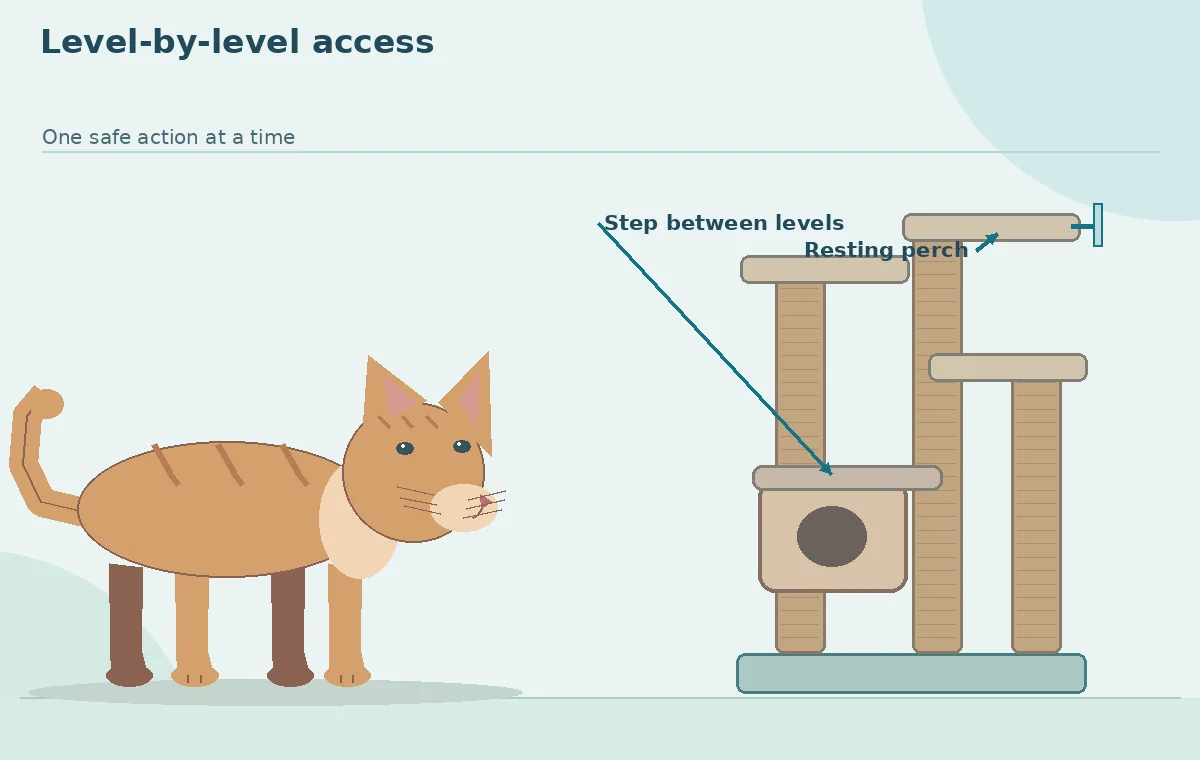
Match the climbing route to the cat, not the number of levels
A lively young cat may enjoy multiple perches and a higher viewpoint, whereas an older cat with stiff joints may choose lower, wider landings and gentle routes. Blue Cross explains that movement-friendly intermediate levels can help cats with arthritis reach their preferred areas. VCA notes that elevated resting places are valuable enrichment. Look for routes that do not require one long jump from the floor straight onto a distant shelf. Make sure the upper ledges have enough usable area and no distracting loose hanging strings that can entangle a cat. Compare designs with large-cat stability criteria rather than trusting a category label alone.
| Cat or room need | Choose this feature | Avoid this mismatch |
|---|---|---|
| Active adult climber | Secure multilevel route with landing points | Wobbly single-post overhang |
| Large-bodied cat | Wide supported perches and suitable load limit | Small circular shelves with little room |
| Older cat with reduced mobility | Shorter steps and reachable lower rests | Single long jumps between levels |
| Multi-cat home | Several routes and separate resting spots | Only one narrow bottleneck |
| Small apartment | Measured footprint and safe placement | Tower that blocks doors or vents |
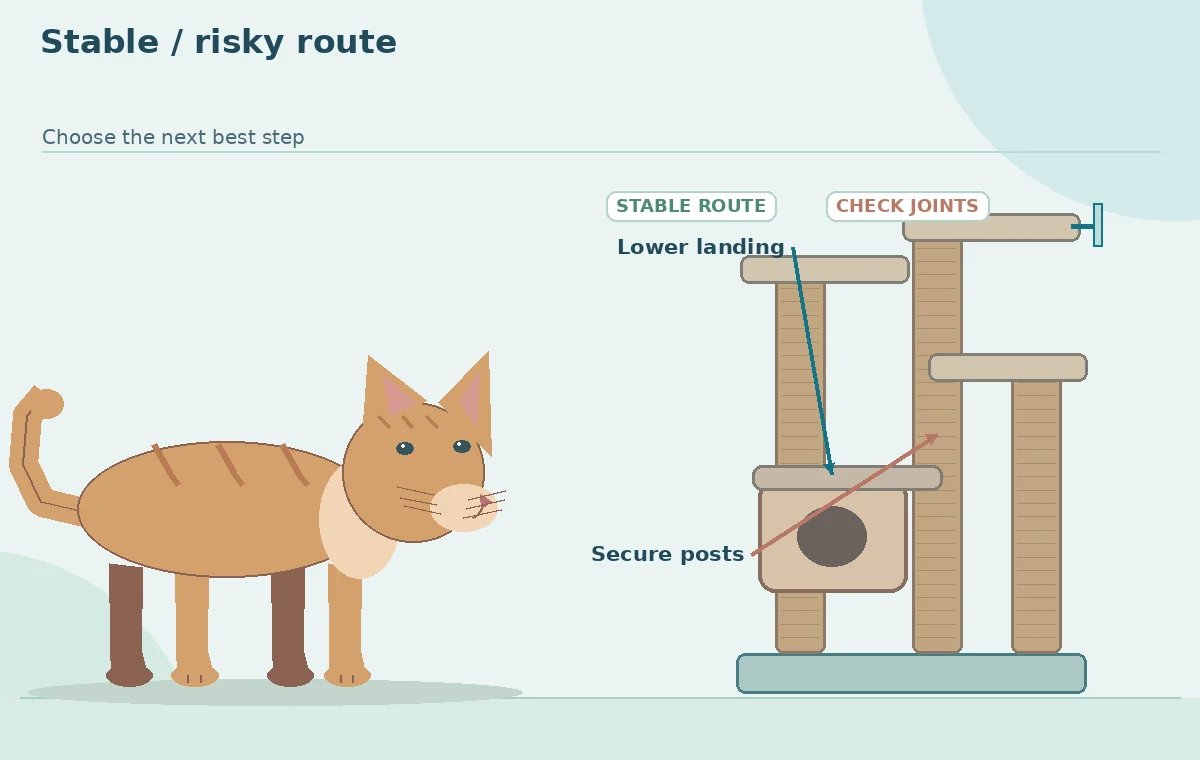
Install, observe and recheck a six-foot cat tower
Before buying, mark the base and wider platform overhangs on the floor with painter’s tape. Confirm room for the door to swing and space to install a wall anchor if the manufacturer requires one. During assembly, keep tiny screws and packaging away from cats, ensure each thread is engaged, and follow instructions rather than guessing the order. Once built, gently test the object without an animal aboard and verify no part rocks. Encourage exploration with treats or play at lower levels; do not place a fearful cat at the top. If a cat avoids a leap, provide an alternate route instead of encouraging a difficult jump.
Monitor wear: re-tighten joints according to the assembly instructions, inspect sisal or carpet for swallowed fibers, and replace cracked platforms or defective fittings. For low-impact enrichment, see gentler cat play options and safe climbing layouts. The safest tower is one your cat can use willingly, in a room where it stays stable. A 70 inch (178 cm) or 72 inch (183 cm) cat tower is not automatically an upgrade from a shorter stable design, especially if the cat needs wide landings and accessible routes.
When to Call Your Vet
Ask your veterinarian about a cat that suddenly stops jumping, limps, appears painful after landing or has a major change in mobility. A taller tower should not be used as a test of a cat’s physical ability.
How We Research
We used VCA and Blue Cross welfare guidance for elevated enrichment and mobility, then checked two current manufacturer/retailer specifications to demonstrate why 72-inch towers differ in base size. Product examples are descriptive only, not endorsements or fixed rankings. Sources checked in November 2026. Read more about our approach on the About page.
Sources
VCA — Cat Behavior and Training: Play and Play Toys; Blue Cross — How to Play With Your Cat; Blue Cross — Arthritis in Cats; Manufacturer example — Globlazer S72 Cat Tree Specifications (updated November 2026); Retailer example — 72-inch Cat Tower Dimensions and Wall Anchor.
72 inches (183 cm) is the nominal height. Measure the finished tower and confirm ceiling clearance, including platforms and any decorative overhang.
Only if the perch dimensions, support structure and manufacturer load limits suit the individual cats. A tall narrow tower is not automatically more stable.
Follow the exact product instructions. Many tall towers include anti-tip hardware; use the specified anchor and appropriate wall fixings rather than assuming the base is enough.
Some can, especially with closely spaced stable steps and broad platforms. For stiffness or pain, favor accessible lower levels and ask a veterinarian about mobility changes.
No. The two-inch height difference tells you nothing about base width, perches, spacing, supports or anchoring. Compare complete assembled dimensions.