
This guide provides general pet-product information, not veterinary advice. For new pain, illness, suspected ingestion, or movement changes, contact a veterinarian; read our veterinary disclaimer.
Some cats carry soft toys, nibble textured edges, or enjoy briefly gripping a toy while they kick. Others chew fabric, cords, or plastic in ways that make toy selection especially important. No material is automatically safe for every cat and there is no chew toy that is indestructible. The practical goal is to choose a shape the cat cannot swallow whole, avoid pieces that could break off, and supervise until you understand its play style. If a cat persistently eats nonfood materials or starts chewing unusually, ask a veterinarian rather than treating it as a shopping problem.
Distinguish mouthing from swallowing
A cat may lightly mouth a plush toy after pouncing without trying to remove pieces. Another cat may bite through seams and ingest stuffing. Watch what happens to the item during the first few play sessions: is the cat licking, carrying, chewing, shredding, or swallowing? The answer matters more than the claim that a toy is “chew proof.” Stop play if your cat removes or tries to eat pieces. If you suspect ingestion, contact a veterinarian promptly and do not induce vomiting or attempt home treatment without professional instruction.
Pick a size the cat can control safely
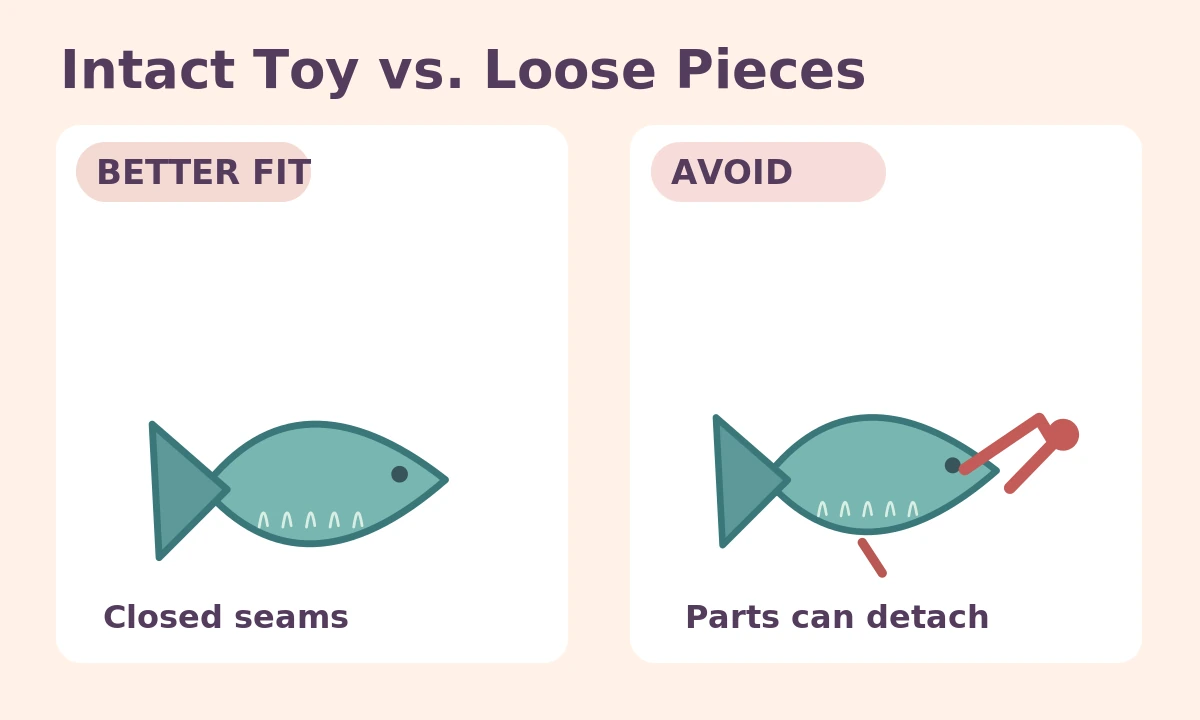
A toy should be light enough to carry or bat yet large enough that the cat cannot easily take it completely into the mouth. There is no universal inch measurement because cats have different mouth sizes and play styles. Examine the narrowest flexible section, not only the toy’s largest end. A long soft body with a tight seam may be easier to grasp than a tiny hard bead or ring. Avoid models whose decorative parts become separate small objects when tugged. Recheck size as kittens grow and their play becomes stronger.
Compare plush, fabric, and molded options
Plush toys can be gentle on the mouth and satisfying to carry, but stitching, filling, and attached eyes need inspection. Woven fabric may tolerate repeated batting but can unravel into long strands. Molded rubber or silicone products should have a maker-stated pet use and should not split into chunks during biting; a familiar-looking human item is not an automatic substitute. Hard plastic can crack or develop sharp edges. Choose based on the individual cat’s behavior, keeping in mind that changing texture can change how the cat bites.
Treat dangling pieces as supervised accessories
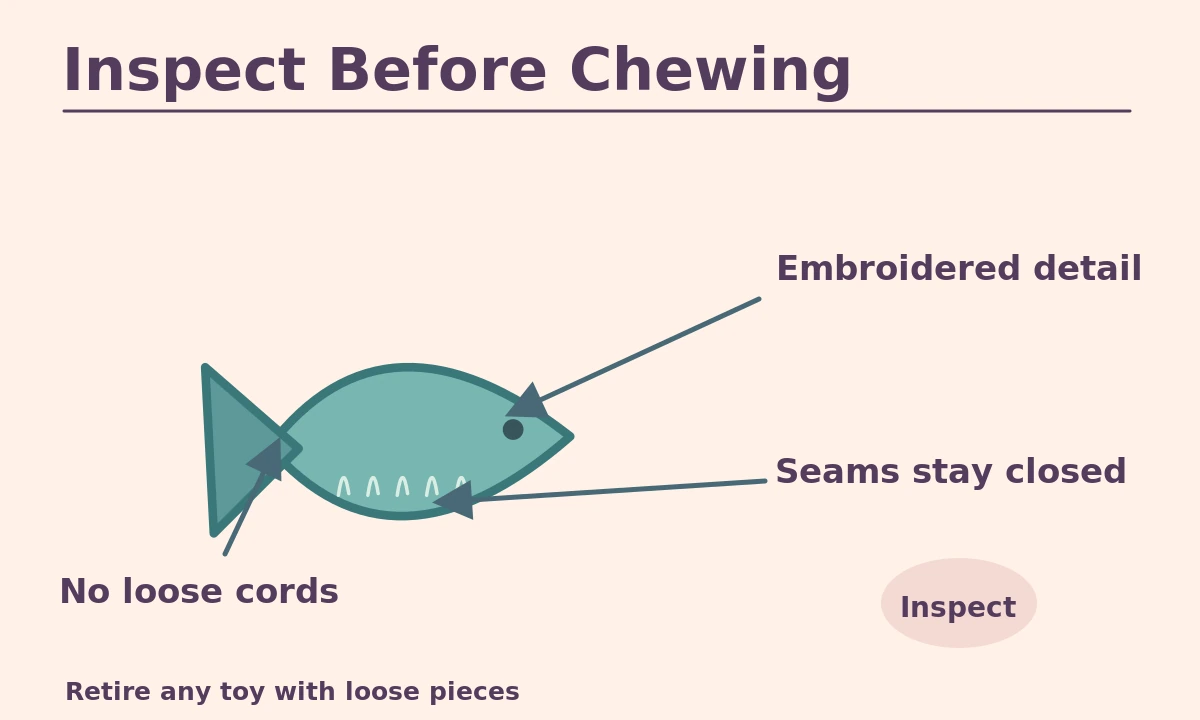
Feathers, bells, ribbons, yarn, glitter, and glued-on ornaments can make a toy look appealing while adding a swallowable or entanglement risk. A cat that tears at attachments needs a simpler toy. Even if decorative parts feel secure today, inspect them before every session. Do not leave string or ribbon toys unattended where a cat can chew off a length and swallow it. Keep packaging film, staples, and plastic ties away from the play area. If a bell housing opens, retire the toy rather than replacing it with a loose bell.
Check seams and stuffing deliberately
Gently compress a new plush toy and inspect the entire perimeter, especially corners and the edge a cat naturally grips. A stitch line with loose loops, an open gap, or stuffing visible is not suitable for chewing. If your cat routinely opens seams, stop buying that type instead of sewing it back with long dangling thread. Inspect again after each active session. Once the toy loses its shape or shows an exposed insert, discard it. Replacement is often safer than hoping the animal will not notice a newly accessible component.
Use play to learn what appeals
Offer the toy on the floor and let the cat investigate without placing it in its mouth. Make a small movement or slide it a short distance, then stop so the cat can catch it. Some cats prefer to chew after a chase; others will only bat. Rotate choices if interest fades, but keep a familiar favorite available. Do not rub unknown oils or strong scents onto chew toys, and do not force contact with a cat’s teeth. Interest and comfort are more useful indicators than a toy’s advertised novelty.
Know the limits of catnip and silver vine
Products sometimes combine chew textures with scented plant stuffing or sticks. Not every cat responds to catnip or silver vine, and stimulating scent does not make a damaged toy safe. Read the manufacturer’s ingredients and age guidance, inspect splinters or loose pieces, and stop if the cat becomes distressed or attempts to swallow fragments. Evaluate each plant stick for the individual cat; a pet catalog listing does not guarantee safety. Ask your veterinarian about a cat with unusual chewing or known medical concerns.
Do not buy a chew toy as dental treatment
A toy may give a cat an enjoyable activity, but it is not a substitute for professional dental examination or a veterinarian-recommended oral care plan. There is no basis to promise that an unspecified chew toy removes tartar, treats gum disease, or prevents pain. Sudden resistance to eating, drooling, bad breath, pawing at the mouth, or new one-sided chewing warrants veterinary advice. Do not use extremely hard objects in the hope that they will scrape teeth clean. Favor comfortable, controllable play instead of forceful chewing.
Set a simple inspection and storage routine
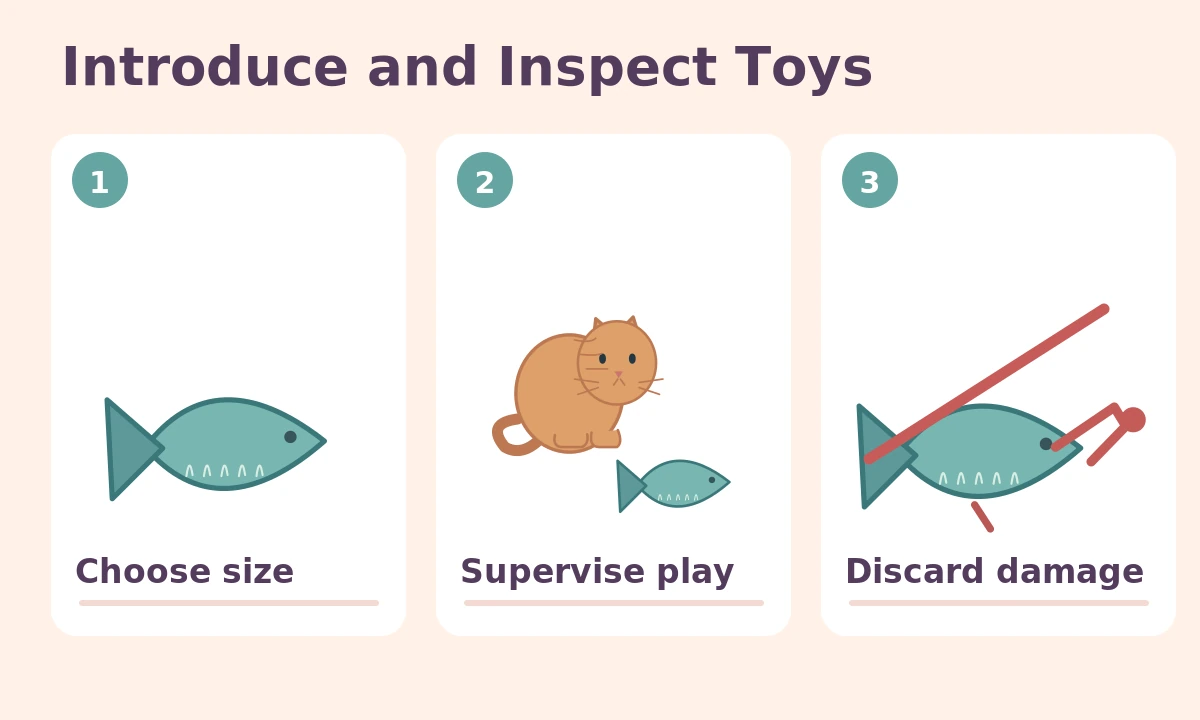
Keep a designated basket for intact toys and a discard pile for anything damaged. Look at seams, attachments, bite marks, and any exposed core before you offer a toy. Supervise unfamiliar items closely; store wand strings and detachable lures outside the cat’s reach after interactive play. Wash only as the maker instructs and allow full drying before reuse. If a toy is difficult to clean, collects food, or remains damp inside, replacing it may be more reasonable than repeatedly using an item you cannot inspect.
Make the final choice without hype
Compare a plain well-made toy with a feature-heavy model. The simpler item often has fewer failure points and can be just as engaging when used interactively. Prioritize suitable size, intact construction, predictable material, smooth edges, and a play style you can observe. A product that sheds pieces during the first session has failed your household test regardless of price. Give the cat alternative outlets such as a safe puzzle feeder, interactive chase game, or scratcher so all enrichment does not depend on chewing one object.
How We Research
Our research approach compares design and safety considerations with published feline behavior and care guidance from veterinary organizations. Product dimensions, structural load ratings, fasteners, and installation restrictions vary by model; check the current manufacturer instructions before use. We do not claim hands-on laboratory tests, safety certification, veterinary diagnosis, or that one product fits every cat.
Sources
VCA, Cat Behavior and Training: Play and Play Toys. Read source.
VCA, Behavior Management: Enrichment and Activity Toys. Read source.
FelineVMA, Your Cat’s Environmental Needs (2026). Read source.
Safety note: Inspect cat furniture and toys for damaged parts before use. Supervise unfamiliar equipment and remove anything unstable or swallowable. For pain, altered movement, persistent chewing of nonfood items, or suspected ingestion, contact a veterinarian; this buying guide is not veterinary care.
Neither category is automatically safe. Soft toys can expose stuffing or threads, while hard toys can crack or have sharp edges. Match the toy to your cat’s habits and inspect it closely.
Only if the manufacturer permits it and your cat does not damage or ingest it. Remove items with loose parts, strings, exposed filling, or bite damage.
Contact your veterinarian or an emergency veterinary service promptly for advice. Do not induce vomiting or try to pull swallowed string out yourself.
Do not assume so. A chew toy is enrichment, not a proven replacement for veterinary dental care or an individualized oral-health plan.
Some cats investigate textures while others may show problematic ingestion behavior. If chewing is persistent, new, or involves eating nonfood items, discuss it with your veterinarian.