
Plastic springs can slide, bounce, and change direction when a cat bats them across a floor. That movement makes them interesting, but not every spring offers a useful size or finish. An oversized coil may skid without bouncing; a tiny or cracked spring can become a chewing concern. This guide explains what to inspect, how to introduce the toy, and when to put it away. For unusual chewing or suspected swallowing, contact a veterinarian and see our veterinary disclaimer.
Inspect the complete coil before the first game
Look along the entire spiral in bright light. The loops should form a continuous shape without split edges, white stress marks, or rough mold seams. Flex the toy gently with two fingers; do not test it by pulling it until it breaks. If the plastic leaves sharp points or flakes when flexed, skip that toy. A smooth product photograph does not show the finish you will handle at home. Inspect the actual spring, especially the cut ends.
Choose a spring your cat cannot easily swallow
Compare the spring with your cat’s mouth, not just with its paw. Avoid miniature coils that could fit entirely into the mouth, particularly for cats that carry or chew toys. Shape matters too: a compressed spring may occupy much less space than its stretched length suggests. There is no universal safe dimension for every cat. Watch how your cat handles the object, and choose a larger robust toy when in doubt. Do not use broken springs.
Understand how floor surfaces change the game
A spring may skid rapidly on smooth tile but stop almost immediately on thick carpet. Test it in an open space with a gentle tap before involving your cat. On slippery flooring, check that your cat has traction during turns. Move the toy away from stairs and narrow ledges. Also keep it clear of furniture gaps where the cat might push its head or paw into a tight space. A slow predictable roll can be more engaging than chaotic bouncing.

Keep the launch gentle and close to the floor
Roll or nudge the spring sideways so the cat can stalk, swat, and catch it. Avoid flicking it at your cat’s face. A soft toss across the floor offers movement without encouraging a high leap into furniture. Let the cat win the chase regularly. If your cat simply watches, try another direction or a quieter surface instead of escalating speed. The goal is a voluntary hunting-style sequence, not nonstop frantic movement.
Compare intact loops with stress-damaged plastic
An intact spring has rounded edges and continuous loops. A stressed coil may show a split at the end, a crushed segment, or a tiny hanging sliver. These differences matter even if the spring still bounces. Scratches and tooth marks can grow into cracks after repeated use. Discard an item once it develops exposed points or small detachable pieces. Do not glue sharp plastic back together or trim a damaged edge while the toy remains available to your cat.
Watch the difference between batting and chewing
Some cats swat springs and chase them across the room. Others carry a spring, clamp it in their teeth, or chew the ends. Observe the first few sessions from nearby. If chewing becomes the main activity, trade the spring for a larger sturdy toy that suits that habit. Never pull an object from a cat’s mouth during a tugging contest. Use a calm distraction or treat swap if you need to collect it. Swallowing plastic needs prompt veterinary advice.

Use a simple short-session play routine
Start with a clean open patch of floor and one intact spring. Move it a short distance, then pause. Watch for a relaxed stalk, a paw swipe, and an easy catch. Allow the cat to end the game, and try again later if interest fades. VCA notes that cats often play in brief bursts followed by rest. A cat that disengages after a few minutes does not necessarily need a faster, louder, or more intense toy.
Check beneath furniture before leaving the room
Springs slip beneath sofas, ovens, and cabinets. Retrieve them from accessible spaces only when it is safe to move furniture. If a toy repeatedly disappears behind an appliance, choose a different play zone or add a stable barrier that cannot trap paws. Do not reach blindly beneath electrical equipment. Count the springs you put out, especially when you have several cats. Missing pieces deserve attention because pets may discover them later without supervision.
Clean plastic without leaving residue
Check the product’s care instructions. For ordinary hard plastic, mild soap and water may suit the material; rinse fully and dry the inner coils. Avoid strong fragrance, solvents, or disinfectants unless the manufacturer explicitly approves them for pet toys. Look for trapped hair and grime between loops. If you cannot clean a crack or a rough groove, replacement is simpler than trying to restore the plastic. Clean surfaces help you notice damage at the next inspection.
Offer an alternative when the spring is a poor match
A cat that ignores springs may prefer a ball track, stuffed kicker, or human-operated wand. Different cats respond to different motions and textures. Do not assume that one inexpensive toy needs to work for every pet. If your cat is timid, begin with a stationary toy and move it slowly once curiosity appears. If your cat becomes overstimulated, stop the session and allow a quiet break. The cat should have other available enrichment, not a single favorite object.
Build a repeatable pre-play safety check
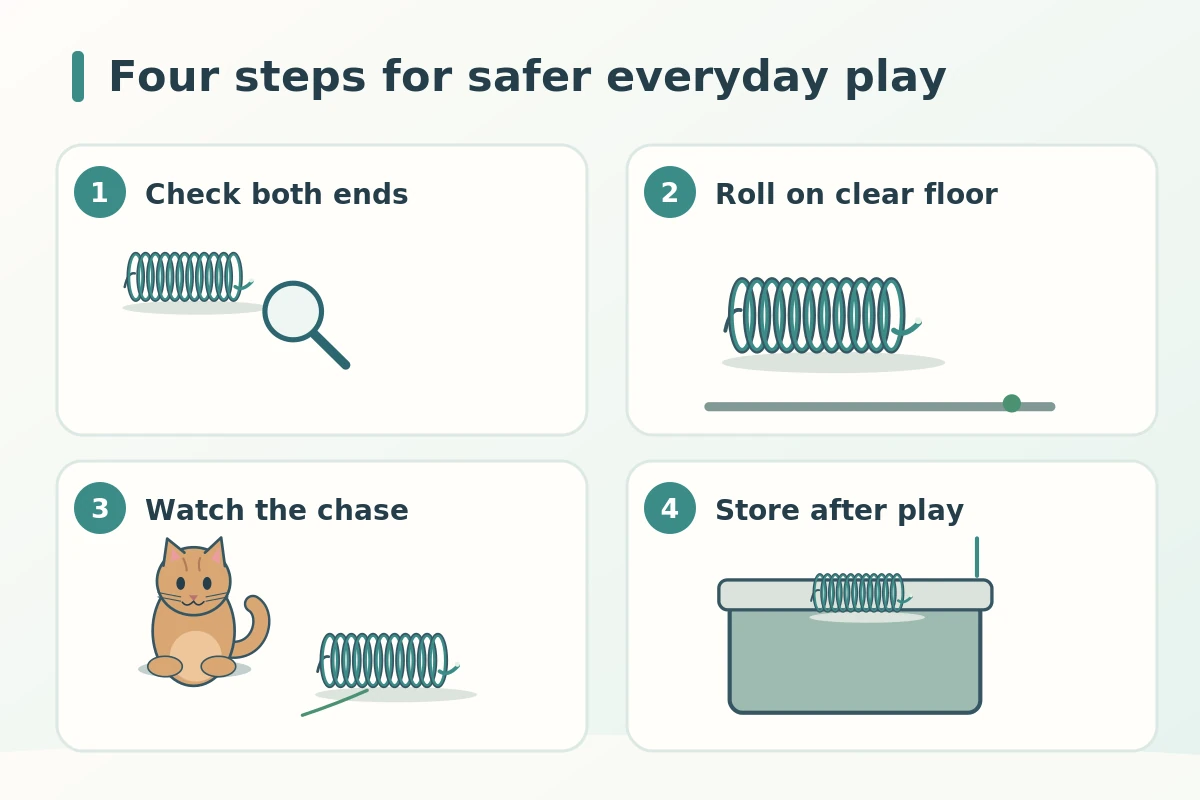
Before each session, examine the two ends, the inner loop surfaces, and the spring’s overall shape. Give it a gentle roll and confirm there are no loose fragments nearby. Play on a clear, grippy floor and collect the spring afterward if your cat chews or destroys toys. Store it away from small children and pets that mouth objects. Replace damaged toys rather than waiting for a break. These checks are more valuable than any unverified durability claim.
How We Research
We used current feline welfare and veterinary guidance about play, hunting-style activity, chewing hazards, scratching, and safe materials. Next, we translated those principles into hands-on inspections of the specific toy or post: the seams, moving parts, size, stability, and cleaning access. We did not test or rank commercial models. The diagrams illustrate what owners can observe without claiming any item has a safety certification. This article is general educational information, not individual veterinary advice. Learn about our editorial approach.
Sources
Cornell Feline Health Center — Safe Toys and Gifts — Cornell Feline Health Center — Safe Toys and Gifts (consulted October 2026).
VCA Animal Hospitals — Cat Behavior and Training: Play and Play Toys — VCA Animal Hospitals — Cat Behavior and Training: Play and Play Toys (consulted October 2026).
Ohio State University Indoor Pet Initiative — Toys — Ohio State University Indoor Pet Initiative — Toys (consulted October 2026).
PAWS — Cat Toys and How to Use Them — PAWS — Cat Toys and How to Use Them (consulted October 2026).
Safety note: Take damaged toys, loose strings, sharp fragments, and accessible batteries away immediately. If a part might have been swallowed, contact a veterinarian promptly. Do not force a fearful cat to participate in play.
An intact, appropriately sized spring can support supervised play. Check cut ends and cracks, and remove it if your cat chews off pieces or could swallow the toy.
Choose a robust size that your cat cannot easily fit fully into its mouth. Consider the compressed coil, not only the stretched length.
Carrying can be part of normal capture and play behavior. Watch for sustained chewing, cracked plastic, or missing pieces.
If your cat chews or destroys them, collect them after play. Any spring with cracked edges or missing material should leave service immediately.
Follow the material instructions; wash suitable plastic with mild soap, rinse thoroughly, and dry between the loops. Replace any damaged coil.