
Dog harness buckles make a harness quick to put on and remove, but a familiar click can create false confidence. Side-release clips may look closed while fabric is twisted nearby, the strap may slide through an incorrectly threaded adjuster, or a cracked prong may no longer hold reliably. The safest inspection is simple and repeatable: identify each load-bearing buckle, confirm the strap path, inspect both prongs, then watch how the harness sits when your dog moves. This guide focuses on ordinary walking gear rather than crash restraints or specialized medical equipment.
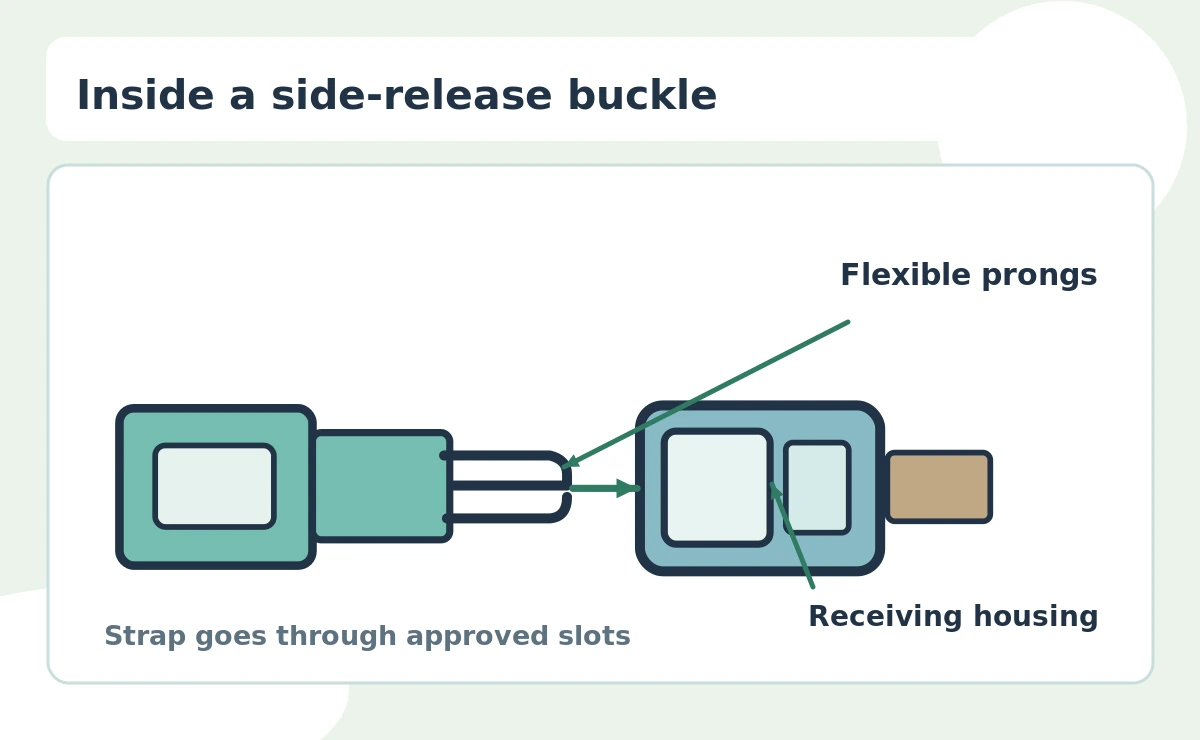
Find every buckle and its intended strap path
Lay the harness flat before putting it on the dog. Separate the neck opening, chest strap, belly band, and any adjustment points. Match each buckle to its intended mate using the product instructions. A harness with two similar side-release clips may be easier to fasten incorrectly when someone twists one panel. Trace the webbing from one attachment ring through each slider and back to the stitched anchor. Never guess which loop carries the load based on color alone. The diagram in the maker’s manual matters more than a generic online photo.
Learn what a full side-release closure feels like
A common plastic buckle has two flexible prongs that enter a receiving body. Both sides should seat fully and resist a gentle straight pull when closed. Listen for a click, but also look and feel because one prong may have damage or catch on a strap. Do not use a sharp tool to force the buckle. Test closure with the harness off the dog before the first use, and repeat the quick check each walk. If a prong stays depressed or a clip opens unexpectedly, stop using the gear.
Check the adjuster as carefully as the clip
Even a perfect buckle cannot prevent loosening if the webbing follows an incorrect path. Follow the path through the sliding adjuster, ensuring it matches the manufacturer’s diagram. Mark where the strap naturally sits with the dog standing, then take a short calm walk and see if it creeps. Some webbing textures move more under wet conditions or after washing. Do not add knots, tape, glue, or improvised stitches to a slipping strap. Replace or seek approved help if the adjuster will not hold a comfortable fit.
Feel for pressure points beneath hard hardware
A buckle near the armpit or directly over a bony area may rub even if it stays closed. Watch your dog lower its head, walk, turn, and lie down for a moment. The clip should not pinch skin, trap hair, or create a hard ridge that presses into the ribs. VCA recommends fitting a harness that allows natural shoulder motion and does not rub behind the elbows. Adjust as directed or change designs when you cannot move hardware away from a sensitive spot. Tightening every strap is not the solution.
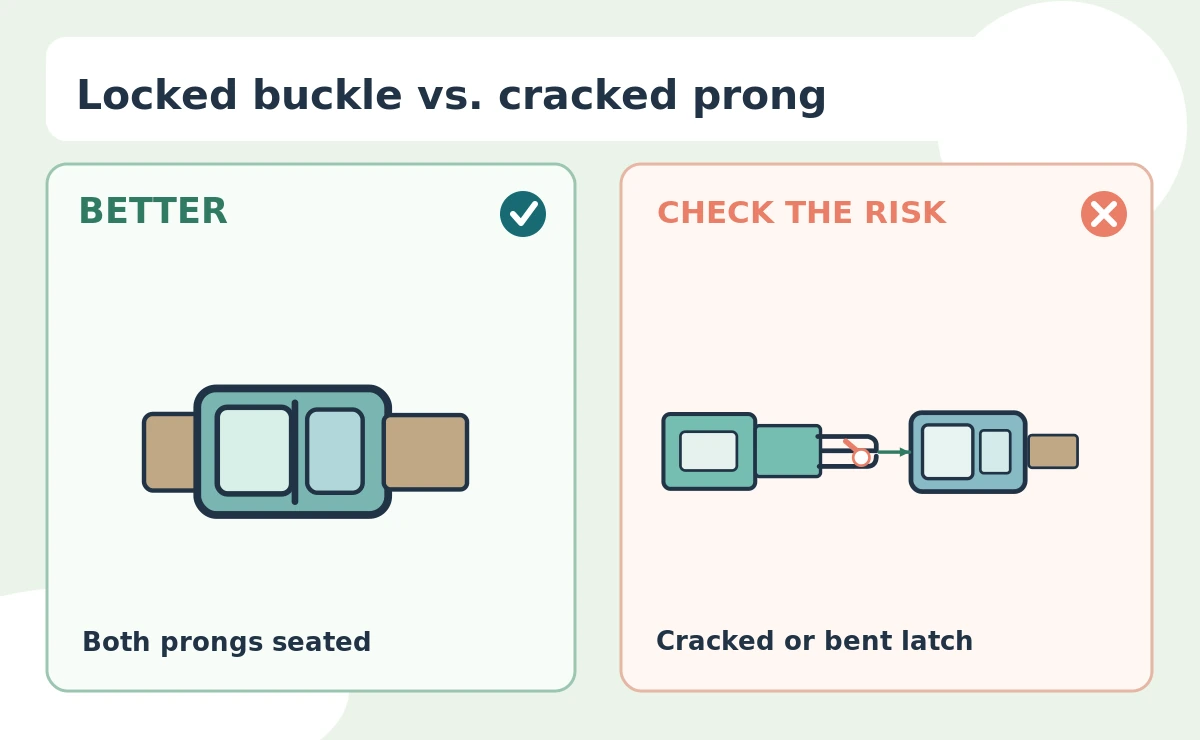
Compare clean and damaged buckle examples
Healthy plastic prongs look symmetrical, spring back smoothly, and seat inside the receiving housing. Warning signs include a whitening stress line, a missing prong tip, a cracked corner, deep chew marks, or a latch that only engages with repeated pushing. Metal fasteners can also develop bent pins or corrosion. Inspect both sides of the buckle under good lighting. Avoid assuming that a clip is reliable because it has not failed on a previous walk. When a structural part breaks, replace the approved component or the entire harness.
Keep fur and dirt out of the latch
Long hair, dried mud, and fine sand can stop a clip from seating fully. Brush away loose debris while the harness is off the dog, and wash it only as directed by the maker. Do not oil plastic buckles unless specifically authorized. Let the webbing and any padding dry completely before use. Snap the clean buckle several times by hand to check smooth closure. If the mechanism remains sticky, do not yank harder or rely on a louder click. Find the approved replacement route instead.
Test escape resistance gently
After you adjust the harness for comfort, confirm that chest and belly straps stay in position while the dog steps naturally. Observe whether the dog can back toward the neck opening without forcing a scary test. Some dogs can slip backward out of a poorly fitted harness, as VCA notes. Do not yank the leash backward to demonstrate an escape scenario. For a dog known to bolt, work with a qualified professional on secure gear and management. A stronger buckle alone will not solve a fit problem near the shoulders or rib cage.
Keep clip placement clear of the leash path
Locate the intended leash attachment ring and make sure the snap sits clear of buckle bodies, stitching, and strap tails. A clip that swings into a side-release latch may rub the dog or create awkward leverage. Watch several gentle turns on a loose leash. A harness should not rotate drastically when you attach a lead, and a front ring should not force the chest strap onto the shoulder. Do not attach the leash to an adjuster, buckle, or decorative loop. Use only load-bearing points identified by the manufacturer.
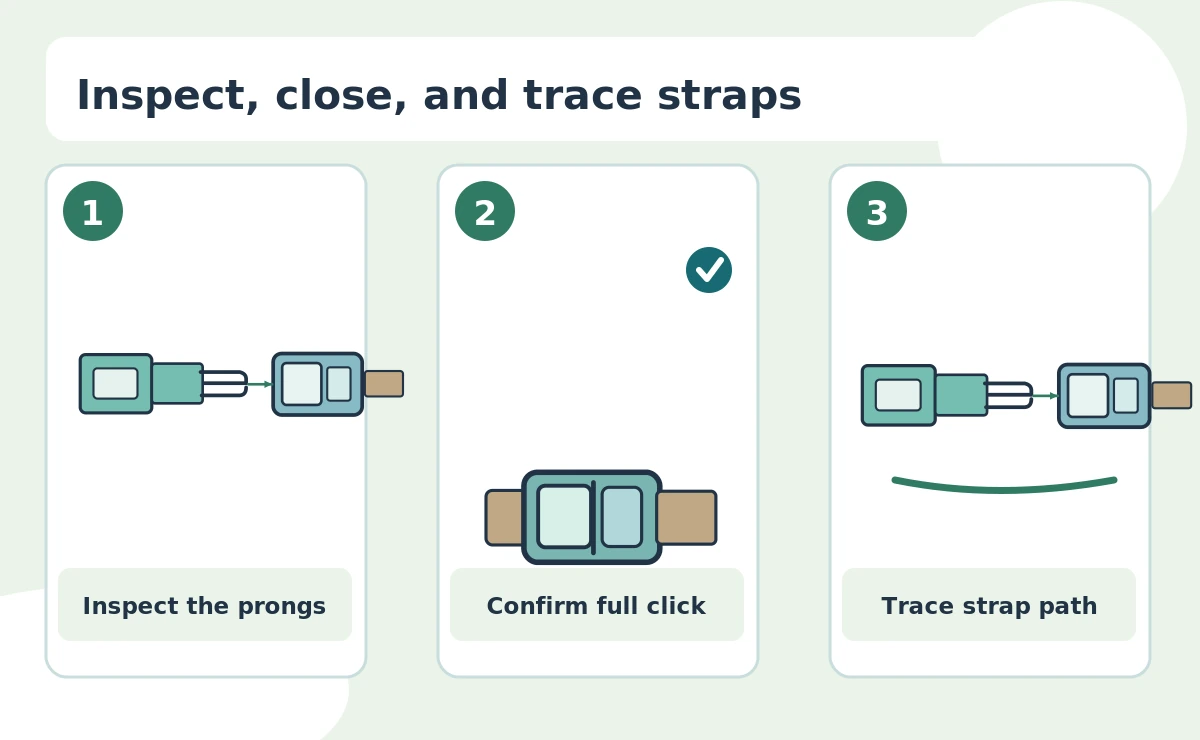
Build a simple four-point pre-walk routine
Before leaving, inspect both prongs for cracks, close each buckle fully, pull the strap flat through its adjuster, and watch your dog walk a few steps. Run your fingers along the inside edge to check for twisted webbing or pinched hair. After wet weather, check that grit has not lodged inside the housing. If you find damage, change equipment before the walk instead of planning to repair it later. This short inspection matters more than advertising that calls a harness escape proof or heavy duty.
Stop when fit or behavior changes unexpectedly
A sudden refusal to move, repeated scratching at a buckle, limping, or skin irritation deserves attention. Remove the harness and inspect contact areas. Persistent soreness or other signs of pain warrant veterinary advice. If the dog becomes frightened by fastening noises, build comfort gradually with rewards rather than forcing the clip closed while the dog struggles. Ask a qualified reward-based trainer for help with handling. Good buckles provide reliable closure, but a safe walking experience still requires a calm dog, appropriate equipment, and gentle leash technique.
How We Research
We compared veterinary and animal-welfare guidance with the physical shape of clips, straps, buckles, rings, and the movement of a walking dog. Because fit differs by breed, body proportions, and manufacturer, our drawings illustrate what to inspect instead of inventing universal dimensions or product tests. For more on our approach see our editorial information and veterinary disclaimer. Seek veterinary help for pain, persistent coughing, skin injury, or sudden mobility changes.
Sources
VCA Animal Hospitals — Collar and Harness Options for Dogs — external guidance on fit, comfortable walking, humane handling, and equipment risks.
VCA Animal Hospitals — Controlling Pulling on Walks — external guidance on fit, comfortable walking, humane handling, and equipment risks.
FOUR PAWS — The Right Harness for Your Dog — external guidance on fit, comfortable walking, humane handling, and equipment risks.
American Humane — Choosing a Dog Collar — external guidance on fit, comfortable walking, humane handling, and equipment risks.
Yes. A damaged or partially engaged prong may make a sound without seating reliably, so look and feel for complete closure.
No. An improvised glue repair cannot be assumed to restore the load-bearing strength of a walking harness.
The webbing may be misrouted or the adjuster may slip. Check the exact manufacturer threading path and replace faulty parts.
No. Positioning that repeatedly pinches or rubs under the front leg needs adjustment or a different harness design.
Introduce the noise gradually in a calm setting and pair it with rewards, without forcing the harness on a worried dog.