
Water fountains for multiple cats can offer moving water, but a bigger bowl does not guarantee every cat feels comfortable approaching it. One cat may wait behind another, retreat from a narrow hallway, or prefer a still bowl elsewhere. The goal is reliable access to clean water without forcing animals to share a crowded resource. Cats Protection recommends more than one water station in different places. Start by mapping your cats’ usual routes and placing water where a cat can enter and leave easily. Then compare the drinking opening, noise, cleaning needs, and backup options before buying a shared fountain.

Count drinking locations, not just reservoir size
A fountain advertised for multiple pets may have a large tank but only one small point where a cat comfortably laps. Think about the number of locations available throughout the home. A clean bowl in another room can matter more than increasing a reservoir from one capacity to another. Put stations in places where a cat can approach without brushing against another cat’s resting spot. If two cats are close companions, they still may drink at different times. Observe choices without trying to schedule them into one location.
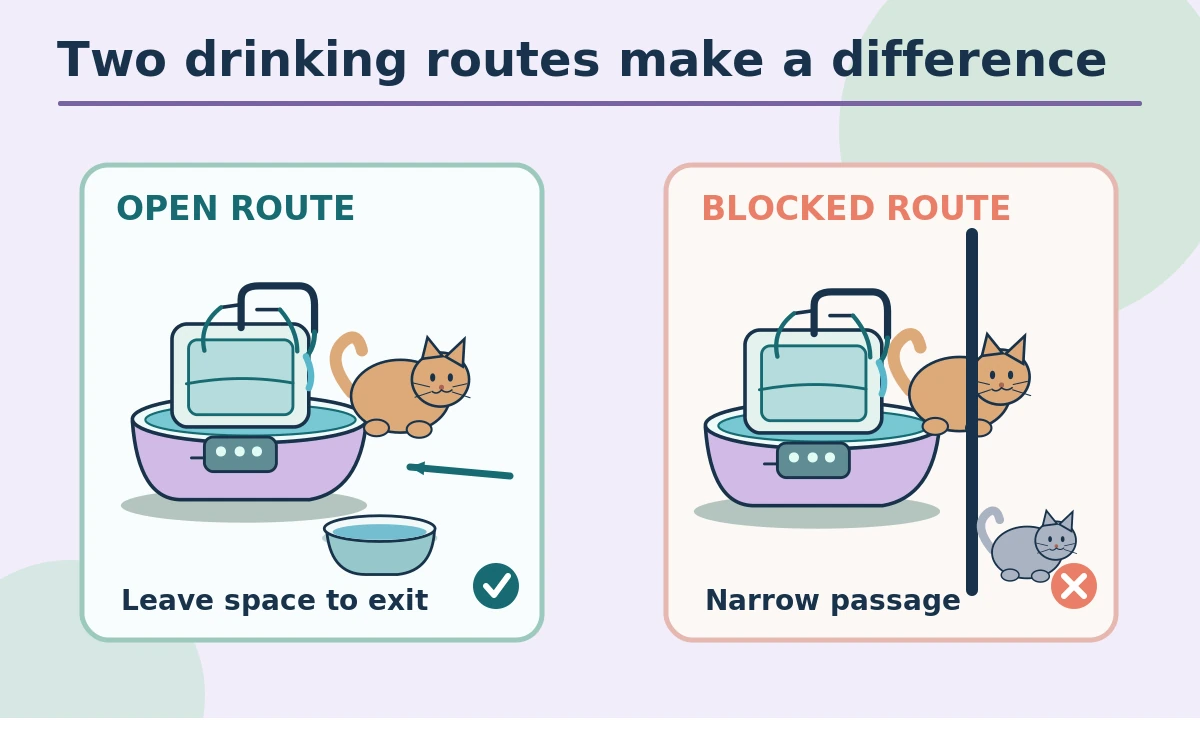
Provide more than one clear route to water
Avoid placing a shared fountain in a narrow hallway, behind a cat door, or at the end of a dead-end furniture alcove. A cat that sees another pet between itself and the exit may decide not to approach. Favor an open corner or a place with room to turn and walk away. If a fountain must sit against a wall, keep the approach unobstructed. Look at the room from cat height rather than only from a standing adult’s perspective. A quiet, predictable route supports ordinary drinking even when household activity rises.
Keep the water away from litter and feeding areas
Cats Protection advises locating water away from the litter tray and often away from food. Give each station a dry, washable surface and make sure litter dust cannot settle directly into the drinking basin. A different location can also help a shy cat drink without passing a dominant feeding position. Avoid crowding a fountain, food bowls, and litter equipment into one compact ‘pet corner.’ Convenience for a human is not always the easiest arrangement for cats. Spread resources to make normal routines less competitive.
Choose a surface that does not crowd whiskers
Cats vary in how they use a flowing stream versus an exposed basin. A narrow spout may attract one animal but frustrate another that prefers a broad still surface. VCA suggests trying different bowl types and providing variety, especially when multiple cats have different preferences. Check whether a fountain leaves enough stable drinking surface while another cat stands nearby. A shallow clean bowl offers a different texture and sound. Do not assume every cat likes moving water just because one cat drinks eagerly from a tap.
Watch subtle access problems rather than only fights
Resource tension can look like waiting in a doorway, moving away when another cat enters, or drinking quickly while scanning the room. Not every delay is aggression, but repeated avoidance deserves a layout change. Add a second station in a separate room and observe without directing or restraining the cats. Note whether a previously hesitant cat begins using the new bowl. If chasing, blocking, or other signs of ongoing conflict persist, discuss the situation with a veterinarian or a qualified feline behavior professional.
Clean a shared fountain more often when needed
Several cats can bring more fur, dust, and food residue to the same basin. Inspect water daily and clean accessible bowl surfaces appropriately; the CDC recommends daily cleaning of pet water bowls. The maker’s full pump, filter, and housing schedule remains important. PetSafe notes that certain multi-pet fountain models may need more frequent deep cleaning than single-pet use. Do not mistake a large filter for self-cleaning technology. Wash approved parts, rinse thoroughly, and keep alternate drinking bowls available while the fountain is apart.
Put a still-water bowl in each useful zone
A stationary bowl continues to work during a power outage and is easy to move when furniture changes. Offer water in a calm room, near a favored daytime resting area without crowding it, and on a level your cats can reach comfortably. Avoid inaccessible elevated surfaces if an older cat has difficulty climbing. Keep bowls away from unsupervised hazards or traffic. Monitor whether the cats use different spots at different times; variety is useful, not evidence that your fountain was a bad purchase. Refresh each bowl daily.
Test new placements gradually
When adding a fountain, keep familiar bowls where the cats already drink. Introduce the new sound at a comfortable distance and allow self-directed investigation. Do not place a cat’s face into the stream or block the exit to encourage a drink. If the motor makes one cat avoid the area, lower the approved flow setting or move the station farther from busy paths. Watch which pet uses the top spout, lower basin, or original bowl. Once you have observed the pattern for several days, refine the layout without removing necessary choices.

Do not rely on one large tank during an absence
One power supply or pump represents a single point of failure even if the capacity looks generous. Separate clean bowls reduce the chance that a household loses all accessible water because a fountain stops. Check levels and signs of leakage before leaving home. Do not promise that any size reservoir safely replaces daily oversight. In hot weather or a household with multiple pets, water can be depleted faster than expected. Plan for ordinary access and monitoring rather than assuming a ‘multi-pet’ label guarantees enough water.
Watch health-related changes individually
If one cat suddenly drinks much more, avoids water, urinates differently, or seems unwell, contact your veterinarian. Changes can be hard to notice when several animals share one reservoir, so observe the cats separately when possible. Do not use the fountain’s total water loss as a medical measurement for a specific cat. Note food changes, drinking location, energy, and appetite. A better layout supports access but does not diagnose or treat illness. Your goal is an easy-to-use set of clean water choices for every cat.
How We Research
We compared published animal-welfare, veterinary, public-health, and manufacturer guidance against real fountain components, access routes, and cleaning steps. Product dimensions and service intervals vary by model, so we explain what to verify rather than inventing universal numbers. The illustrations are original instructional drawings, not a model endorsement. Read our editorial information and veterinary disclaimer; contact your veterinarian about sudden changes in drinking or health.
Sources
Cats Protection — Cats and Drinking — specific background on fresh water, safe cleaning, equipment care, and pet drinking preferences.
VCA Animal Hospitals — Tips to Encourage Cats to Drink More Water — specific background on fresh water, safe cleaning, equipment care, and pet drinking preferences.
CDC — About Cleaning and Disinfecting Pet Supplies — specific background on fresh water, safe cleaning, equipment care, and pet drinking preferences.
PetSafe — Cleaning a Stainless Multi-Pet Fountain — specific background on fresh water, safe cleaning, equipment care, and pet drinking preferences.
One large tank does not guarantee comfortable access. Provide several drinking locations, including clean stationary bowls.
Usually not. Separate quiet locations provide choices and can reduce the need to pass another cat to drink.
Create separate stations and avoid forced sharing. Seek veterinary or qualified behavior advice if blocking or conflict continues.
Yes. Inspect and refresh water daily and follow model-specific cleaning instructions, adjusting for increased hair and debris.
Keep familiar bowls while cats adjust, and maintain a backup still-water option in case the pump fails.