
Dog Carrier Car Seat Installation solve a specific car-travel problem, but appearance can hide limits. The most useful questions concern fit, access to vehicle safety equipment, everyday comfort, and how the product behaves after cleaning. This guide explains what to measure and what to inspect before a trip. A cover, padded seat, or accessory is not automatically a collision restraint. Keep dogs safely secured using appropriate equipment and follow the instructions for both the vehicle and the restraint. For health concerns rather than equipment selection, see our veterinary disclaimer.
Choose a carrier meant for vehicle use
Not every soft travel bag or household crate can serve safely as a secured car carrier. Look for a model whose maker explains placement, direction, compatible vehicle belts or anchors, and size limits. Prefer independently documented crash performance where available. A handle meant for carrying a pet into a building is not automatically an anchoring point for a collision. Inspect the complete unit for a secure door, intact hinges, ventilation, and enough usable room for the dog to stand or sit comfortably, turn around, and lie down.
Read the exact belt-routing illustration
A manufacturer-approved seat belt path may run through molded slots or an external guide on a specific carrier. If the maker shows no approved path, do not thread the belt through a door handle, mesh panel, or zipper loop. Check that the belt lies flat, that it can lock as required, and that the carrier does not crush the buckle. Vehicle seat shapes differ; a carrier approved for one seat may not be appropriate on another. Follow both the carrier instructions and the vehicle owner’s manual instead of guessing from a generic online picture.
Check the floor-behind-seat option carefully
Some veterinary travel guidance discusses securing a small carrier on the floor behind a front seat when a suitable crash-tested restraint is unavailable. Fit depends on the vehicle and carrier dimensions. The carrier must not rock under a pedal, interfere with seat travel, obstruct heating ducts, or contact electrical mechanisms. Never wedge a crate with improvised straps or treat an unstable floor location as certified. Verify the carrier maker’s allowed locations first. A snug-looking space that blocks ventilation or a door is not an acceptable placement.

Keep the door usable for controlled exits
Check where the carrier’s door opens after you secure the unit. Avoid trapping the door against a console, seatback, or door panel where you cannot reach the latch. Never open a carrier door into traffic or let a frightened dog rush out during a roadside stop. Park safely and attach a leash or harness before releasing the animal when appropriate. Sometimes you can lift the entire carrier out of the vehicle before opening its door. Rehearse the exit with the car turned off so another caregiver can perform it calmly.
Leave enough air around ventilation panels
A travel carrier can have large mesh windows but still suffer restricted airflow if pushed against a seat, covered by a blanket, or stacked with luggage. Read the ventilation layout and keep all necessary panels unobstructed. Do not place the carrier where direct sunlight causes persistent heat or where a heater blows intensely into its side. Check the dog’s comfort without opening the door while moving. Never leave a pet unattended in a parked vehicle, even for a short errand. Cooling the car beforehand does not make an unattended vehicle safe.
Compare hard shells and soft-sided options
Hard-sided carriers often have more defined edges and doors, while soft-sided bags may be easier to store but can collapse or distort under load. Construction alone does not guarantee crash performance. Compare exact model testing, closure security, belt path, and manufacturer weight limits. A zipper that pops open or a door that flexes may be a major concern. The ASPCA recommends secure, ventilated hard-sided carriers for vehicle travel. If choosing a soft-sided travel product, require equally convincing evidence that it is appropriate for the intended vehicle use.
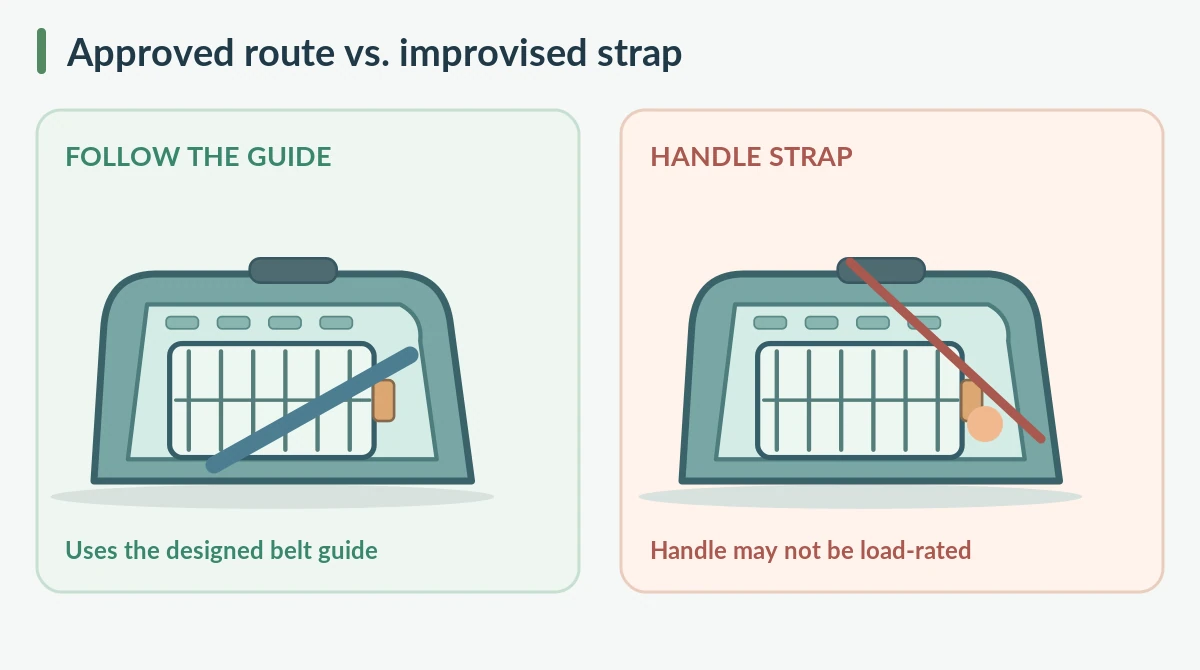
Protect against shifting without extra tethers
A carrier that slides in normal driving is not appropriately secured. Do not solve the problem by adding an untested rope around the carrying handle or a zipline from one seat to another. The Center for Pet Safety warns about unsuitable extension connections in vehicle cargo configurations. Use manufacturer-approved anchoring hardware and a correctly rated vehicle attachment location. Avoid placing a loose nonslip mat where it changes an approved installation. If your car does not support the carrier’s specified connection, select another compatible system.
Practice the route before the first long drive
Introduce the carrier as a calm resting place at home. Use short, voluntary entry sessions and rewards rather than pushing a worried dog inside. Once the dog is comfortable, practice closing the door for brief intervals, then carry the carrier to a parked car and complete the installation. Check that the dog can turn and settle before moving. Start with short trips and gradually build tolerance. Signs of motion sickness, distress, or pain warrant a veterinary conversation, not stronger confinement or punishment.
Inspect the unit after cleaning and travel
Remove bedding and check for cracks, loose fasteners, brittle plastic, frayed webbing, worn zippers, and damaged latch springs. Clean with products approved for the carrier material and let all parts dry. Do not cover ventilation holes with absorbent pads or tape over a damaged corner. Look for a clear, readable pet ID label and carry an updated contact plan. After a crash or significant impact, follow the manufacturer’s replacement guidance; a normal-looking shell can conceal damage. Check the carrier before every important trip.

Complete a three-part departure check
Before departure, assess the dog, the carrier, and the vehicle separately. Check the dog for comfort and ID, confirm the carrier fits and its door and vents work, and verify the vehicle supports the required connection. Close the carrier and verify the seat belt or anchor as directed. Confirm the most recent photo, emergency contact, and water plan are accessible. A seat cover, towel, or decorative bucket seat must never replace the designed connection. A quiet, secure trip is the goal.
How We Research
We reviewed veterinary school and animal welfare guidance on car travel, plus research-led pet restraint information. We distinguished manufacturer fit claims from independent crash-safety evidence. No product featured here was independently crash-tested or certified by HubPet, and we do not present comfort features as safety ratings. Vehicle and product instructions take priority whenever a generic drawing cannot show a specific model. We checked the sources in October 2026; learn more about our editorial approach on the About HubPet page.
Sources
Merck Veterinary Manual — Traveling by Car With Pets (accessed October 2026).
ASPCA — Traveling With Pets: Dos and Don’ts (accessed October 2026).
Center for Pet Safety — Cargo Connection Advisory (accessed October 2026).
Travel safety note: Never leave a dog unattended in a parked vehicle. Avoid front airbags, loose pets, open pickup beds, unsecured cargo, and improvised tether extensions. Look for testing of the exact model and configuration before trusting any crash-safety claim. Ask your veterinarian about travel sickness, pain, or distress instead of forcing equipment use.
Only if the carrier maker explicitly approves that path. Carrying handles are not necessarily rated as vehicle restraint points.
No. Suitability depends on vehicle geometry, the specific carrier and its instructions. It must not obstruct controls, vents or seat mechanisms.
All manufacturer-required openings must remain clear. Avoid blankets, luggage or seat surfaces blocking the dog’s airflow.
Some are designed for vehicle use, but do not assume every soft bag provides crash protection. Verify the exact model’s installation and evidence.
Confirm dog comfort and ID, secured door, unobstructed vents, and an approved belt or anchor connection without loose straps.