
A dog seat belt is not simply a leash with a car buckle. In many listings, the phrase describes an add-on tether that has not been tested with the harness, seatbelt, or vehicle. That distinction matters when comparing a complete restraint system with a cheap clip. The Center for Pet Safety warns against extension tethers because additional travel can expose dogs to dangerous forces during sudden stops. This guide focuses on connections and product claims rather than ranking models. Seek veterinary care for injuries or persistent travel distress; see our HubPet veterinary disclaimer.
Identify the full restraint system
Before shopping, separate the parts: the dog-worn harness, the vehicle belt, and any connector between them. Some travel harnesses route the car’s existing belt directly through sewn loops. Others use a particular manufacturer-approved method. A clip sold as a “dog seatbelt” may merely prevent wandering around the cabin, with no published crash-test performance. Read the entire product listing for model-specific test evidence, installation requirements, and limits on dog weight. If the seller describes only the breaking strength of a metal clip, it has not established impact protection for a living animal.
Never connect a vehicle tether to a neck collar
An ordinary collar distributes force around the neck, which makes it inappropriate as the sole vehicle restraint. During hard braking, a collar connection can load the throat and cervical area. Instead, use a purpose-designed, properly fitted travel harness or verified carrier system according to its instructions. SaskSPCA explicitly advises against attaching a seatbelt to a collar. A walking leash attached to a collar can still help guide the dog to the parked car, but it is not an adequate substitute for a vehicle restraint while driving.

Be skeptical of adjustable extension leads
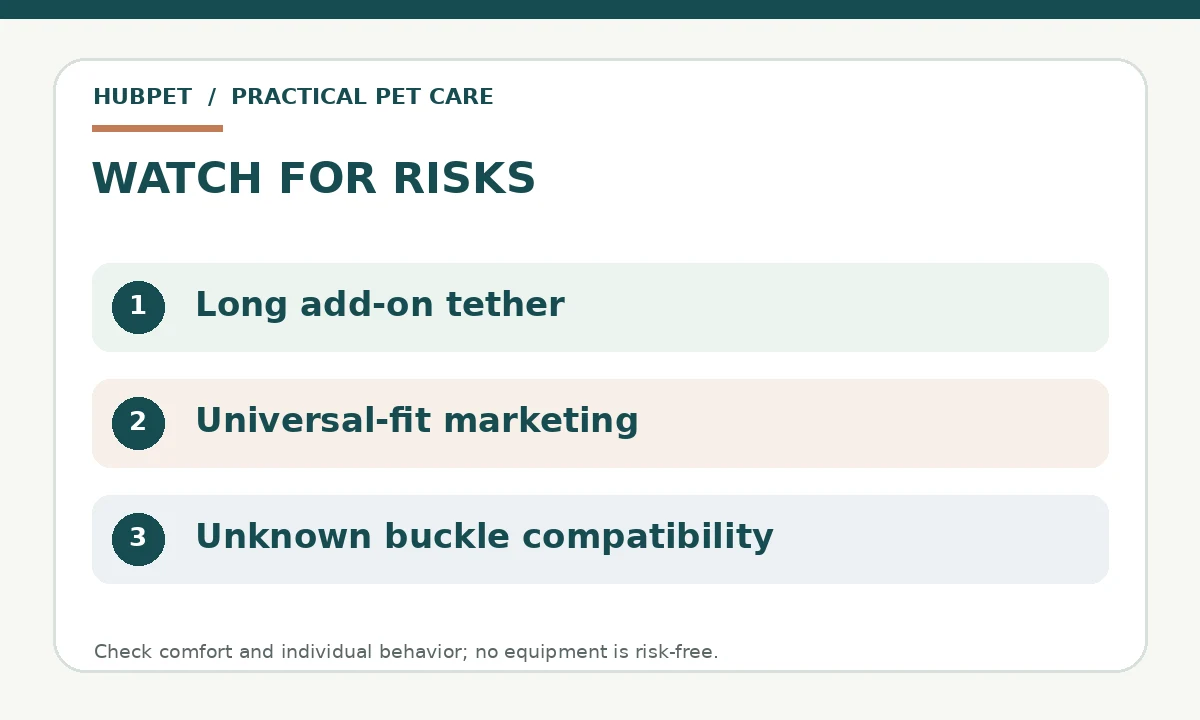
A longer strap can look more comfortable because the dog can pace across the rear bench. However, extra travel also gives the dog more room to accelerate and strike the interior. The Center for Pet Safety warns that extension tethers and zipline-style systems may cancel out protection from a tested harness. Do not infer that a car-rated harness remains certified after adding an unrelated strap. Ask whether the specific connector is part of the test protocol. When evidence is missing, choose a complete documented system rather than trying to calculate a safe tether length yourself.
Check the vehicle buckle and routing
Seatbelt receptacles vary by vehicle; a connector that clicks into one car may not lock properly in another. Moreover, a click is not proof of impact performance. Examine vehicle and restraint instructions for compatibility, routing, and seating position. Avoid aftermarket adapters whose approval cannot be verified. The dog should ride in the rear seating area, away from active front airbags. If an installation crosses a fold-down seat, sliding rail, or sharp edge, ask the product maker for guidance before driving. Do not modify the vehicle belt or anchor to accommodate an accessory.
Fit the harness before trying the connector
Put the harness on a standing, relaxed dog and check that straps lie flat on the chest and shoulders. A harness that shifts over the head or rubs beneath the forelegs may fit poorly even if the car clip is secure. The dog should be able to settle without entanglement. Practice short rewards while stationary, then attach the prescribed restraint according to the manual. If the dog twists into the belt or paws at the buckle, end the session and troubleshoot. Improvised padding and extra knots may change how a restraint responds in a crash.
Distinguish routine travel convenience from crash evidence
A clip may keep paws off the center console during normal driving, but that alone does not demonstrate crash protection. Look for a recognized test protocol, an independent result, and the exact approved components. Ask whether an assessment included dynamic forces or only static pulling on hardware. A “universal” description is especially weak when it omits specific belt routing and fit ranges. The goal is not to prove that a strap is strong in isolation; the full system must manage the movement of the dog without creating additional injury risks.
Consider a secured carrier when a harness is unsuitable
Some small dogs travel more comfortably in a properly sized, secured carrier; others can use an appropriately designed car crate. Confirm that the carrier itself suits car travel and that its vehicle attachment method has supporting evidence. CDC advises securing a crate so it cannot shift on stopping, and CPS maintains separate certification information for travel carriers and crates. Never treat an ordinary household wire crate or loose soft bag as automatically crashworthy. Test accessibility and ventilation in the parked car before taking a journey.
Practice a calm boarding routine
Make the sequence predictable: arrive at the car on leash, enter on cue, receive a small reward for standing calmly, then allow a patient harness and belt connection. Start with the engine off. Later, progress to a brief ride and a familiar destination. Avoid driving while someone tries to untangle a restless dog. Motion sickness or fear can make fitting harder and may need veterinary advice. Keep identification current and take water and scheduled stops on longer journeys. None of these steps replaces a properly installed restraint, but they make correct use more realistic.
Inspect equipment after every change
Recheck the buckle after adjusting the vehicle seat or folding down a backrest. Inspect the harness for loose stitches, worn attachment loops, and sticking clasps. After laundering, follow the maker’s instructions for drying and assembly. If the dog grows, gains weight, or recovers from illness, check measurements again. Avoid borrowing a different car’s latch connector without verifying compatibility. Preserve the complete instruction manual or its official electronic version so another family driver can install the same system correctly.

Choose with a no-shortcuts checklist
Select a restraint with published model-specific evidence, compatible vehicle belt routing, suitable dog fit, and complete instructions. Reject products that market collar clips as crash solutions or rely on vague “military-grade” claims. Check the manufacturer’s own limits before purchasing and do not add an aftermarket extension tether. Finally, fit the full setup while parked and repeat the check on your first short trip. The safest buying decision is often to decline a cheap accessory rather than attach it to a system the maker never evaluated.
How We Research
Our editorial team compared current pet travel, vehicle restraint, and safety-testing guidance with the specific shopping question in this guide. The review distinguishes sourced safety principles from practical inspection prompts. Our team did not test specific products, and this guide does not claim any car accessory prevents injuries or fits every dog. Our team reviewed source pages on October 27, 2026. Learn about our process on the About HubPet page. For distress, injuries, or medical questions, consult your veterinarian.
Sources
Center for Pet Safety: Extension tether safety advisory. Reviewed October 27, 2026.
Center for Pet Safety: CPS Certified Products. Reviewed October 27, 2026.
Centers for Disease Control and Prevention: Pet travel safety. Reviewed October 27, 2026.
Merck Veterinary Manual: Traveling by car with pets. Reviewed October 27, 2026.
Center for Pet Safety: Cargo-area connection advisory. Reviewed October 27, 2026.
Saskatchewan SPCA: Vehicle safety for pets. Reviewed October 27, 2026.
No. A collar attachment can concentrate crash forces on the neck; use an appropriately evaluated body restraint.
Not necessarily. CPS warns that extension tethers can increase injury risks and undermine tested restraint performance.
No. Check the exact vehicle and product instructions; fitting the receptacle does not prove crashworthiness.
No. Covers protect upholstery and must not be treated as a restraint.
A secured, appropriately evaluated carrier can be an alternative depending on the dog and vehicle; verify installation and ventilation.