
A dog car seat cover protects upholstery from wet paws, hair and dirt. It is not a substitute for an appropriately secured pet. The American Veterinary Medical Association advises restraining dogs in vehicles and keeping them out of dangerous airbag positions. The Center for Pet Safety warns against untested extension tethers and travel accessories that undermine restraint systems. This guide focuses on buying an upholstery protector without confusing it with crash protection. See our veterinary disclaimer for animal-specific travel concerns.
Decide first whether you need to cover a rear bench, a bucket-style seat, or a vehicle cargo surface. Map the real belt and restraint routing before placing any fabric over it. Our dog car-anxiety article covers comfort and gradual acclimation; safety equipment is a separate decision.
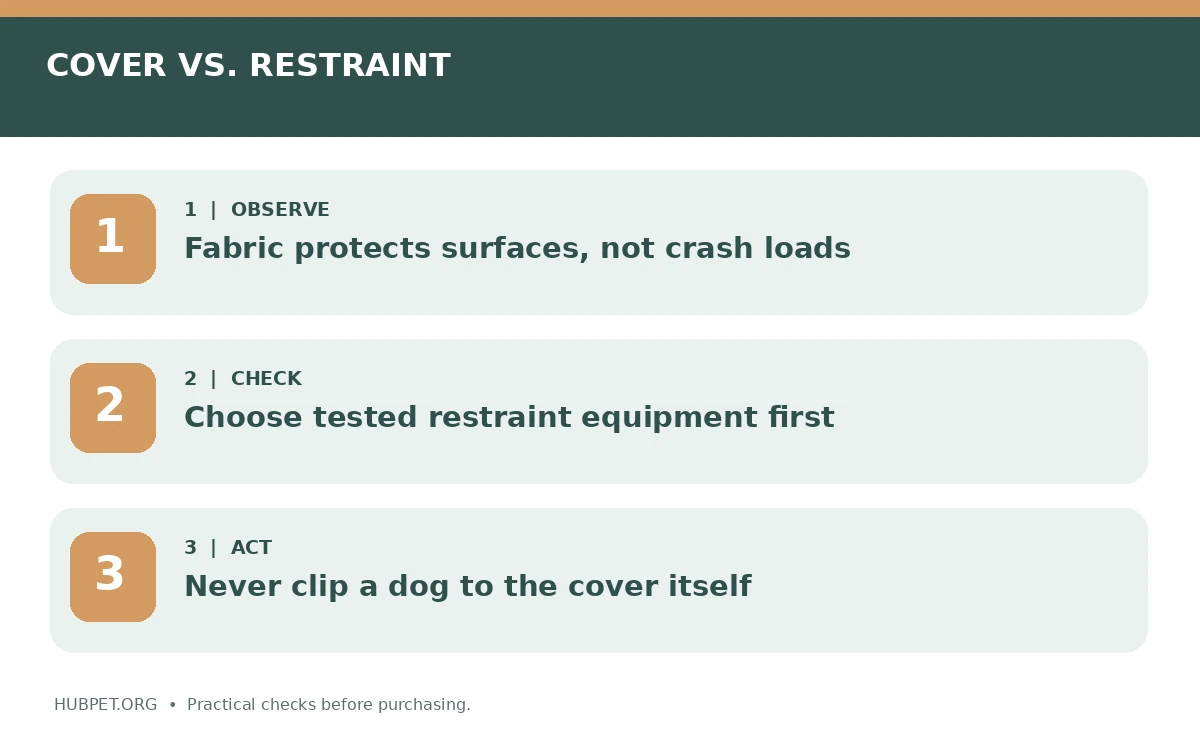
Treat the cover as a cleaning accessory, not a restraint
A protective cover is fabric or a liner positioned over the seat or cargo floor. It may protect against scratches, mud and loose hair, but does not by itself secure a dog or prove collision performance. Words such as heavy-duty, hammock, or nonslip describe features, not verified crash results. Compare cover claims separately from any restraint advertisement.
Choose the animal’s vehicle restraint independently: a suitable travel carrier, crate, or safety harness with credible evidence and correct installation. The cover must work around that setup. Never attach a dog to the cover itself or assume that a zipper opening acts as a load-bearing anchor. If two products conflict, prioritize the restraint manufacturer’s instructions.
Compare bench, hammock and cargo-area designs
A flat bench cover protects the seat cushion and sometimes the backrest. Hammock styles connect front and rear headrests and add a fabric barrier across the footwell. Cargo liners cover larger trunks or cargo floors. Each design fits different vehicle geometry, door arrangements, and cleaning needs.
A hammock is not a rigid barrier or proven way to contain a dog during sudden braking. Some covers may push against the back of front seats or interfere with passenger access. Cargo use also requires suitable restraint anchorage, as the Center for Pet Safety cautions. Choose the cover shape after deciding the safest approved pet travel location.
Measure the vehicle rather than relying on a universal label
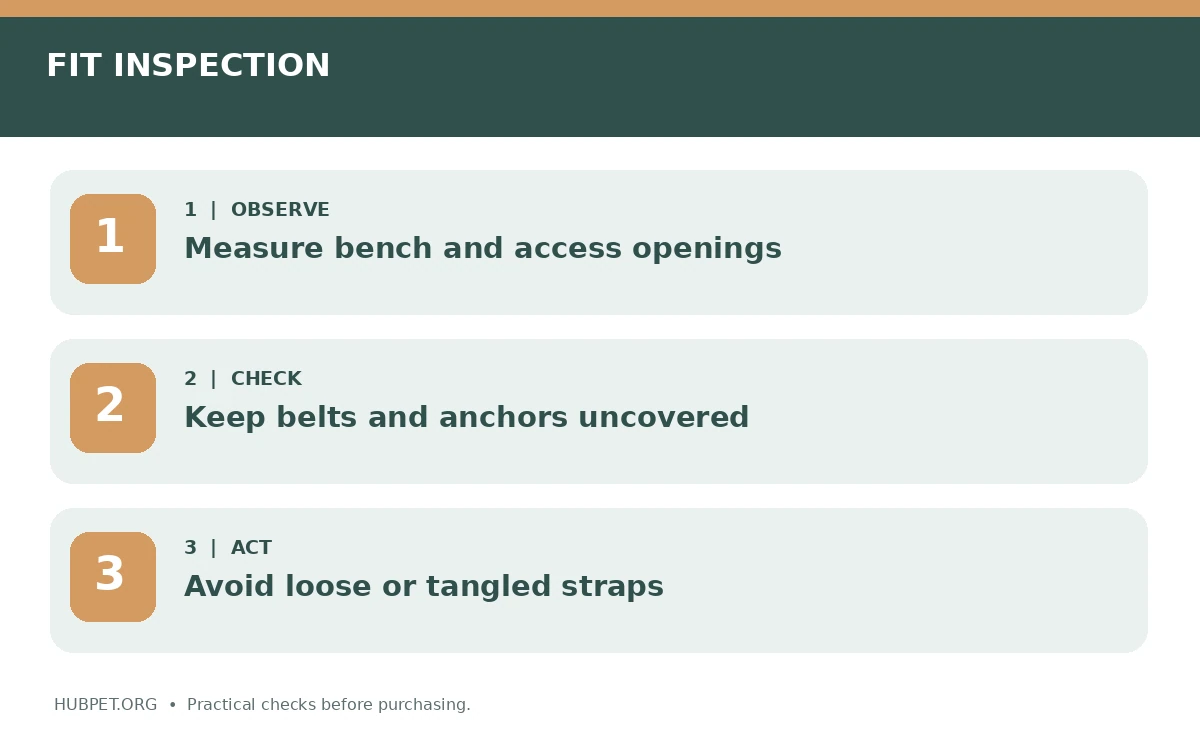
Record rear-bench width, seat depth, backrest height and the distance between headrests. Include the shape of bolsters, armrests and seat splits. In a cargo area, measure the usable floor and required access to securement hardware. Photos showing one popular SUV are not proof of a universal fit.
A cover that bunches under the dog can create unstable footing or push a restraint out of position. Check whether the maker provides specific model compatibility and measurements. If your bench folds asymmetrically, look for access panels that match its segments without covering essential controls. Plan for door opening and passenger belts, too.
Keep belt buckles and anchors fully accessible
Seat belt receivers must remain easy to find and use exactly as designed. Slits and hook-and-loop flaps may offer access, but their placement must match your vehicle and restraint instructions. Do not push belts through undersized holes that bend the webbing, conceal damage or change the intended routing.
Examine whether the cover blocks child-seat anchor locations or any approved pet restraint connection points. Do not substitute cover straps for vehicle-rated restraints. If the chosen cover cannot coexist with correct restraint installation, use a different cover or leave the area uncovered. Upholstery protection should never set the rules for securement.
Evaluate backing, grip and movement under normal use
Nonslip backing, seat anchors and headrest straps may help a cover stay in place as a dog gets in and out. They do not certify crashworthiness. Examine how the fabric lies when the seat is empty and when an adult presses lightly on likely paw locations. Look for rolling edges, raised wrinkles and hidden strap loops.
Long unsecured straps can catch on feet or become chew targets. Tuck loose ends only as instructed and keep them away from the dog’s mouth. A strong chemical odor or crumbly backing may be a reason to reject a cover. If the cover shifts repeatedly during routine travel, replace or remove it rather than relying on constant readjustment.
Choose an easy-to-clean surface that dries completely
Compare actual care labels. Some covers can go in a washing machine; others require wiping or spot cleaning. A water-resistant fabric may resist brief splashes without being fully waterproof at seams, zippers or access flaps. Ask which cleaning solutions the manufacturer permits and avoid chemicals unsafe for animals.
For muddy paws, remove visible dirt before washing. Dry the cover fully before replacing it so moisture is not held against upholstery. Inspect seams and coating after repeated wash cycles. A cheaper washable design may be more practical than an elaborate multilayer cover that cannot be thoroughly cleaned.
Plan entry, exit and paw comfort
Dogs need a stable route onto their assigned travel surface without stepping on dangling material or sharp buckles. Check the door-side flap length and make sure it does not drag onto the road or become caught in a door seal. For a senior dog, consider an appropriate ramp or assistance plan in addition to a fitted restraint.
A slick waterproof outer surface may protect seats while leaving the dog’s paws less secure. Check traction with the actual permitted restraint and dog present during a parked-car trial. Avoid adding loose quilts that disrupt harness or carrier fit. A cover can support comfort only if it leaves the approved safety system working correctly.
Protect passengers and electronics too
Consider where people sit. A rear-seat cover should not prevent a passenger from fastening the seat belt or block access to essential seat controls. Be careful around seat-mounted airbags, heated seats, ventilation outlets and occupancy sensors; follow the vehicle manual about allowable aftermarket seat accessories.
Keep covers away from pedals, the driver’s seat movement and visibility areas. Check doors can close properly without pinching straps. After installation, have each planned passenger sit down and buckle up. If you routinely travel with children and a dog, map everyone’s secured position before adding a large hammock configuration.
Inspect the cover as part of every trip
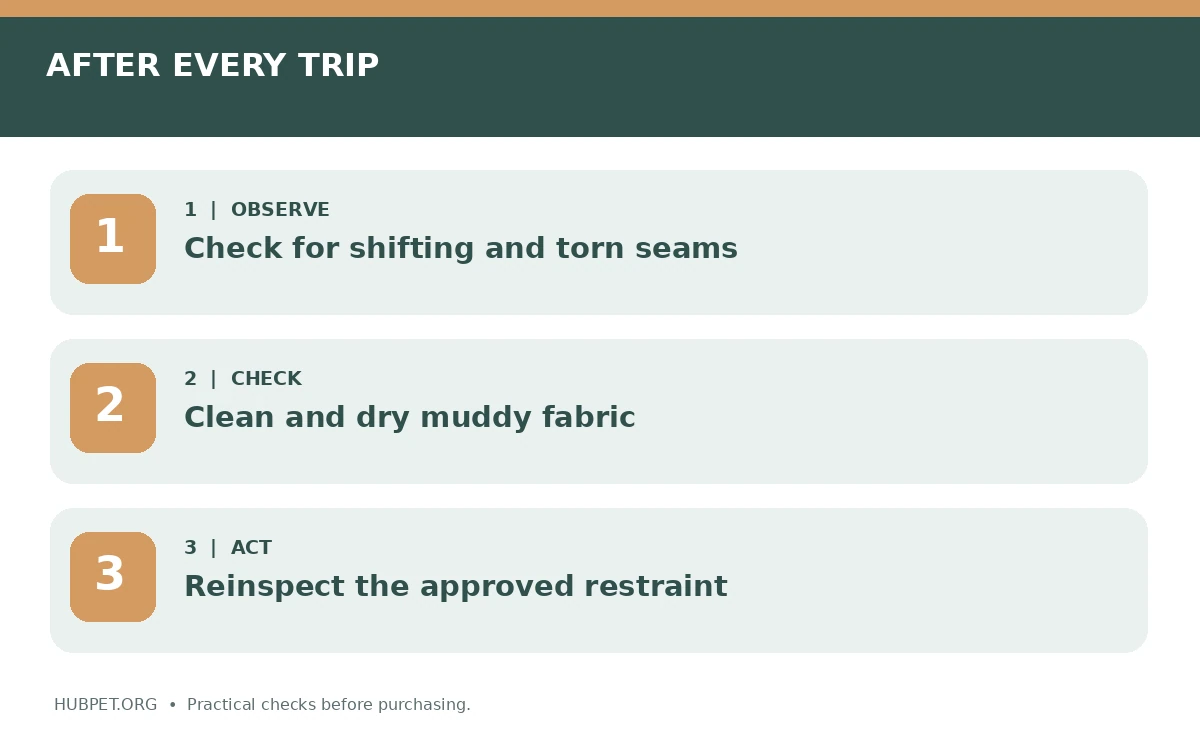
Before driving, confirm that restraint hardware, belt routing and headrest connections are correct. Look for torn openings, stretched straps, loose clips and bunched fabric. Remove any chewed or swallowed fragments immediately and seek veterinary advice if ingestion is suspected. A torn cover should not remain installed just because it still shields the seat.
After rainy walks, dry both dog and fabric when practical. Brush loose hair from seams and examine the underside where grime can transfer to upholstery. A routine check takes less effort than dealing with a belt concealed by a twisted cover at the start of a trip. Record specific cleaning instructions if multiple family members use the vehicle.
Finish with a safety-first purchase decision
Use a simple comparison table: exact vehicle fit, access for approved restraints, cleaning method, traction and the ability to inspect all attachments. Disregard unsupported claims that a seat cover alone protects a pet in a collision. Verify headrest strap compatibility and the cover’s own installation directions before paying.
After fitting the cover, test a short trip with an appropriately restrained dog. Recheck fabric position and restraint routing afterward. If the cover gets in the way, remove it. For cleaning beyond the car, see our home floor-cleaning guide. A spotless seat matters less than a safe animal and an undistracted driver.
How We Research
We prepared this guide using animal welfare guidance and practical questions owners can ask about size, materials, supervision, fit and safe use. We did not purchase or independently test products, and we do not rank brands or claim veterinary endorsement. On October 26, 2026, our editorial review considered these sources. Learn more about HubPet and our editorial approach. This material does not replace advice for a specific animal from its veterinarian.
Sources
American Veterinary Medical Association: Traveling with Your Dog or Cat. Accessed October 26, 2026.
Center for Pet Safety: Extension Tether Safety Warning. Accessed October 26, 2026.
Center for Pet Safety: Securing Pets in Vehicle Cargo Areas. Accessed October 26, 2026.
Center for Pet Safety: CPS Certified Products. Accessed October 26, 2026.
No. A fabric cover protects upholstery and is not a crash restraint. Use a correctly installed, appropriately tested harness, carrier or crate instead.
They can be useful for containing dirt, but they are not a substitute for proper restraint. Check that the design does not block belts or interfere with approved pet equipment.
Yes. Confirm that all required buckles and restraint pathways remain accessible and correctly routed. Choose another cover if openings do not align with your vehicle.
Yes. Dirt, moisture and residue collect around seams and flaps. Follow the care label and dry the cover completely before putting it back on the seat.
No. Do not attach the dog to fabric cover straps or assume a cover can carry crash forces. The Center for Pet Safety cautions against unsupported tether arrangements.