
A dog car seat may elevate a small dog or keep a washable cushion in one place, but that does not mean it protects the dog in a crash. The American Veterinary Medical Association recommends safely restraining dogs in vehicles and keeping them away from active passenger airbags. The independent Center for Pet Safety has documented problems with some pet travel-seat designs. This guide separates convenience from restraint claims. Review our veterinary disclaimer for health or motion-sickness concerns.
Before comparing plush fabrics or window height, identify how a proposed product secures the animal and where it attaches to the vehicle. Check the actual current product model against independent test information rather than trusting an unqualified crash-tested phrase. Our dog car-anxiety guide covers gradual comfort training separately from crash safety.
Understand what the term dog car seat can mean
Shops use dog car seat for a wide range of products: soft booster baskets, enclosed carriers, seats with short tethers and cushions that resemble beds. These designs do not share one safety performance level. A booster can improve a dog’s view or restrict wandering but may not contain the animal during a sudden stop.
List your actual goals. If crash protection is the priority, research a compatible tested travel carrier, crate, or safety harness rather than equating an elevated cushion with a restraint. If comfort is the goal, use it only as part of a safely restrained setup consistent with manufacturer instructions. Do not combine unrelated parts and assume that the system remains tested.
Check independent crash evidence for the exact model
The Center for Pet Safety publishes studies and a directory of independently certified harnesses, travel carriers and crates. Its pet-seat pilot study observed important limitations in travel-seat designs. Look for a verifiable test protocol, tested size, configuration and installation method rather than vague references to a laboratory or impact resistance.
A certification for a different product or an earlier version is not evidence for a new seat. A claim about the fabric’s strength does not show that the full restraint system works. Read the test report where available and review any weight or size limitations. If no credible vehicle-safety evidence exists, do not present the seat as crash protective.

Keep dogs out of the front airbag zone
AVMA recommends keeping dogs out of front passenger seats equipped with airbags. The driver must also be able to steer and operate pedals without interference. A console-mounted booster that places an animal between front occupants may create distractions and expose the animal to unpredictable forces. Never allow a dog to ride on a lap.
Plan a compatible rear-seat or manufacturer-approved travel position. Check the vehicle manual for airbag zones, belt paths and seat geometry. Some cars have child-restraint anchors, but those points are not automatically rated or approved for every pet restraint product. Follow both the vehicle and device manufacturer’s specific guidance.
Never rely on a collar tether for crash protection
A tether clipped to a normal walking collar can concentrate sudden forces around a dog’s neck. Even a familiar walking harness may not be engineered for collision loads. The Center for Pet Safety warns against extension tethers and zipline-style accessories, including combinations that can undermine an otherwise tested system.
If a candidate seat uses a flexible leash attachment as its sole animal restraint, evaluate that limitation carefully. Avoid improvised knots, extra connectors, or aftermarket extensions. Choose an independently evaluated complete system where possible. Comfort accessories must not obstruct the correct routing or operation of safety hardware.
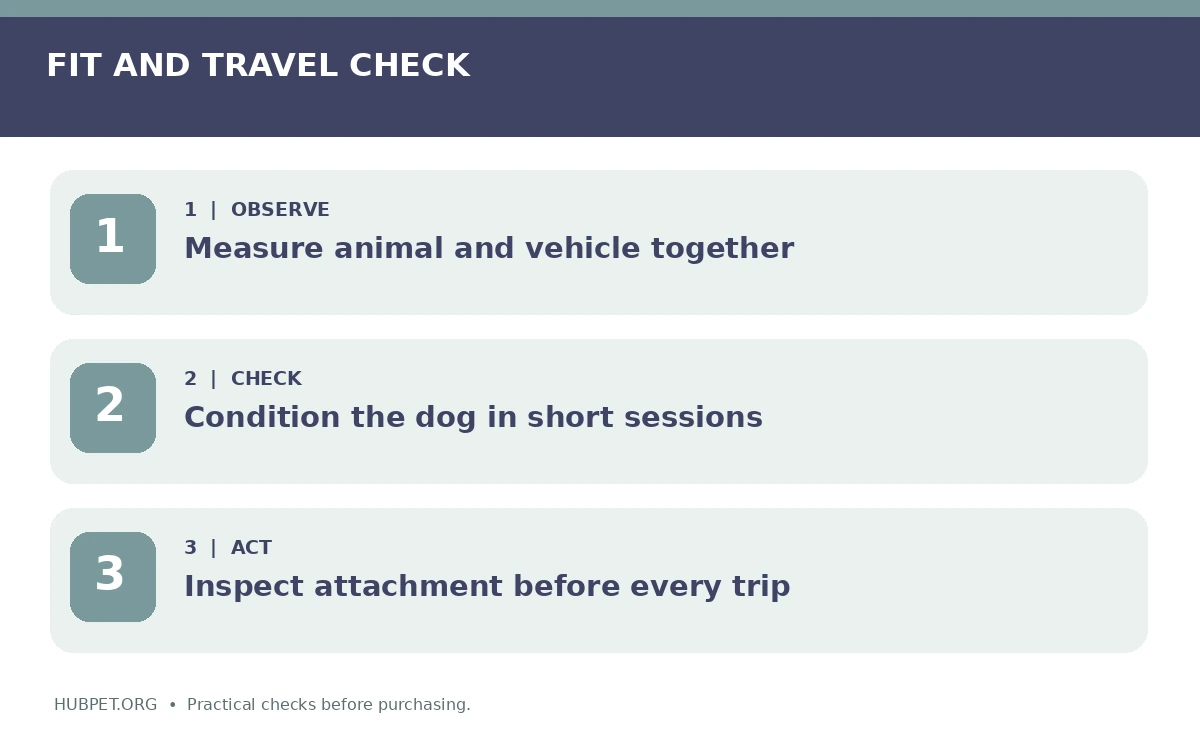
Measure both the dog and the vehicle
For a carrier-based option, compare the animal’s standing, turning and lying dimensions with the manufacturer’s usable interior dimensions and weight range. A dog should not be wedged into a narrow shell. For a harness, use the maker’s chest and body measurements instead of treating breed labels as universal.
Also measure seat width, belt geometry, headrest clearance and door operation. Confirm that the device will not tip or block another occupant’s belt. Installation diagrams should match the exact vehicle position you intend to use. If a carrier occupies more room than expected, do not leave it partially unsecured just to make it fit.

Assess anchorage, belt routing and hardware
Read how the product is held in place: vehicle belt, specified anchors or strength-rated straps for appropriate crate installations. The Center for Pet Safety emphasizes correct securement and warns about unsuitable extension arrangements. A well-constructed shell can still move dangerously if attached by a weak or incorrect connection.
Confirm that every buckle closes, straps lie flat and the intended routing does not cross a sharp edge. Never route a vehicle belt through a random fabric loop unless the manufacturer specifies it. A seat that requires forcing the belt into place may not fit your car. Consult the installation instructions and discontinue use when components show damage.
Separate comfort features from measurable protection
Padding, breathable mesh and a washable liner can make travel more pleasant. Those features can help a dog settle but do not independently prove crashworthiness. Thick loose cushions may interfere with harness geometry or occupy needed space in a tested carrier. Use only liners and accessories allowed for that model.
Consider temperature and airflow, especially for short-nosed or heat-sensitive dogs. Do not position a device in direct, intense sun with poor ventilation. A booster seat that allows a dog to put its head outside the window adds eye, ear and debris hazards; AVMA advises against that practice. Keep windows and doors secure.
Condition the dog before expecting a longer journey
Introduce any carrier or harness at home with brief, positive sessions. Let the dog enter voluntarily and rest without the car moving. Practice closing or fastening for very short durations while a caregiver is present. Gradually add time in the parked vehicle and then short drives that end somewhere neutral or pleasant.
Watch for drooling, repeated swallowing, panting, vocalizing or refusal to enter. Motion sickness and anxiety require different plans, and a veterinarian can help assess either. Avoid forcing a distressed animal into a product because it was expensive. A safe restraint is still part of a broader welfare routine.
Check emergency access and ongoing upkeep
Imagine a roadside stop where you must remove the dog safely without allowing an escape. Check whether the harness or carrier can be accessed from the appropriate door and whether one person can use the buckles correctly. Keep identification current and maintain a leash for transitions outside the vehicle.
Inspect seams, belt passages, hardware and any rigid shell before each trip. Follow cleaning instructions and replace the product after a collision if the manufacturer requires it. Washable covers should not conceal damage. In addition, plan water breaks and never leave the dog unattended in a parked vehicle.
Use a decision test before buying
Ask for evidence supporting four claims: what the seat does, what testing applies to this exact product, how it must be installed, and which dog sizes it accommodates. Write down uncertainties. An attractive listing with no installation manual is not enough. Compare total cost with a correctly fitted certified travel carrier or safety harness.
If the main feature you value is a raised view, remember that height and crash protection are separate questions. Select vehicle safety first, then comfort accessories that do not compromise it. For preparation beyond equipment, see our pet first-aid readiness checklist. No restraint eliminates all collision risk.
How We Research
We prepared this guide using animal welfare guidance and practical questions owners can ask about size, materials, supervision, fit and safe use. We did not purchase or independently test products, and we do not rank brands or claim veterinary endorsement. On October 26, 2026, our editorial review considered these sources. Learn more about HubPet and our editorial approach. This material does not replace advice for a specific animal from its veterinarian.
Sources
American Veterinary Medical Association: Traveling with Your Dog or Cat. Accessed October 26, 2026.
Center for Pet Safety: Pet Travel Seat Pilot Study. Accessed October 26, 2026.
Center for Pet Safety: CPS Certified Products. Accessed October 26, 2026.
Center for Pet Safety: Extension Tether Safety Warning. Accessed October 26, 2026.
Some sellers advertise tests, but evidence varies widely. Confirm independent results for the exact model and configuration. A soft raised seat is not automatically a crash restraint.
Do not assume a walking collar and short tether protect a dog in a crash. Concentrated neck forces and attachment failures are concerns. Research a tested complete restraint system.
The AVMA advises keeping dogs away from front passenger airbags. Choose a compatible manufacturer-approved travel position, typically in the rear, and follow the vehicle instructions.
No. A soft booster may offer comfort or elevation without full containment. A tested carrier or crate uses different structures and attachment methods; check the specific product evidence.
Stop and reassess. Build comfort through short positive sessions and ask a veterinarian about motion sickness or severe travel distress. Do not force a long ride to make the dog adjust.