
This article is general information, not veterinary advice. If your pet seems unwell, is in pain or may have eaten something harmful, contact your vet or an animal poison control line right away. Read our vet disclaimer.
This guide provides general educational information, not veterinary diagnosis or treatment. A cat straining to pass urine with little or no output needs emergency veterinary care immediately; do not wait or assume constipation. See the HubPet veterinary disclaimer.
Cat peeing out of the litter box is not a sign of spite. Urine on the floor can reflect pain, urgency, difficulty climbing into the tray, a disliked litter, social pressure or a box that simply misses the stream. This guide separates three scenes owners often call the same problem: urine beside a tray, urine elsewhere in the home and repeated attempts with little output. Each scene needs a different response; a veterinarian must first assess potential urinary emergencies before anyone experiments with new products.
First, watch what happens at the box
Notice whether the cat enters the litter tray and squats with the hindquarters over the edge, stands beside it, or avoids that room entirely. If urine appears directly behind a box after the cat has entered, a low rear wall or cramped turning space may be the immediate problem. A cat that chooses carpet or bedding in another room may prefer that location or surface, but illness may still contribute. Write down the time and location of each accident rather than guessing motives.
The ASPCA distinguishes box aversion, surface preference, location preference and medical causes. Any new house-soiling deserves a veterinary check; blood, crying, frequent tiny puddles, straining or genital licking need prompt professional attention. A male cat producing little or no urine may have an obstruction, a life-threatening emergency according to Cornell. Do not treat repeated unproductive visits as a behavioral issue or wait for a new tray to arrive.
| What you observe | Likely category to investigate | Next step |
|---|---|---|
| Cat squats inside; urine behind rim | Tray geometry or posture | Measure space; ask vet if posture changed |
| Accident on bed or rug | Surface or location preference; possible illness | Veterinary assessment; add accessible box |
| Frequent trips; drops or no urine | Possible urinary obstruction | Emergency veterinarian immediately |
| One cat blocks access | Social resource conflict | Separate boxes in different locations |
| Avoids new scented litter | Substrate or scent aversion | Offer familiar unscented choice |

Match the visible pattern to the first useful action
Use the chart as a starting point, not a diagnosis. Compare actual urine amounts when safe to observe, but never withhold veterinary care to collect data. The same cat may show an environmental issue and a painful urinary condition at the same time. After a veterinarian rules out pain, change one practical feature at a time: access, size, location or litter type. Keeping a second familiar box available makes it easier to interpret your cat’s preference and avoids forcing acceptance of a disliked new setup.
A tray that is one and a half times the cat’s nose-to-tail-base length, as suggested by feline veterinary guidance, gives room to turn. Check whether the cat can enter without stepping over a tall side; senior and mobility-limited cats often benefit from a low entry. A higher rear wall can help urine overshoot when posture is otherwise comfortable, but never solve the problem by enclosing a cat in a cramped covered container.
- Record whether the cat squatted inside or outside the box and whether urine actually passed.
- Contact a veterinarian promptly for new accidents; seek emergency care for repeated unproductive straining.
- Set up one large uncovered tray in a quiet, unobstructed location.
- Keep the familiar litter while testing one new factor at a time in a second tray.
- Clean accidents safely and track results without scolding the cat.
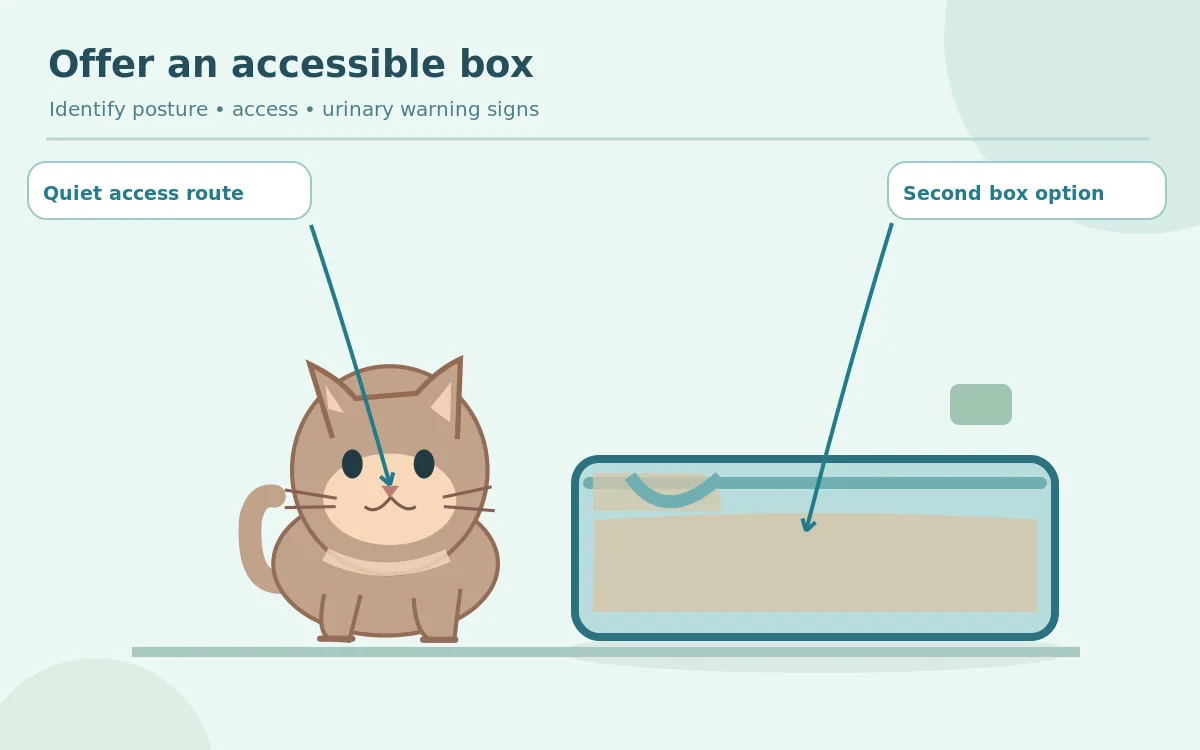
Set up an easier place to toilet
Put an open, roomy box in a quiet accessible spot, separate from food and away from loud appliances. In multi-cat homes, plan approximately one box per cat plus one extra, spread across locations rather than lined up in one room. Keep an unobstructed route so another pet cannot guard the only doorway. Many cats prefer unscented fine-textured litter; offer the familiar type while you test another rather than abruptly switching every tray.
Scoop every day and clean the tray with mild unscented soap or water, drying it before refilling. Avoid ammonia-based cleaners around accidents and do not use strong fragranced disinfectants in the box. For urine on carpet or upholstery, follow the surface maker’s cleaning instructions and an appropriate enzymatic cleaner’s label. Keep pets away while products are wet, and do not mix cleaning chemicals.
Know when a different box is not the answer
A cat that repeatedly squats but produces almost no urine needs emergency veterinary care, not a high-sided tray. A sudden increase in thirst, an obvious change in urine volume, visible blood or persistent accidents also merits a timely examination. Veterinary testing can distinguish problems that appear identical at home. Cornell notes that lower urinary tract signs can come from several causes, so this guide makes no diagnosis from location or stain size.
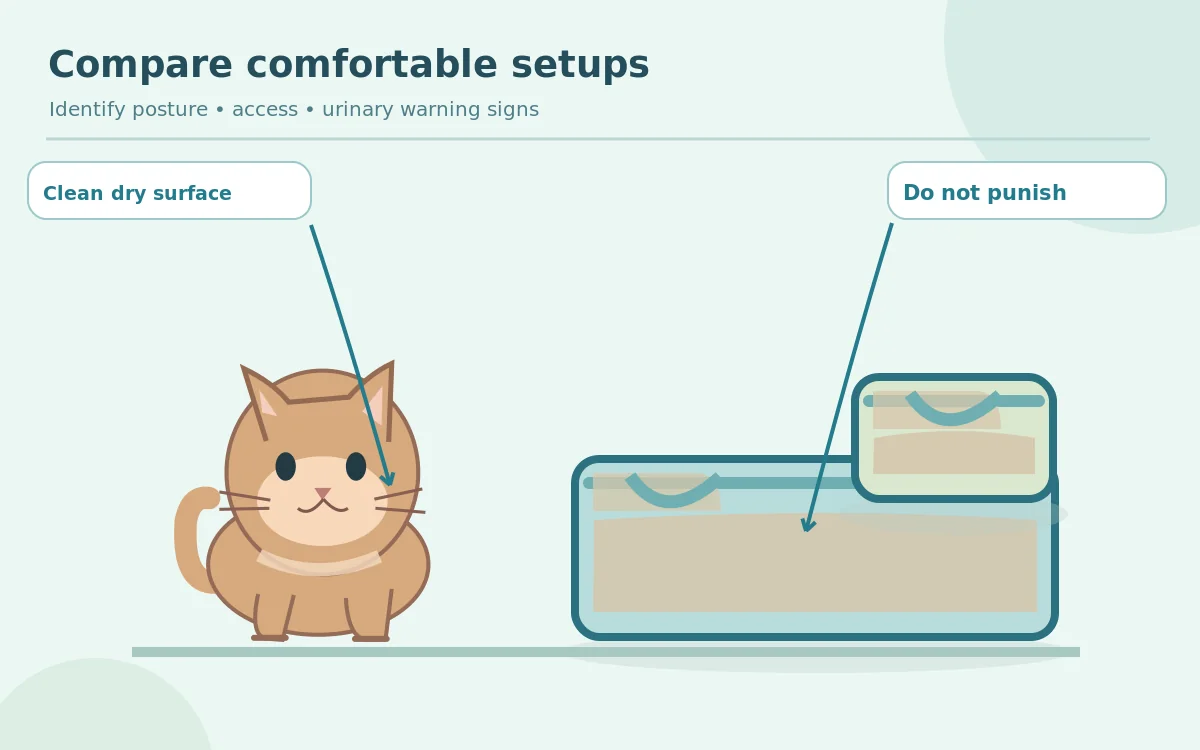
Never shout at the cat, push paws into litter or punish accidents. Fear can deepen an aversion and delay appropriate care. Once your veterinarian has excluded medical causes, a week-long log of location, surface, box used and household disruptions can help you and a qualified behavior professional identify a repeatable pattern. Our published litter-box problem guide provides the wider behavior-management context.
For an overshooting cat, measure the usable interior floor, not the advertised outer dimensions. Place a washable mat under the tray to protect the surface, not to trap the cat behind a narrow wall. If the cat starts standing awkwardly, has trouble stepping or suddenly changes posture, ask the veterinarian about pain or mobility. A tray accessory is not a substitute for investigating a new physical change.
When to Call Your Vet
Seek immediate emergency veterinary care if the cat repeatedly strains to urinate and little or no urine appears. Contact your vet promptly for sudden house-soiling, blood, pain, abnormal stool, lethargy or a worrying behavior change. Cat behavior guidance does not substitute for veterinary assessment.
How We Research
HubPet checked the specific cat behavior and safety guidance linked below, compared environmental choices with veterinary warning signs, and avoided unsupported product superiority claims. The tables offer decisions a household can observe without diagnosing disease. Read HubPet’s editorial approach for our process. For individual medical concerns, ask your veterinarian to adapt these choices to your pet.
Sources
ASPCA — Litter Box Problems — referenced for animal-welfare guidance and safety limits.
Cornell — Feline Lower Urinary Tract Disease — referenced for animal-welfare guidance and safety limits.
Cornell — Feline House Soiling — referenced for animal-welfare guidance and safety limits.
The cat may enter but overshoot a low edge, dislike the interior, or have urinary urgency. Record posture and have new accidents assessed by a veterinarian.
Yes. Some cats dislike trapped smells, narrow entries or poor escape visibility; compare with a large uncovered option.
A common feline welfare rule is one box per cat plus an additional box, distributed across separate accessible locations.
No. Punishment can increase fear and does not identify pain, urgency or box preferences. Clean the area and investigate the cause.
Repeated straining, frequent attempts with little or no urine, vocalizing in pain or obvious distress require immediate veterinary attention.