
An automatic litter box is still a toilet when the electricity fails, but its waste system and sensors may no longer work normally. Some models stop in place, others restart or retain different settings. You should not assume all units recover the same way or that a smartphone will report every fault. Planning is simple: keep a conventional tray, know the manual for your machine, and inspect the unit before resuming automatic use. A power cut should not leave the cat without a dependable place to eliminate. General guidance cannot replace the exact manufacturer instructions or veterinary advice. See our veterinary disclaimer.
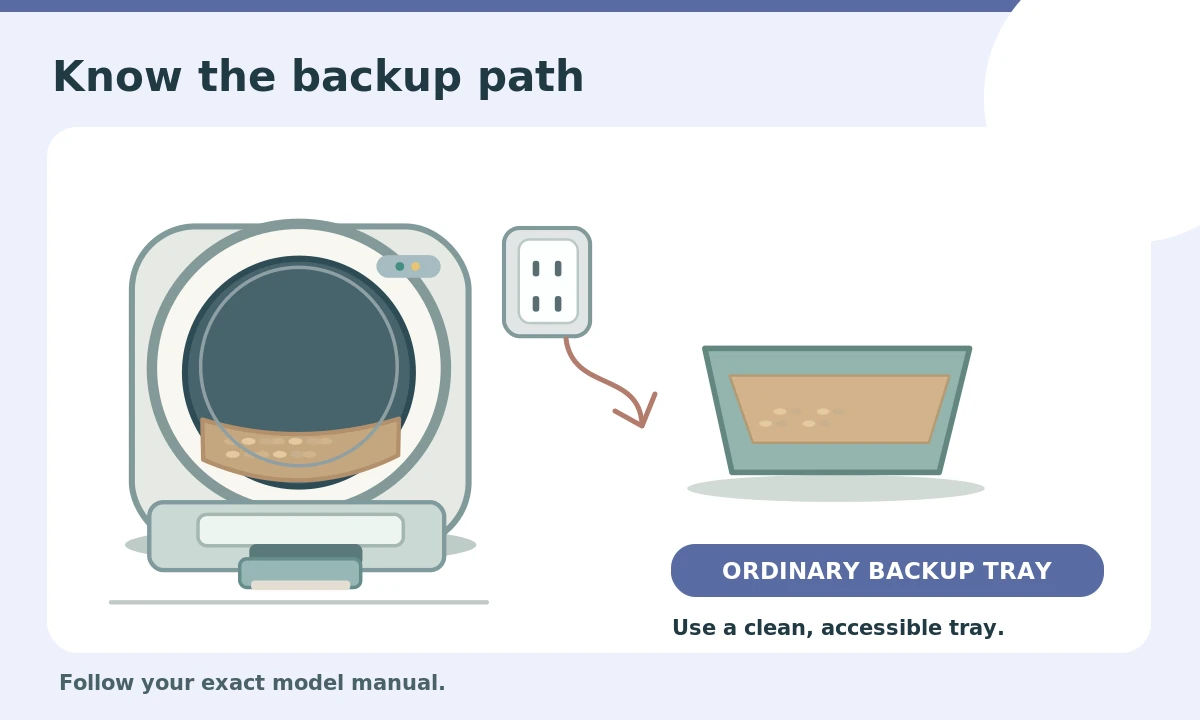
Keep an ordinary tray ready before the outage
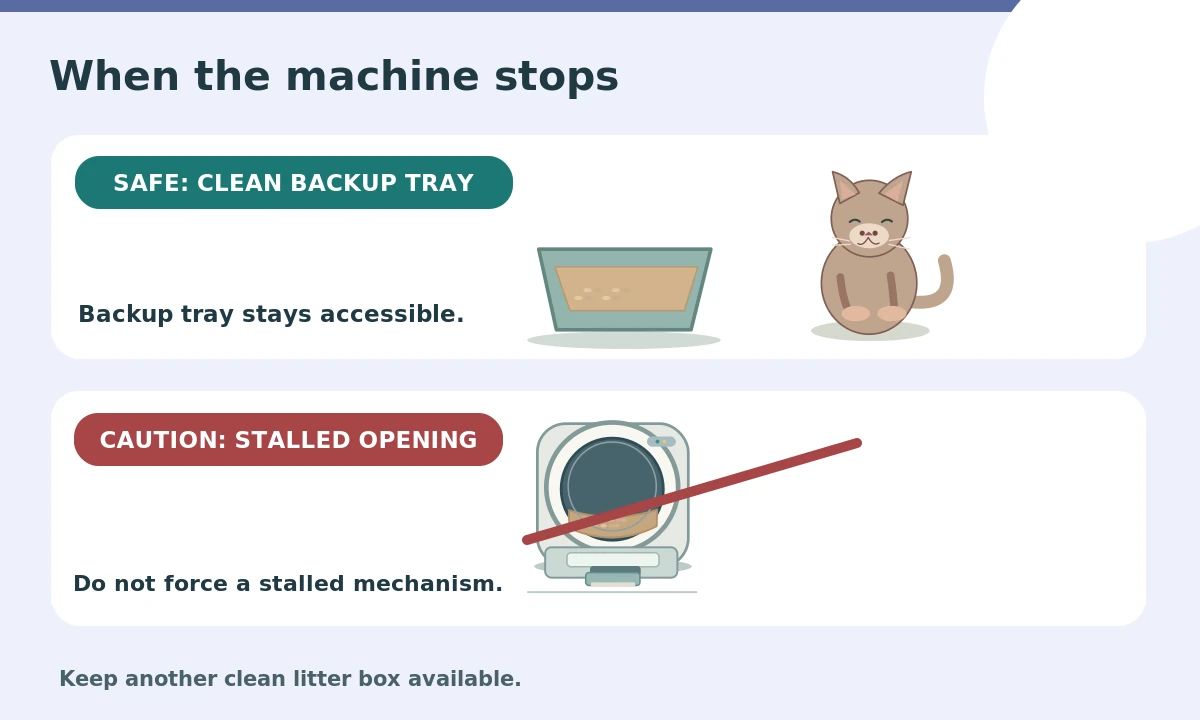
Store a clean open litter tray in a known place, along with suitable litter and a scoop. During a prolonged outage, place it in a quiet accessible area away from food and water. If the automatic drum or rake has stopped across the entrance, do not expect the cat to climb into it. Offer the alternative immediately and continue daily scooping. The backup box is not a temporary luxury: it also helps if the motor fails, the cat becomes frightened or the litter sensor needs service.
Learn how your specific model stops
Read the instruction manual before the first outage. Identify the safe home position, the meaning of error indicators, whether cycles resume automatically and how to disconnect power without moving the mechanism. One product may use an optional approved backup battery while another needs wall power. The presence of an app is not proof of battery backup. Do not fit an improvised battery or power adapter to a motorized appliance. Record the support page for the exact model and keep it accessible offline.
Check the cat’s access when power disappears
Look at the opening without putting hands into a moving mechanism. If the unit is in a normal static position and the manufacturer says it can be used without power, it may function temporarily as a stationary tray. However, do not treat the machine as fully operational until you inspect it. If debris obstructs the opening or the cat cannot reach the litter surface, keep the cat away from the appliance and use the ordinary tray. Never rotate the globe by force unless the official manual explicitly instructs you to.
Inspect after the power returns
Before switching automatic mode back on, confirm that the cat is nowhere inside or near the moving parts. Inspect the power cord for damage, verify the unit stands level, and check the drawer and waste path for spilled litter. Review any status lights or alerts using the correct manual. Some machines run a cycle after power returns; stay present for that first cycle. If a motor strains, a panel shifts out of place or an error persists, power off and contact the manufacturer rather than improvising a sensor reset.
Treat the app as an extra channel, not your safety system
A phone notification may arrive late or not at all when power and internet service fail. If you are away, an app cannot confirm that the cat has a safe and usable opening. A separate conventional box reduces this risk. Do not interpret a missing cleaning-cycle alert as proof that no cat used the box. Check the litter surface, waste drawer and the cat’s actual elimination patterns when you return. Keep an alternative box available during vacations and arrange a reliable caregiver to inspect it.
Use only approved backup batteries and power supplies
Check whether the maker offers a compatible backup battery for the exact model and accessories. Look for installation instructions, battery-life limits and disposal guidance. Backup time can vary with usage, temperature and battery age; the manufacturer’s advertised maximum is not a guarantee. Unplug before any approved installation work and follow the manual rather than opening sealed electronics. Do not place a battery, charger or extension connection where litter or spilled water can contact it. If in doubt, use a normal tray instead.
Practice a low-stress manual cleaning routine
Set a reminder for scooping and topping up the backup tray during an outage. Empty clumps into an appropriate waste bag; do not flush cat feces or litter unless local rules and the product explicitly permit it. Keep cleaning products away from cats, rinse equipment and dry thoroughly before refilling. For the automatic unit, only clear clogs or remove components that the manual describes as user-serviceable. Keep hands away from powered actuators. Regular basic hygiene remains necessary even when the motor normally does the work.
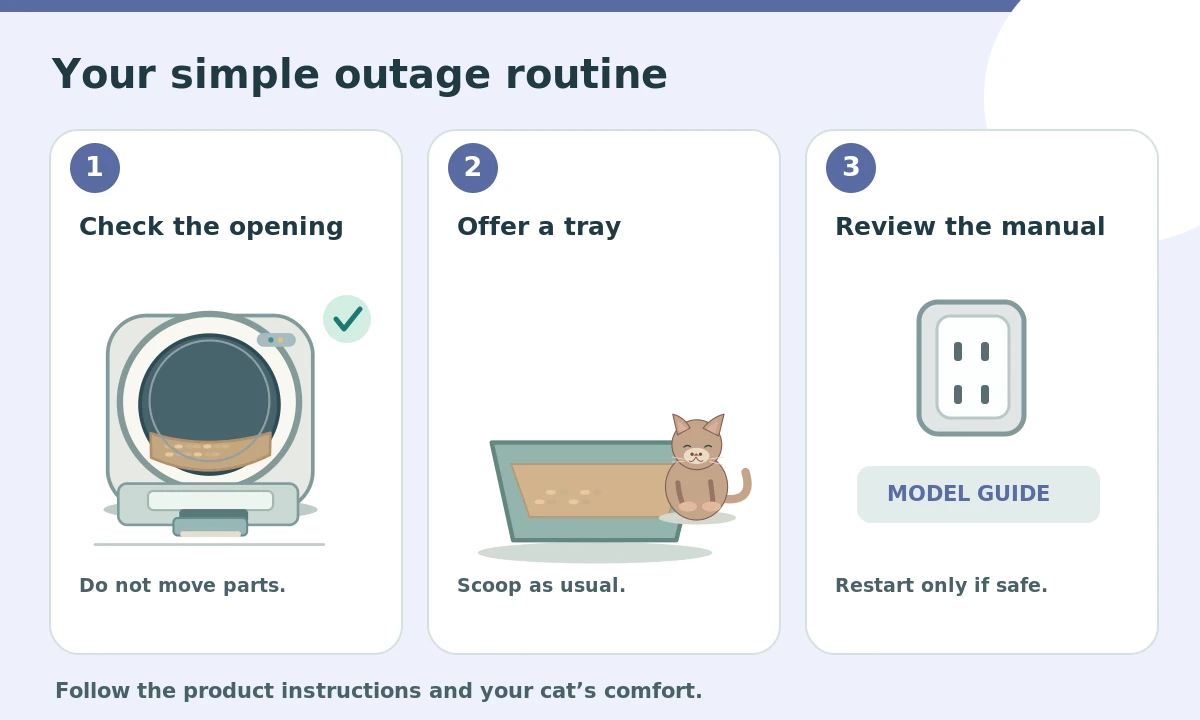
Decide when to leave the machine off
If power repeatedly drops, the unit makes abnormal sounds, something obstructs the entrance, or an error does not clear according to the manual, stop automatic operation. Rely on the conventional box and contact customer support. The same applies if a cat becomes reluctant to enter after a restart. Do not use repeated test cycles while the cat is near the appliance. A dependable, clean ordinary tray is safer than rushing to restore a feature. Contact a veterinarian for sudden elimination changes or signs of urinary distress.
How We Research
We consulted the Cornell Feline Health Center, the American Animal Hospital Association, and AAFP/ISFM feline litter-box and environment guidance. For model-dependent electronics, installation, behavior and software claims, we read manufacturer help and policy pages rather than assuming all devices work alike. This article compares observable design decisions and provides no commercial testing or product endorsement. Read About HubPet for our editorial approach. Cat preferences and normal elimination habits are the first priority; follow the exact manual and seek veterinary care for new urinary or stool-related concerns.
Sources
Cornell Feline Health Center — House Soiling — guidance on feline toilet access, device operation or product-specific limitations.
AAHA — General Litter Box Considerations — guidance on feline toilet access, device operation or product-specific limitations.
Whisker — Litter-Robot Frequently Asked Questions — guidance on feline toilet access, device operation or product-specific limitations.
Whisker — Automatic Litter Box Setup Guide — guidance on feline toilet access, device operation or product-specific limitations.
Only if the model allows stationary use and the entrance and litter surface are safely accessible; otherwise use a conventional tray.
No. Restart and cycle behavior vary. Consult the manual for the exact model before restoring automatic operation.
Do not rely on them. Network and power interruptions may prevent alerts, even on otherwise connected units.
No. Some have an optional approved battery, while others depend on an external power supply.
A clean, accessible ordinary litter box with scoop and appropriate litter offers the simplest fallback.