
The cleaning sound from a motorized litter box may be brief, but the cat hears it in the place where it needs to feel secure. A sudden rake, rotating drum or clattering clumps can make a sensitive cat suspicious of the toilet. This guide focuses on reducing surprise and preserving choice rather than finding a supposedly silent model. Start with the machine turned off, learn the cat’s response, and keep a familiar open box accessible. A cat that appears startled deserves more time, not pressure. General guidance cannot replace the exact manufacturer instructions or veterinary advice. See our veterinary disclaimer.
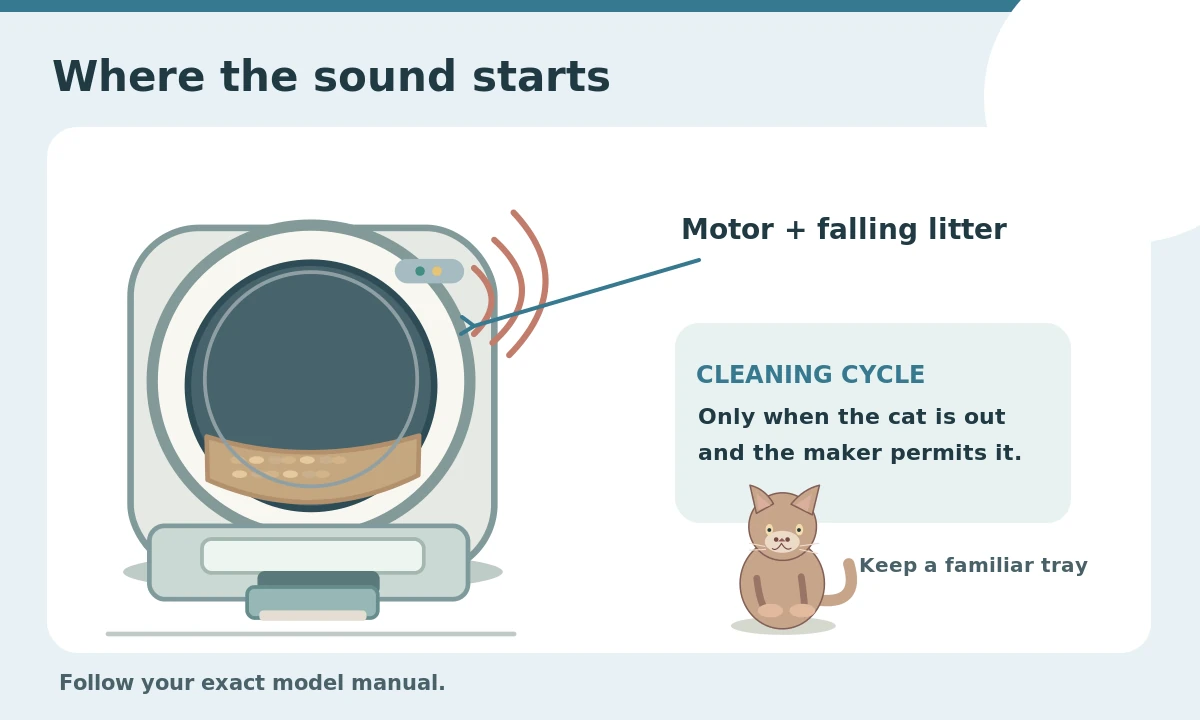
Listen for different sources of sound
A manufacturer’s quiet-mode label does not tell you what the cat hears in your room. Notice the low motor hum, loose plastic parts, falling clumps, drawer rattles and end-of-cycle clicks. The sound may grow louder beside a bare wall or on a resonant wooden floor. Compare different settings only when the machine is empty of cats and operated exactly as instructed. Avoid trying to silence the device by covering its vents, changing sensor position or placing it on an unstable pad.
Begin with a stationary, unplugged or off unit
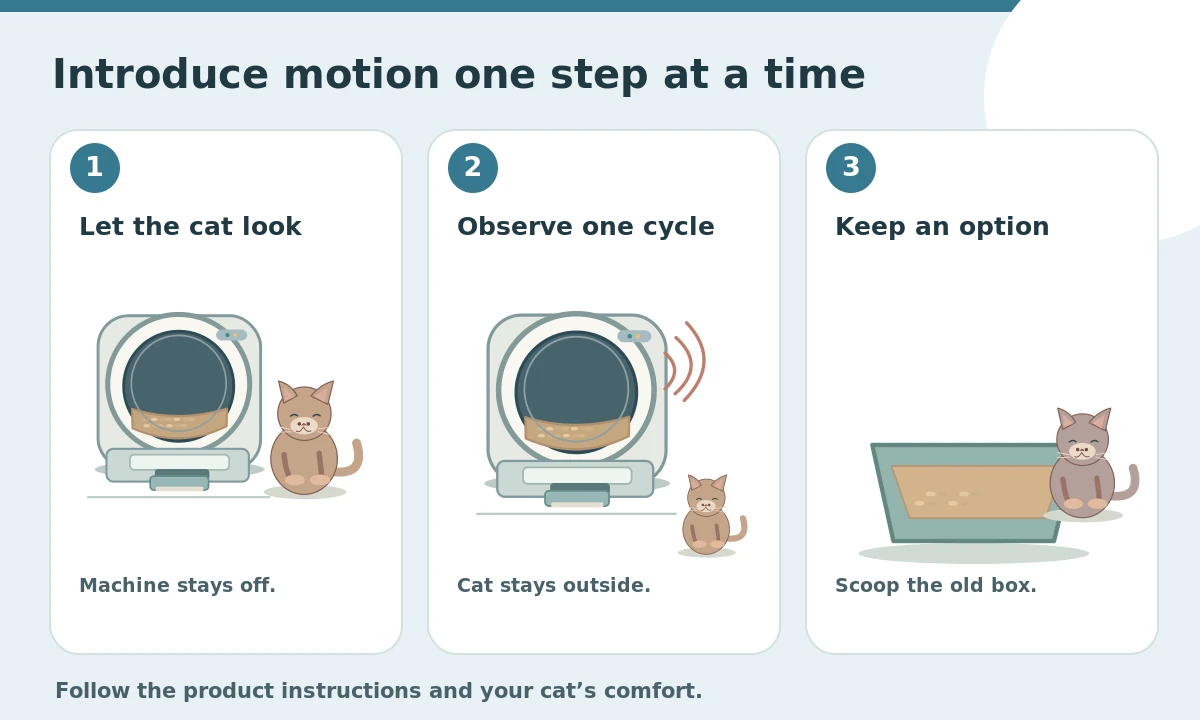
Put the machine in a suitable location with its power off and normal litter prepared according to the manual. Allow the cat to investigate without lifting, placing or holding it inside. Some cats will sniff the opening and leave several times before stepping in. Reward voluntary interest with a favored treat or calm attention at a distance the cat chooses. The original conventional box should remain available and clean. Never force the cat inside as a method of proving the machine is safe.
Keep the familiar box in a different accessible place
During the transition, the cat needs a dependable option if it dislikes the new enclosure. Retain the old box and regular scooping instead of allowing waste to pile up to pressure a change. For cats that need multiple locations or have existing litter issues, a second clean ordinary tray is especially valuable. Record whether the cat uses either box, where it hesitates and whether there is a pattern after a cycle. Elimination outside the box is communication, not misbehavior deserving punishment.
Introduce one observed cleaning cycle calmly
Only after the cat has used the stationary unit should you consider showing one cleaning cycle, when the cat is outside and able to move away. Follow the manufacturer’s introduction procedure and supervise the machine. Watch for flattened ears, abrupt fleeing, hiding, freezing or reluctance to return to the room. Stop and return to manual operation if distress appears. The timing delay and safety sensors are part of the device’s instructions; do not defeat them to make the cleaning cycle occur sooner.
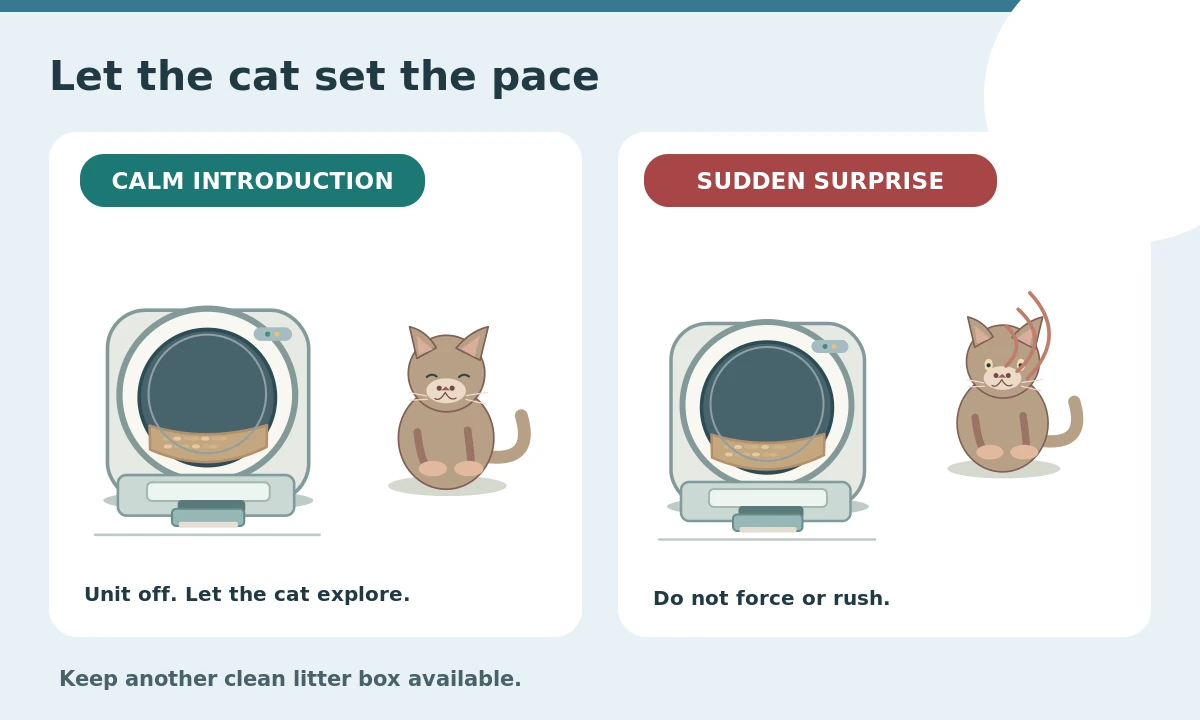
Choose a place that does not amplify the motor
Try a quiet, well-ventilated area away from rattling laundry appliances, door slams and busy foot traffic. A location that seems hidden to people may have poor sightlines or a narrow exit for the cat. Keep the machine on its approved stable surface. If sound echoes from tile or walls, moving to a suitable different location may help, but do not move the toilet repeatedly in a single day. Predictable placement and easy approach usually matter more than a perfect decorating solution.
Separate noise aversion from access problems
A cat may reject the box because of the opening, litter texture, cleanliness, scents or a competing cat rather than the motor alone. Observe the entire route. Does the cat approach while the machine is off? Does it hesitate on the step? Does it only retreat after a cleaning cycle? These patterns help you decide what to change. Avoid adding strong fragrances or noisy accessories to make the area more inviting. If the cat starts urinating frequently or straining, arrange veterinary care quickly.
Give each cat an independent option
In a multi-cat household, one bold cat may investigate while another avoids the machine. Neither cat should be pressured to follow the other. Place separate clean boxes in more than one accessible area and monitor each cat’s behavior. A cat that guards the automatic unit may make the entrance feel unsafe. Keep the floor around the machine unobstructed so a cat can leave without being cornered. Shared household convenience is not a reason to reduce a shy cat’s toileting choices.
Build a simple observation routine
For the first several days, check the cat’s normal urination and stool patterns, not just the machine’s cycle history. Keep notes on voluntary entry, reaction to sound and box preference. Increase automatic use only when the cat remains relaxed and the maker allows it for the animal’s weight and age. Clean the familiar tray daily and maintain the new unit normally. If fear continues, return to a conventional box. Protecting reliable toileting is more important than using the automatic feature.
How We Research
We consulted the Cornell Feline Health Center, the American Animal Hospital Association, and AAFP/ISFM feline litter-box and environment guidance. For model-dependent electronics, installation, behavior and software claims, we read manufacturer help and policy pages rather than assuming all devices work alike. This article compares observable design decisions and provides no commercial testing or product endorsement. Read About HubPet for our editorial approach. Cat preferences and normal elimination habits are the first priority; follow the exact manual and seek veterinary care for new urinary or stool-related concerns.
Sources
Cornell Feline Health Center — House Soiling — guidance on feline toilet access, device operation or product-specific limitations.
AAHA — General Litter Box Considerations — guidance on feline toilet access, device operation or product-specific limitations.
Whisker — Introducing Your Cat to an Automatic Litter Box — guidance on feline toilet access, device operation or product-specific limitations.
AAFP/ISFM — Feline Environmental Needs Guidelines — guidance on feline toilet access, device operation or product-specific limitations.
Often yes, when the manufacturer permits it. Let the cat explore and use a stationary unit before introducing the cleaning sound.
No. Motor, litter and plastic noises vary by room and cats may respond to sounds that people barely notice.
Reward voluntary approaches, but never lure or hold a fearful cat inside or remove every other clean toilet.
Choose a quiet accessible site with a clear exit, ventilation and the floor conditions required by the device.
Contact a veterinarian for new or persistent elimination changes, and seek urgent help for straining or repeated unsuccessful urination.