
The outside dimensions of a self-cleaning litter box do not describe how much usable room a cat has. Some models have tall drums, rear power plugs, opening doors, removable drawers, and wide steps. Each needs additional space around the machine. Before ordering, draw the whole setup on the floor and consider the cat’s route in and out. The goal is not to hide a large appliance in a tight corner. It is to provide a stable, accessible toilet that the cat willingly uses. General guidance cannot replace the exact manufacturer instructions or veterinary advice. See our veterinary disclaimer.

Measure the entire appliance, not just its base
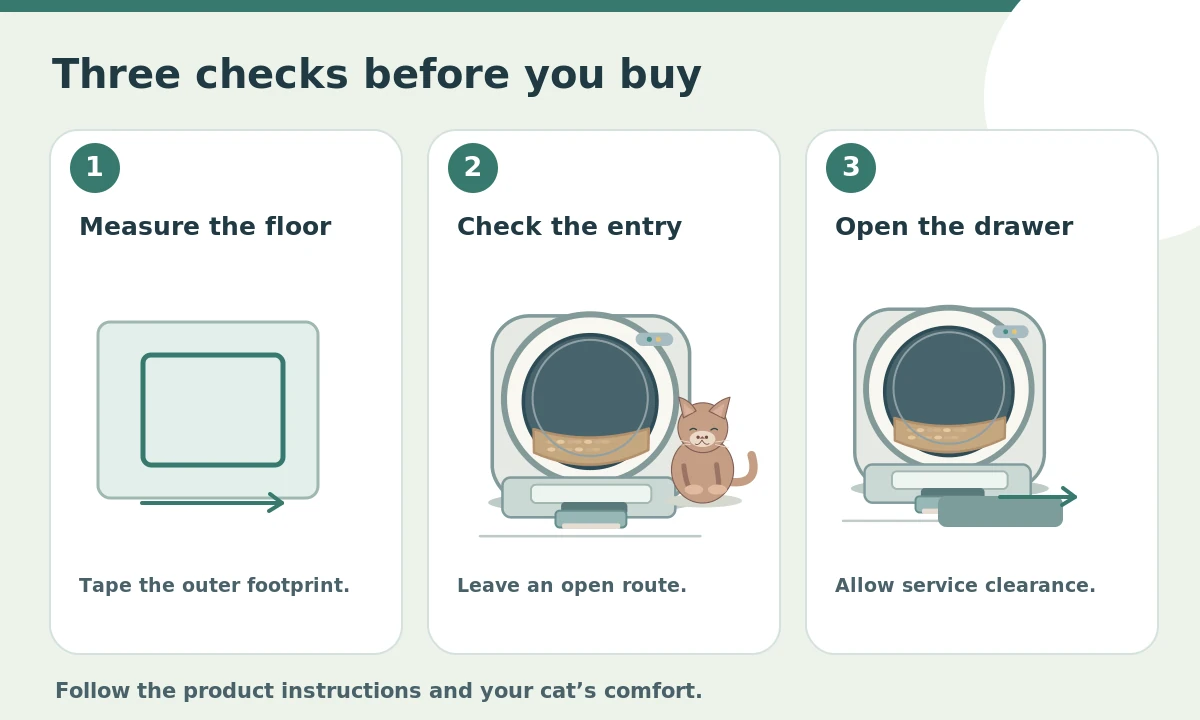
Record the manufacturer’s width, depth and height, then add room for the waste drawer and any lid or globe that must lift away. A unit may fit between furniture but still be impossible to service. Tape its footprint onto the floor and test how a person would pull out the drawer. If you must tip the device to refill litter, check overhead space as well. Use the exact product instructions for clearance; there is no universal distance that suits every machine.
Check the real entry height and opening
Measure from the finished floor to the first surface a cat must step onto, not only the opening to the drum. Examine the height of any stair, the width of the opening and whether an adult cat can turn around comfortably inside. Cats with stiffness, older cats and smaller cats may find a high step difficult even when the overall housing is large. The guidance for regular boxes favors generous interior space and easy entry. A convenient floor footprint is not a substitute for cat comfort.
Leave a clear approach and an exit route
A cat should be able to approach, enter and leave without squeezing past clutter or a second animal. Position the entry away from a narrow dead end where another cat could block escape. Do not place food and water right beside the toilet. Avoid locations that require a cat to pass a frightening washer or dog crate. AAHA recommends accessible boxes in separate quiet locations. In multi-cat homes, keep additional ordinary boxes available in distinct areas, not all grouped in one cabinet.
Put the machine on the surface its maker approves
A flat, stable floor helps keep a large motorized machine from rocking and may affect sensors or scales. Some models require hard floors; others explicitly permit certain carpet setups. Follow the exact manual instead of making a universal claim. If you use a base plate, mat or step, confirm the maker allows it and check that it does not obstruct a sensor or opening. Route the power cable where pets cannot chew, snag or tug it and keep the supply away from splashes.

Plan for drawer removal and cleaning
Try the motion of sliding the waste drawer out while the unit is placed in its intended corner. Can you reach the latch, see the fill line and remove clumps without brushing the wall? Also plan a place to set removable pieces during cleaning. Narrow storage alcoves can trap odor and make routine inspection inconvenient. Keep the route from machine to trash can simple enough that daily checks will not be skipped. A self-cleaning machine still requires regular waste disposal and sanitation.
Compare the machine opening with the cat’s body
The exterior shell can look generous while the inner floor is small. Compare the interior usable standing and turning room with the length of your cat, measured from nose to the base of the tail. The AAFP/ISFM house-soiling guidelines recommend conventional boxes about one and a half times this length. That is a useful comfort benchmark, not a claim that every automatic mechanism can meet it. If your cat cannot turn naturally or avoids the enclosure, choose a larger or open alternative.
Test a temporary floor plan before changing the home
Use painter’s tape for the base, folded cardboard for the approximate height, and a free-standing stool to represent required clearance. This dry run tests walking paths without bringing moving machinery near a curious cat. Make sure nobody can knock the appliance while passing. Look at the layout from cat height: a dark recess or narrow turn may feel different to the cat than it does to a person standing above it. Leave the familiar ordinary litter box in service during any transition.
Know when a normal box is the better fit
A compact apartment does not automatically call for a motorized toilet. A roomy open tray may be easier to place, inspect and clean. If the appliance blocks the hallway, cannot be serviced, or requires your cat to jump into a narrow opening, treat those as reasons to choose another design. Sudden avoidance of any litter box, straining or frequent unsuccessful trips can signal a medical issue. Contact a veterinarian promptly rather than assuming the robot’s location is the only cause.
How We Research
We consulted the Cornell Feline Health Center, the American Animal Hospital Association, and AAFP/ISFM feline litter-box and environment guidance. For model-dependent electronics, installation, behavior and software claims, we read manufacturer help and policy pages rather than assuming all devices work alike. This article compares observable design decisions and provides no commercial testing or product endorsement. Read About HubPet for our editorial approach. Cat preferences and normal elimination habits are the first priority; follow the exact manual and seek veterinary care for new urinary or stool-related concerns.
Sources
Cornell Feline Health Center — House Soiling — guidance on feline toilet access, device operation or product-specific limitations.
AAHA — General Litter Box Considerations — guidance on feline toilet access, device operation or product-specific limitations.
AAFP/ISFM — House-Soiling Guidelines — guidance on feline toilet access, device operation or product-specific limitations.
Whisker — Automatic Litter Box Setup Guide — guidance on feline toilet access, device operation or product-specific limitations.
Use the model-specific clearance guidance and add accessible space for drawer removal, power cords, and the cat’s approach.
Only if the cat has easy access, the machine has its required clearances, and the location stays ventilated and serviceable.
Stability and sensor accuracy may depend on the surface. Always follow that model’s installation instructions.
Keep an easy-entry ordinary box available and consider a lower, more open unit rather than forcing the cat through.
No. Compare the usable inside space and turning room separately from the exterior footprint.