
How to train a dog to settle during guest visits starts before the guests arrive. The Dogs Trust settle-training guide recommends beginning in a quiet place and rewarding increasingly relaxed behavior. Then the Dogs Trust visitor-training guide adds door sounds and real visitors gradually. A useful companion training page is how to Reward Calm Behavior Effectively.
This method also matches the AVSAB humane-training position, which recommends reward-based methods for dog training and behavior modification. Start with the settle-on-a-mat guide and the positive reinforcement guide before you expect the dog to settle around a social distraction.
How to Train a Dog to Settle During Guest Visits: Build the Skill First
How to train a dog to settle during guest visits becomes much easier when the mat or bed already predicts calm rewards. The short-session guide can help you keep repetitions brief. Meanwhile, the doorbell guide separates the arrival sound from the later social interaction.
Do not begin with a crowded living room. Use the distraction-training guide to raise difficulty one factor at a time. If the dog starts barking at the door, the door-barking guide can help you manage the trigger before you ask for a settle.
| Stage | Set up | Reward |
|---|---|---|
| 1. Quiet mat | No visitor present | Any relaxed orientation to the mat |
| 2. Duration | Dog already comfortable | Longer calm pauses |
| 3. Door sound | Low-intensity knock or bell | Return to mat and relax |
| 4. Helper enters | Distance and barrier if needed | Calm staying or disengaging |
| 5. Real guest | Short visit | Relaxed behavior and recovery |
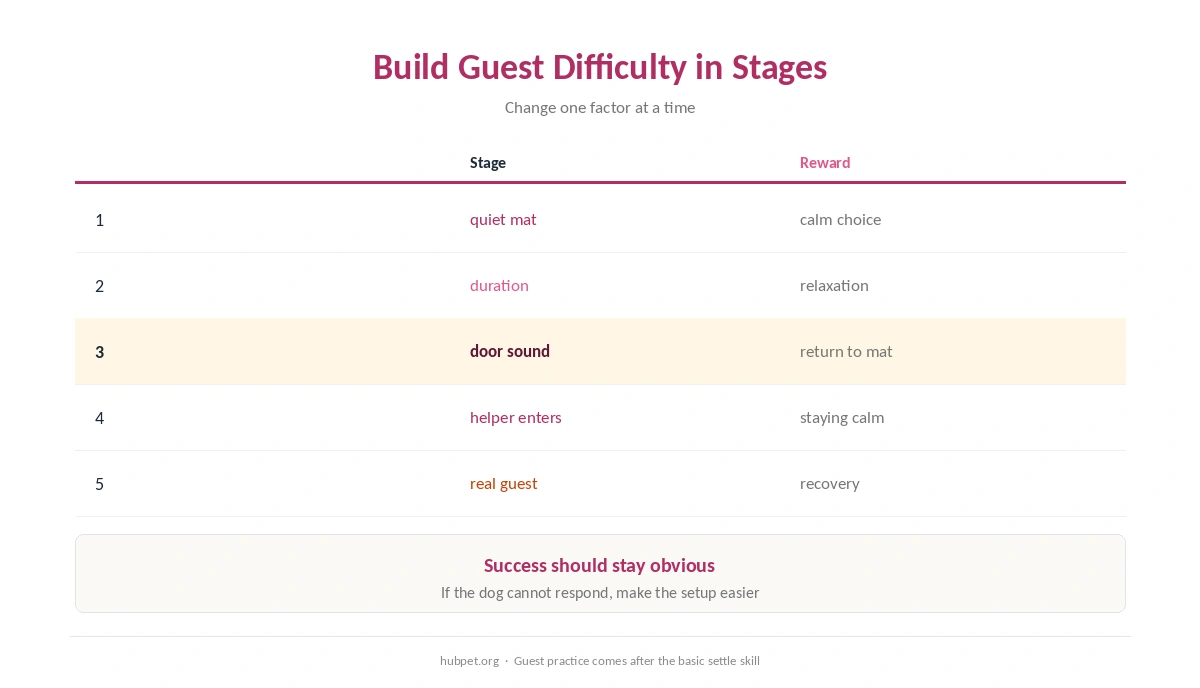
How to Train a Dog to Settle During Guest Visits Step by Step
When jumping is part of the arrival routine, manage that separately with the jumping guide. For a dog showing worry rather than excitement, use the fear-confidence guide and add more distance instead of luring the dog toward the guest.
- Choose a mat or bed in a place that is not directly in the traffic path.
- Reward the dog for calmly orienting to or resting on the mat.
- Build short duration before adding any visitor cue.
- Practice a soft knock or doorbell sound at a level the dog can handle.
- Cue the mat, then reward calm behavior after the sound.
- Use a helper who can enter quietly and ignore the dog at first.
- Keep the first guest repetitions short and easy.
- Release the dog only when you choose, rather than when excitement peaks.
- End the session or increase distance if the dog cannot settle.

Troubleshooting How to Train a Dog to Settle During Guest Visits
Repeatedly leaving the mat can mean the criterion is too hard. Return to easier duration or more distance. The stay-training guide can help with duration. Use the common training mistakes guide to spot jumps in difficulty. Aim for relaxed behavior rather than rigid stillness.
How to train a dog to settle during guest visits also requires easier setups when movement raises arousal. When the dog escalates as a person moves closer, use barriers and management. The guest-anxiety guide covers lowering social pressure, while the redirection guide shows how to reinforce a safer alternative before the unwanted pattern repeats.
Do not punish barking, growling, or attempts to move away. Instead, increase space and reassess the setup. A dog with a bite history or cannot recover around visitors, stop rehearsing the situation and seek qualified reward-based behavior support.

When to Get Professional Help
Seek reward-based professional help if the dog shows escalating fear, repeated lunging, redirected aggression, a bite history, or an inability to recover even with distance and barriers. Management comes first when visitor safety is uncertain.
How We Research
HubPet reviewed the Dogs Trust settle guide, the Dogs Trust visitor guide, and the AVSAB humane-training position page on October 11, 2026. Read more about our research process.
Teach the basic settle in a quiet setting first. Add door sounds, movement, and real visitors only after the dog can relax at easier levels.
They can be part of a planned reward strategy if the dog is comfortable, but do not lure a worried dog closer than they choose to go.
Lower duration, reduce distraction, or increase distance. Repeated failure is a reason to lower difficulty and rebuild success at an easier step.
A leash can be part of safe management if it stays loose and you avoid corrections. Barriers may be easier for some dogs.
Create distance and stop the interaction. Do not punish the warning. Seek qualified help if fear or aggression is persistent or creates safety risk.
The Bottom Line: How to Train a Dog to Settle During Guest Visits
How to train a dog to settle during guest visits is a progression: teach calm on the mat, add door sounds, add a quiet helper, then practice real visits. Reward relaxation, lower difficulty when the dog struggles, and never rely on punishment to create stillness.