
This article is general information, not veterinary advice. If your pet seems unwell, is in pain or may have eaten something harmful, contact your vet or an animal poison control line right away. Read our vet disclaimer.
How to create safe climbing spaces for cats starts with stable routes, secure resting points, and more than one way to move through the area when possible. The FelineVMA environment guidance describes climbing as normal feline behavior and says vertical space and hiding options are important for indoor cats. The 2024 indoor/outdoor position statement likewise includes safe territory with vertical space among the needs of indoor-only cats.
Your goal is not to build the tallest possible structure. A useful route lets the individual cat climb, pause, observe, rest, and leave without being trapped by another pet or by household traffic. Pair vertical space with the basics in the indoor-cat stimulation guide and the enrichment-corner guide.
How to Create Safe Climbing Spaces for Cats: Start With the Route
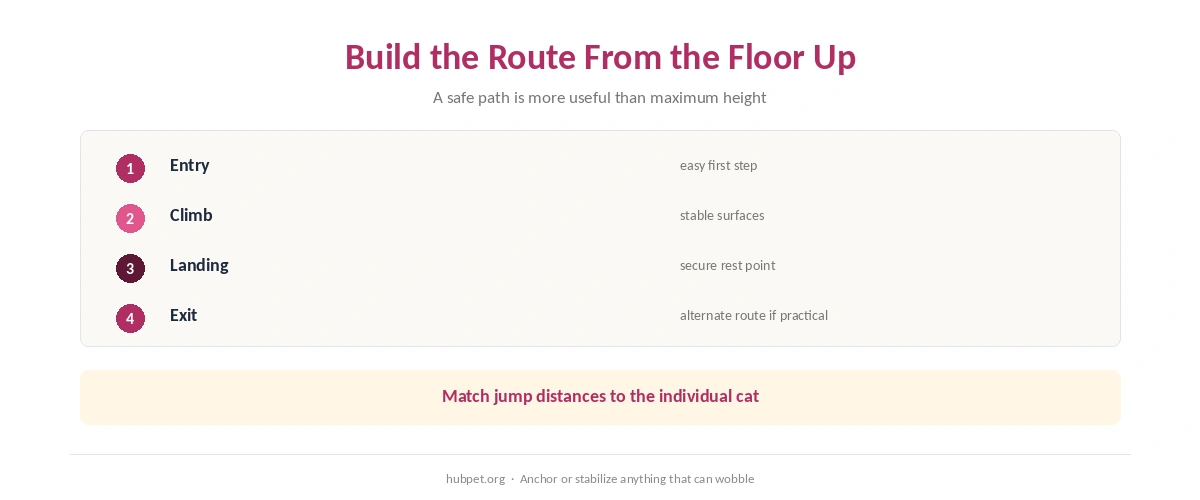
Look at the path from the floor up, not only the final perch. How to create safe climbing spaces for cats begins with reachable steps and secure landings. The 2009 feline enrichment review describes climbing and jumping as normal behavior. It also notes that vertical space can add vantage points, activity, rest, and retreat. Offer intermediate surfaces if the jump to the destination would be awkward for your cat.
Choose locations that do not force the cat past a dog, another cat, a loud appliance, or a busy doorway. FelineVMA guidance says safe spaces should let a cat retreat, with more than one route when practical. A calm-space setup can help with placement. In multi-cat homes, use the multi-pet household checklist and the two-cat introduction guide to reduce blocking and ambush points.
| Design question | Safer answer | Why it matters |
|---|---|---|
| Can the surface move? | Anchor or stabilize it before access | A wobbling route can discourage use or cause a fall |
| Is there only one exit? | Add another route when practical | Cats may avoid places where another pet can block them |
| Is the landing slippery? | Use a secure, non-slip resting surface | Stable footing makes climbing and resting easier |
| Is the route near a hazard? | Move it away from hot, breakable, or open-fall areas | Vertical enrichment should not create a new household risk |
How to Create Safe Climbing Spaces for Cats in a Small Home
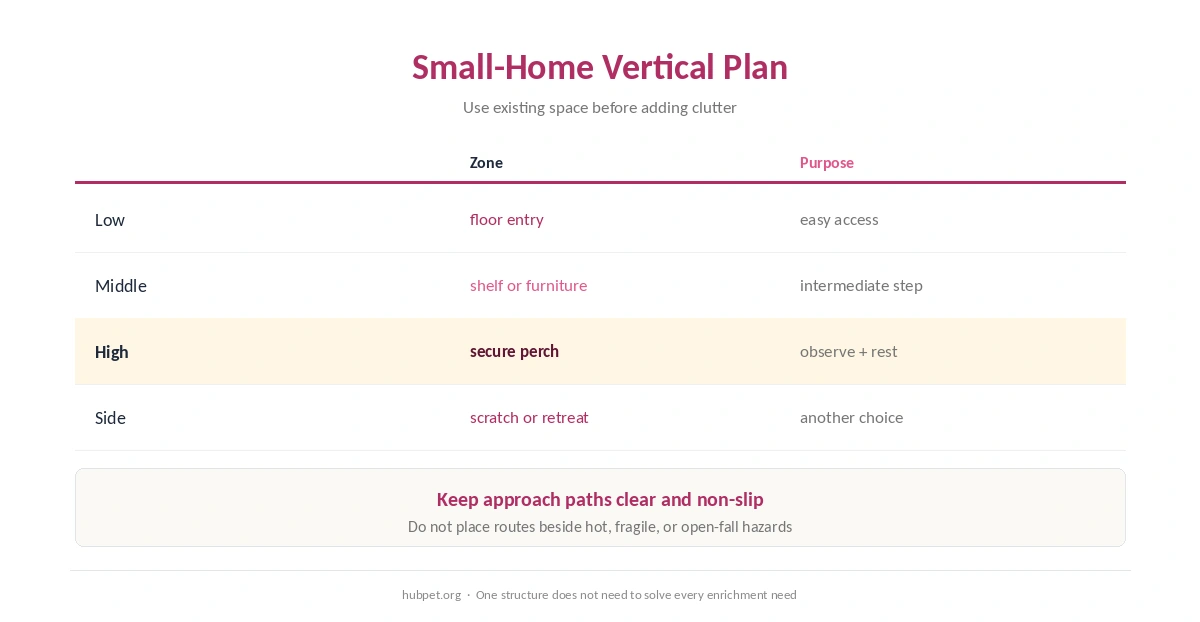
Use existing vertical surfaces before adding clutter. How to create safe climbing spaces for cats in a small home often means making existing routes more usable. A stable cat tree, secure shelf route, window perch, or furniture arrangement can expand territory without taking much floor space. The pet-floor cleaning guide can help keep approach areas clear. The furniture-hair guide is useful if a route includes upholstered surfaces.
Give climbing a purpose. One route might lead to a quiet resting place, another to a window view, and another to a scratching area. The AAFP/ISFM environmental-needs framework treats resting, play, scratching, and safe places as separate resources. Therefore, a single tall structure should not be expected to solve every enrichment need.
If the cat ignores the new route, do not place them on it and hold them there. Use preferred rewards near easy entry points and let the cat explore voluntarily. The reward-based principles in scratching-post training also apply here: make the desired location convenient and worthwhile rather than punishing other choices.
Adjust Climbing Space for Age, Mobility, and Other Pets
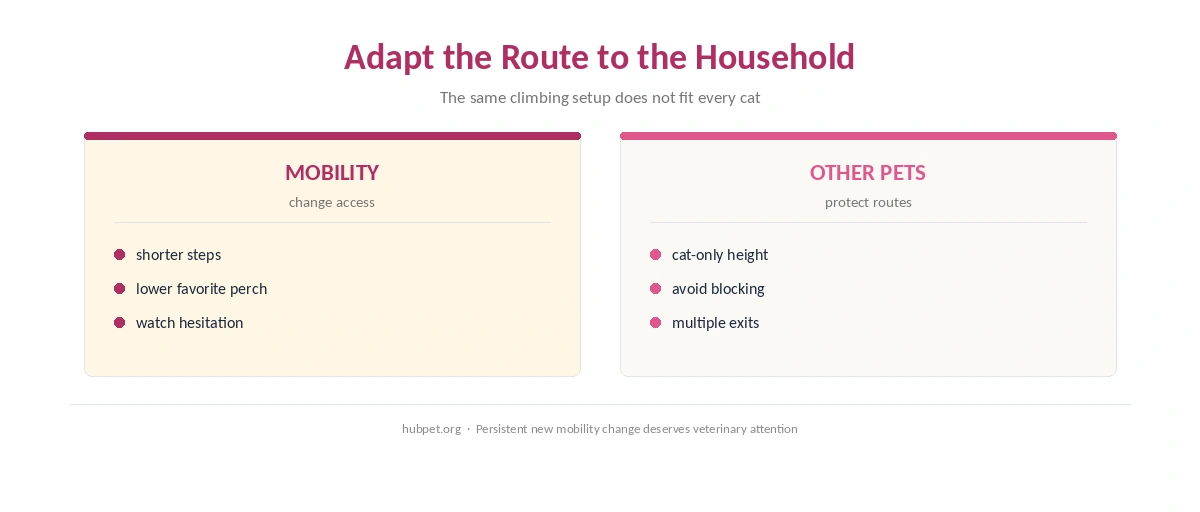
A route that works for a young athletic cat may become difficult later. FelineVMA guidance notes that preferences for vertical or horizontal scratching can change with degenerative joint disease, and senior-care resources may use steps or ramps to preserve access to favorite places. If your cat starts hesitating, missing jumps, or abandoning a usual perch, do not assume stubbornness.
Compare the change with signs of pain and the at-home pet check approach. A new mobility change deserves veterinary attention, especially when it is persistent or paired with changes in grooming, appetite, elimination, or social behavior. Do not give human pain medication.
For dog-cat homes, create cat-only height and escape paths that the dog cannot easily crowd. The dog-cat introduction guide and helping pets get along both emphasize separation, safe routes, and gradual interaction. Vertical space is useful only if the cat can actually reach and leave it safely.
How We Research
HubPet reviewed feline environmental guidance on October 11, 2026. We used the 2013 AAFP/ISFM Environmental Needs Guidelines, the FelineVMA environment and positive-reinforcement guidance, and the 2009 review of feline environmental enrichment. Our research process favors practical recommendations that match normal feline behavior without claiming that every cat needs the same structure.
Use a stable cat tree, secure window perch, or furniture arrangement with reliable intermediate steps and resting points.
FelineVMA and AAFP/ISFM guidance includes climbing, elevated resting options, and vertical territory as important parts of a healthy indoor environment.
There is no universal home height that fits every cat. Choose a route that matches the cat’s mobility and gives secure landings and exits.
The location may have become less comfortable or harder to reach. A persistent new mobility change can also be a sign that veterinary assessment is needed.
No. Let the cat explore voluntarily and reward interest in the route instead of forcing the cat to stay on an unfamiliar surface.
The Bottom Line on How to Create Safe Climbing Spaces for Cats
How to create safe climbing spaces for cats is mainly about usable routes: stable footing, secure rest points, sensible exits, and placement that avoids conflict. Start with the cat’s current mobility and preferences, then adjust the route as those needs change. Vertical space should add choice, not pressure.