
How to teach a dog to wait at the door is mostly a lesson in reinforcing calm behavior before the door opens. Dogs Trust advises beginning at a quiet door, rewarding calm behavior, opening the door only a little at first, and making the exercise harder gradually (Dogs Trust, accessed 2026). AVSAB continues to recommend reward-based methods for all dog training (AVSAB, 2021; reaffirmed 2025). A useful companion training page is how to Practice Calm Behavior Before Walks.
How to Teach a Dog to Wait at the Door: Step by Step
Start where success is easy. If the front door makes your dog too excited, use a quiet inside doorway first. This follows the same low-distraction principle used in basic dog training at home and positive reinforcement training.
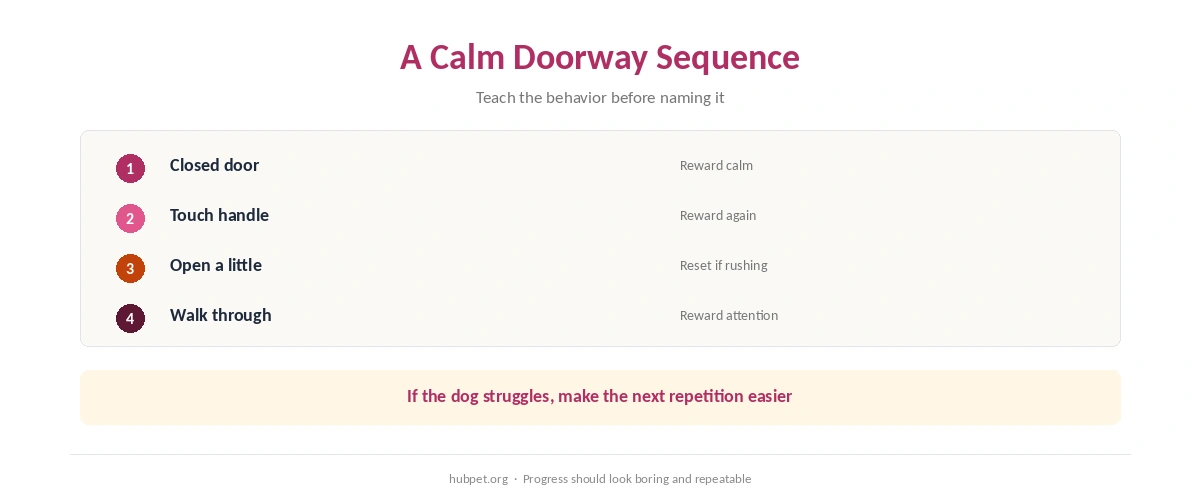
- Clip on the leash and stand by a closed door while you stay quiet and relaxed.
- Wait for loose-leash, four-paws-down behavior; a sit is optional rather than mandatory.
- Reward the calm moment immediately.
- Touch the handle. If calm behavior continues, reward again.
- Open the door a small amount. If the dog rushes forward, close it gently and reset.
- Increase the opening only when the previous step is easy.
- Walk through together, then reward attention again on the other side.
| Moment | Your action | Lesson |
|---|---|---|
| Calm at closed door | Reward | Calm makes progress happen |
| Rushes forward | Close and reset | Rushing does not open the route |
| Waits as door moves | Open a little more | Patience keeps the door moving |
| Too excited | Use an easier door | Training can become simpler |

You can use a verbal cue later, but the cue is not the first priority. Dogs Trust notes that dogs can learn the pattern without repeated sit or wait cues. Once your dog follows the pattern predictably, you can add a cue just as you would in sit training or stay training.
How to Teach a Dog to Wait at the Door Around Distractions
How to teach a dog to wait at the door around real-world distractions starts by changing only one difficulty at a time. Practice with a slightly more exciting door, a slightly wider opening, or a little more outside activity. Do not jump from a quiet hallway to a busy sidewalk in one step.
- Keep the leash loose enough that you are training a choice, not holding the dog in place.
- Reward before excitement becomes too high.
- If the dog struggles twice in a row, make the next repetition easier.
- Use especially valuable rewards for difficult environments.
- End while the dog can still succeed rather than drilling until frustration rises.
Doorway waiting also pairs well with loose-leash walking and recall training. Those skills help once you leave the doorway.
For greetings, use four-paws-down practice. If a visitor rather than a walk is the trigger, the door-barking guide covers that separate problem.
In practice, how to teach a dog to wait at the door is a progression from easy calm moments to real doorway use. Keep each step simple enough that the dog can choose the behavior you want.
Common Doorway Training Mistakes
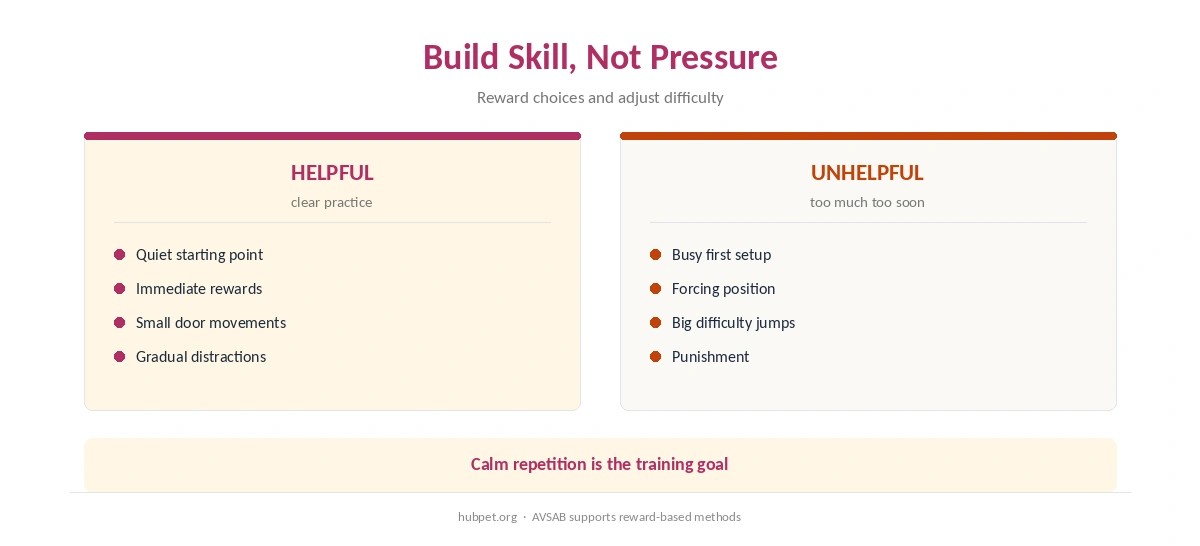
Avoid turning the doorway into a confrontation. AVSAB advises trainers to avoid aversive methods and use reward-based training instead. Instead, lower the difficulty and reward the behavior you want. The broader dog training mistakes guide explains why inconsistent criteria and moving too fast can stall learning.
How to teach a dog to wait at the door should produce a dog who can stay calm while the door opens, then move through with you. It should not require intimidation. If the dog is so fearful, frantic, or reactive that normal doorway practice cannot stay below threshold, use the reactive-dog walking guide and consider qualified reward-based professional help.
When to Get Professional Help
Get qualified behavior help when doorways trigger intense fear, repeated lunging, biting directed at nearby people or animals, or reactions you cannot manage safely. A trainer should use reward-based methods consistent with AVSAB. For ordinary excitement, start easier and build gradually.
How We Research
HubPet uses primary organizations and peer-reviewed research rather than personal anecdotes. We read these sources on October 11, 2026: Dogs Trust doorway-training guidance, accessed 2026, AVSAB Humane Dog Training position, 2021; reaffirmed 2025. See How We Research for our method.
How to Teach a Dog to Wait at the Door FAQ
No. Dogs Trust focuses on calm, patient behavior; sitting can be one option, but you do not need to require it.
Close the door gently, wait for calm, and retry with a smaller opening.
You can add a cue after the behavior is becoming predictable. First make the calm pattern easy to understand.
Yes. Dogs Trust notes that getting outside becomes a powerful real-world reward once the dog can wait calmly.
Increase difficulty when your dog can repeatedly stay calm at the current step without pulling or rushing.