
A practical inspection guide for sturdy collars, with attention to skin comfort and the limits of neck restraint. This guide concerns equipment choices, not medical diagnosis. For individual pain, injury or persistent skin problems, consult a veterinarian and read our veterinary information disclaimer.
Define heavy-duty without marketing shortcuts
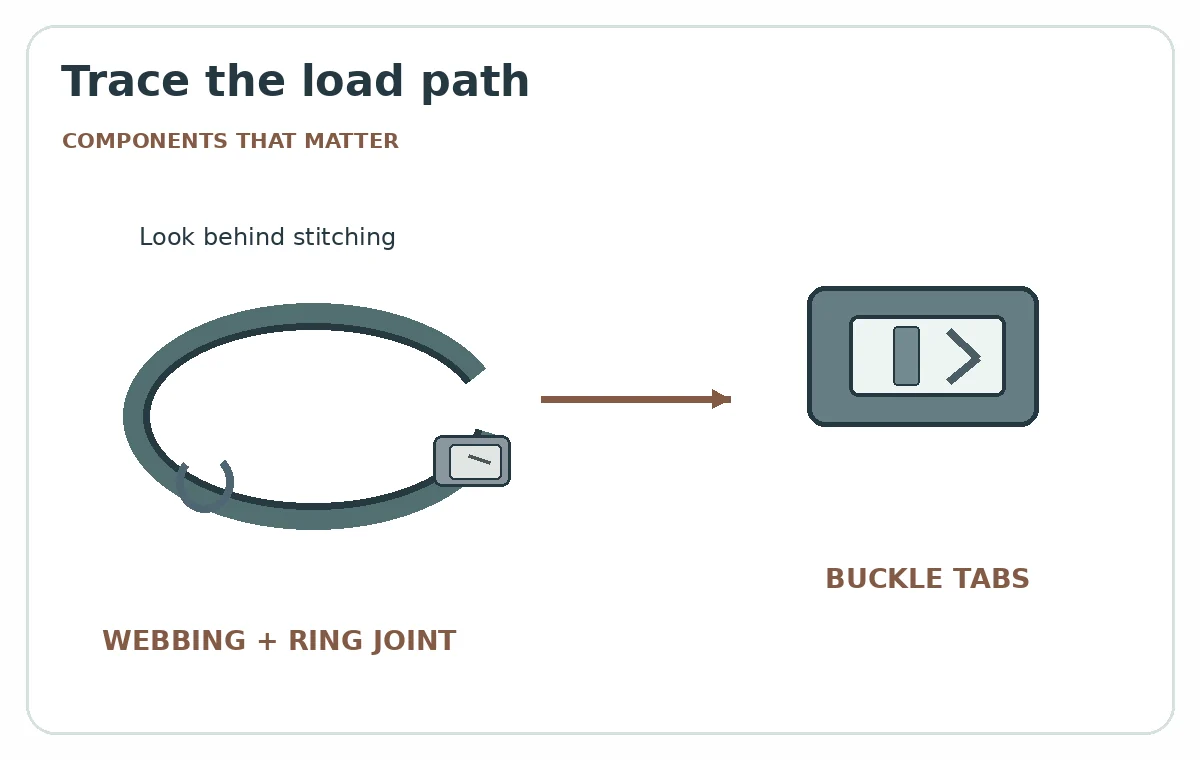
Heavy-duty may describe wide webbing, oversized rings, metal buckles or reinforced stitching, but the phrase does not establish a universal performance standard. A collar can look substantial while its weakest rivet, buckle pin or folded seam determines whether the assembly stays together. Assess the entire load path from leash clip through ring, stitching and strap to the closure. If a manufacturer publishes test data, ask whether it refers to raw material, a component or the finished collar under a specified method. None of these numbers makes the dog safe from neck injury during abrupt pulling.
Inspect the connection between strap and ring
Pull the collar flat on a table and identify where the D-ring joins the webbing. Look for dense, even stitching with no broken threads, or sound mechanical fasteners without sharp exposed ends. A welded ring should have a finished join rather than a visible gap. Check that the ring can pivot without pressing a hard edge into the neck. If there are two layers of webbing, examine the space between them for dirt or a hidden tear. A large ring is not automatically stronger if the surrounding attachment fails first.
Compare closures without assuming metal always wins
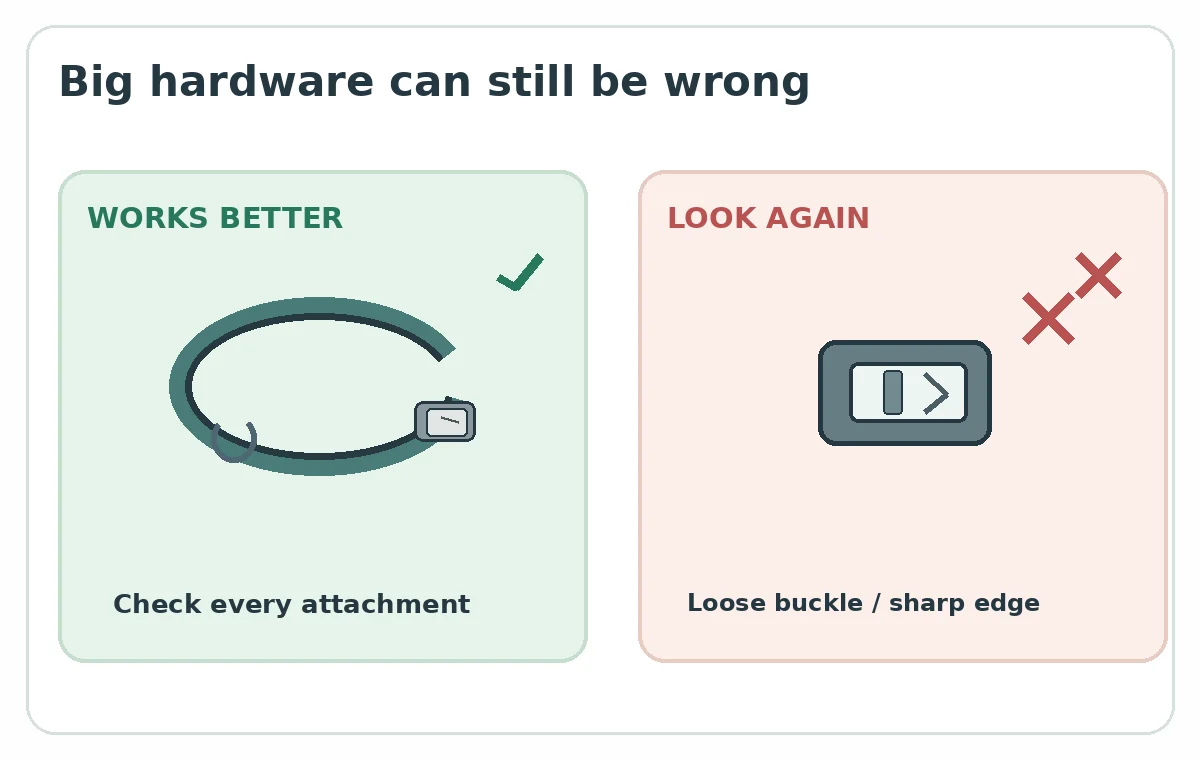
A traditional buckle has a tongue, frame and adjustment holes; a side-release buckle uses interlocking tabs. Metal parts may resist some forms of wear but add weight, while some engineered plastic closures work reliably when used as designed. Inspect hinge movement, sharp corners, corrosion and the way a closing tab seats. Operate the fastener several times with both hands before putting the collar on a dog. If it sticks or releases without deliberate action, replace it. Do not add a knot or zip tie around a faulty closure to keep walking.
Consider width, weight and coat clearance
A very broad collar may spread some contact pressure but can limit neck movement, rub the jaw or crowd a short-necked breed. Thick padding can also hold dirt under the edges. Narrow webbing on a powerful dog may concentrate pressure in one strip. Compare the actual surface contact and the dog’s comfort as it turns, sniffs and lowers its head. Avoid stiff plate-like collars that bridge over the neck rather than conforming to it. RSPCA emphasizes correct, comfortable fit and suitable equipment over sheer bulk.
Do not confuse strength with safe walking control
A stronger collar does not make leash jerks safer. VCA describes risk from neck pressure when a dog pulls hard against a collar. Use a well-fitted body harness for dogs that lunge, train with positive reinforcement and avoid aversive tightening devices. High force may come from a dog startled by traffic, not just a dog trained to pull. Maintain safe leash length and grip, plan distance from triggers, and seek help from a credentialed reward-based trainer when walks are difficult. The goal is to reduce force before relying on any hardware.
Test adjustment range on the actual animal
Measure the neck with the dog calm and standing naturally; then match the measurement to the manufacturer’s usable range. A tight collar can press on the throat, while a loose one can slide off or snag an object. Try the familiar two-finger starting fit and inspect under the jaw, behind the ears and along the fur after short wear. Bulky buckles can sit uncomfortably on narrow necks. If you are between sizes, compare two products rather than drilling extra holes into reinforced webbing; unplanned holes can weaken or fray the strap.
Understand the limits of rated webbing
A fabric supplier may give a break-strength number for a straight piece of coated webbing. BioThane’s published technical notes distinguish strength of the polyester webbing from coating properties and separately describe buckle pull tests. These figures cannot be copied onto an assembled consumer collar without proof of its construction and test method. Think of load ratings as questions to ask the seller, not as a promise of a safe maximum pulling force. Inspect attachment points after any sudden hard tug, particularly when the dog has backed against the end of a leash.
Check for abrasions, chewing and damage
Inspect the collar more often after beach outings, brushy hikes or rough play. Frayed outer threads, a stretched adjustment hole, a crooked ring or an exposed sharp staple make the collar unsuitable for restraint. Look for tooth marks near the buckle if the dog can reach it. A collar that becomes rough should be retired before it causes skin damage. Clean according to material instructions, and dry both the neck and strap before prolonged wear. Avoid aggressive chemicals not approved for the finish; they may weaken coatings or leave residues against the coat.
Use ID and home-safety checks too
An identification tag may help if a dog escapes, but a swinging metal disc introduces noise and another catch point. Check the attachment for security and readable contact information. Monitor interactions between dogs: a collar can become trapped around another dog’s jaw during intense play. Remove equipment during unsupervised confinement when appropriate, consistent with the enclosure’s safety guidance. Keep a spare collar or harness available, and never tie a large dog to a fixed point with a collar and assume the hardware solves entanglement or injury risks.

Make a pass-or-replace decision
Your pre-walk check should cover five areas in order: strap, seams, ring, closure and fit on the dog. Look and feel for sharp edges, fastener play and distorted holes; then remeasure as needed. Watch the animal walk and turn without pressure points. Replace the collar immediately if any critical connection fails inspection. Choose a calmer training and handling plan rather than seeking ever-stronger restraint when a dog repeatedly hits the end of the leash. Strength is meaningful only alongside an appropriate fit, sound construction and responsible use.
How We Research
We evaluated heavy-duty dog collars against veterinary, humane-equipment and published manufacturer-material guidance, focusing on fit, hardware, observable wear, cleaning and the distinction between component and product claims. These are research-based editorial criteria, not first-hand laboratory testing or an endorsement of a retail brand. We excluded punitive training tools and avoided presenting generalized sizing as individual medical advice. See our editorial approach. Sources reviewed October 28, 2026.
Sources
VCA Animal Hospitals, Collar and Harness Options for Dogs. Read original guidance. Accessed October 28, 2026.
RSPCA Australia, What equipment should I use when teaching my dog or puppy to walk on a leash?. Read original guidance. Accessed October 28, 2026.
American Kennel Club, Finding and Choosing the Right Dog Collar for Your Dog. Read original guidance. Accessed October 28, 2026.
BioThane Coated Webbing Corporation, Frequently Asked Questions about BioThane. Read original guidance. Accessed October 28, 2026.
Safety note: Keep damaged equipment away from pets. For sudden neck pain, choking, skin injury or a suspected swallowed battery, seek veterinary assistance promptly. Never rely on a collar or leash alone to eliminate traffic, snag or escape risks.
No. Escape risk depends on fit, head shape, closure and handling as well as materials.
No. Too much width or stiffness can restrict movement and rub the neck.
No. Use humane training and an appropriate harness rather than relying on neck pressure.
Check the ring join, stitching or fasteners, surrounding material and any sharp edges or loosening.
Not automatically. The entire assembled collar needs its own meaningful testing and inspection.