
This article is general information, not veterinary advice. If your pet seems unwell, is in pain or may have eaten something harmful, contact your vet or an animal poison control line right away. Read our vet disclaimer.
Are certain breeds always aggressive? No. A large 2022 Science study found that breed explained only 9% of behavioral variation among individual dogs in its dataset, and the AVMA says it is inappropriate to predict a dog’s propensity for aggressive behavior based solely on breed (Morrill et al., 2022; AVMA, current 2026).
Are Certain Breeds Always Aggressive? What the Research Found
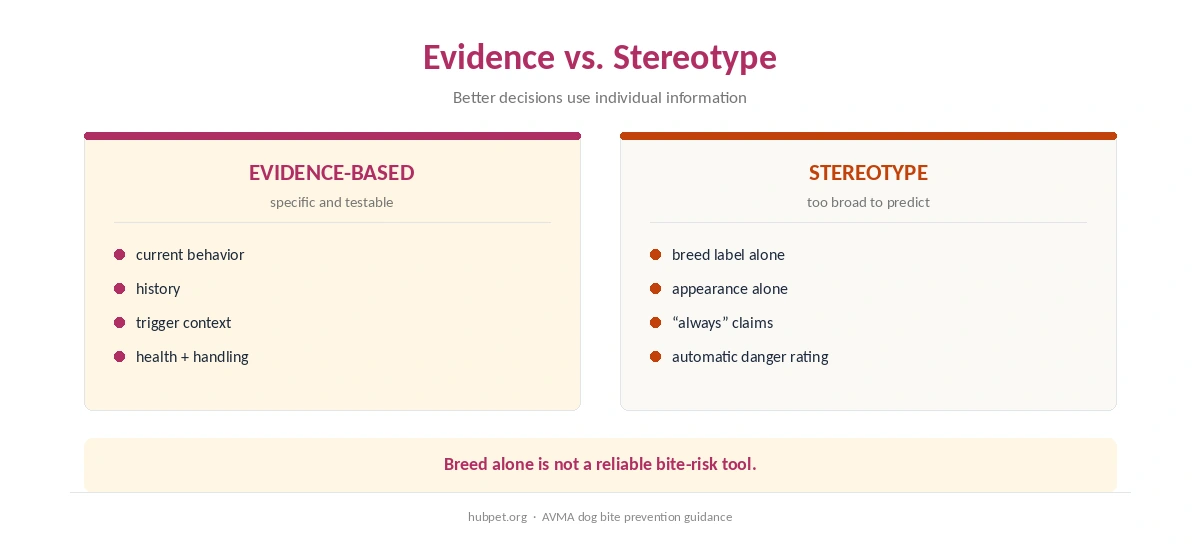
Morrill and colleagues surveyed 18,385 purebred and mixed-breed dogs and genotyped 2,155 dogs. They found that many behavioral traits are heritable, but modern breed ancestry was a weak predictor of an individual dog’s behavior overall; breed explained 9% of behavioral variation in the study (Science, 2022). That result does not mean genetics never matter. Instead, it shows why a breed label is a poor shortcut for judging one dog.
The practical alternative is to watch the dog in front of you. Tail wagging is not a simple happiness meter, and jumping on people is not proof of aggression. Likewise, people need context before they label excessive barking as dangerous behavior.
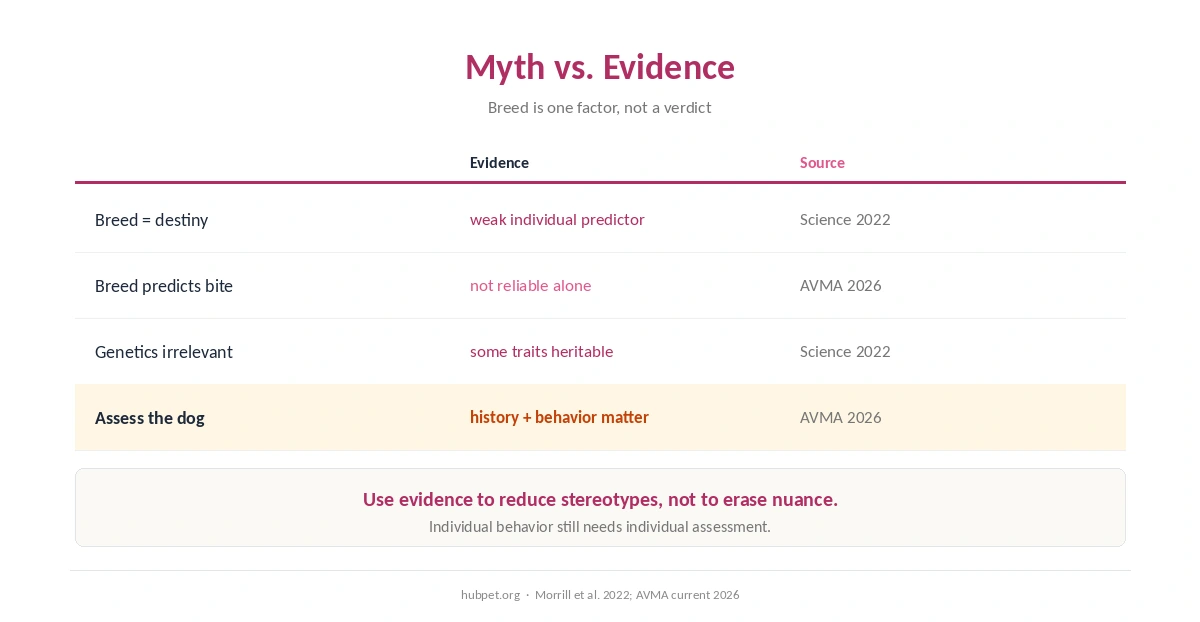
| Claim | What the evidence supports | Source |
|---|---|---|
| Breed determines individual behavior | Breed is only one weak predictor among many | Morrill et al., 2022 |
| A breed label can predict biting | AVMA rejects prediction based solely on breed | AVMA, current 2026 |
| Genetics do not matter at all | Some behavioral traits are heritable | Morrill et al., 2022 |
| All dogs need identical handling | Risk assessment should focus on the individual and context | AVMA, current 2026 |
Are Certain Breeds Always Aggressive in Real-Life Situations?
The AVMA’s dog-bite guidance says any dog can bite under certain circumstances and emphasizes individual history and behavior rather than breed as the useful signal (AVMA, current 2026). Fear, surprise, guarding, pain, illness, and other situations can raise bite risk. Therefore, prevention starts with body language, supervision, health, and humane handling rather than a breed blacklist.
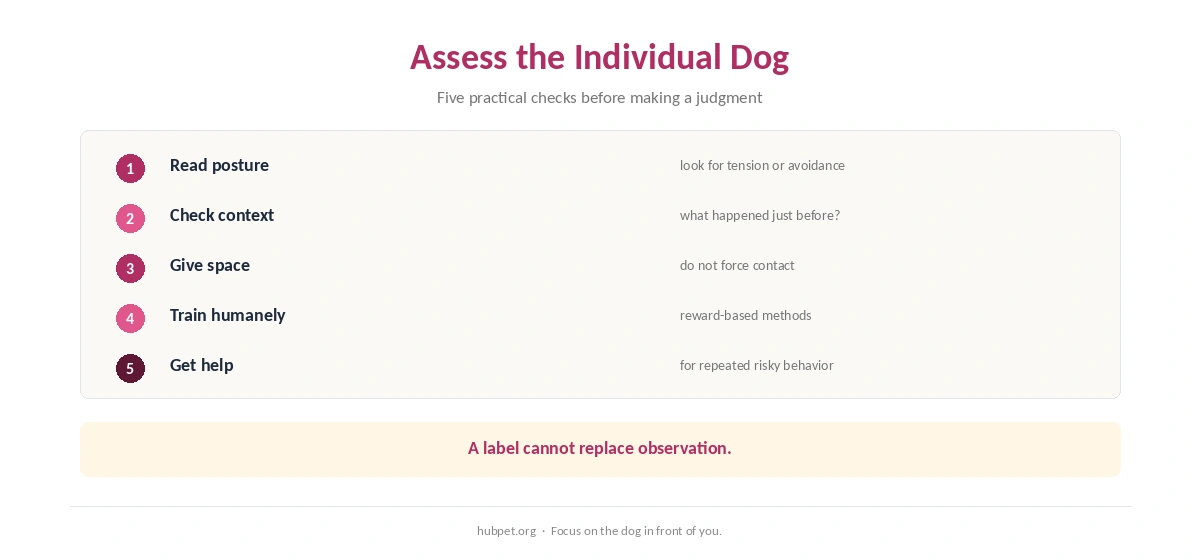
- Assess the individual dog’s current body language and behavior instead of assuming intent from appearance or breed.
- Give a tense, fearful, or avoidant dog more space rather than forcing contact (AVMA, current 2026).
- Use reward-based training; AVSAB recommends humane, reward-based methods for behavior work (AVSAB, 2021; reaffirmed 2025).
- Manage specific triggers such as door arrivals, leash frustration, or resource competition rather than applying a breed label.
- Seek qualified help when aggressive behavior repeats, escalates, or becomes difficult to predict.
Are certain breeds always aggressive is also the wrong question for training. Start with positive reinforcement and basic dog training at home.
Then use specific skills such as stay and recall to improve management. Training still cannot erase every risk.
Certain breeds are not always aggressive, and no breed label can replace an individual safety assessment. Use the dog’s current behavior and context instead.
When to Get Professional Help
Get qualified help for repeated growling, snapping, biting, guarding, or lunging that creates a safety risk. A veterinarian should also assess a sudden behavior change because pain or illness can affect behavior; see signs a pet may be in pain. For leash-specific problems, use loose-leash training only when the issue is pulling rather than aggression or severe reactivity.
If a case involves another animal, use controlled introductions instead of relying on breed assumptions. The dog-to-cat introduction guide focuses on barriers, escape routes, and individual responses. Severe separation distress is also its own condition; it belongs in the separation-anxiety guide, not under a breed stereotype.
How We Research
HubPet uses peer-reviewed research and veterinary policy rather than breed stereotypes. Sources read on October 11, 2026: Morrill et al., Science 2022 and AVMA dog-bite guidance. We also checked the AVSAB humane training position. See How We Research for our method.
Are Certain Breeds Always Aggressive FAQ
Some behavioral traits are heritable, but the 2022 Science study found breed explained only a small share of individual behavioral variation overall (Morrill et al., 2022).
No. It found breed propensities for some traits, but breed was a weak predictor of an individual dog’s behavior overall (Morrill et al., 2022).
The AVMA says no; it considers predictions of aggressive propensity based solely on breed inappropriate (AVMA, current 2026).
Watch current body language, history, triggers, health, and the context of the interaction (AVMA, current 2026).
Treat the event as an individual safety and behavior case. Veterinary assessment and qualified behavior help are more useful than a breed-based assumption.
The Bottom Line
Are certain breeds always aggressive? The evidence does not support that claim. Modern breed ancestry can relate to some behavioral tendencies, but it cannot replace individual assessment, context, humane training, and appropriate professional help (Morrill et al., 2022; AVMA, current 2026).