
This article is general information, not veterinary advice. If your pet seems unwell, is in pain or may have eaten something harmful, contact your vet or an animal poison control line right away. Read our vet disclaimer.
Do cats purr only when happy? No. Purring often accompanies relaxed social contact, but research and veterinary guidance show that the same broad sound category appears in other contexts. McComb and colleagues recorded a distinct solicitation purr while cats sought food in a 2009 Current Biology study. VCA also lists purring at unexpected times among behavior changes that can accompany pain (VCA, accessed 2026). Context matters more than the sound alone.
Do Cats Purr Only When Happy? What Research Actually Shows
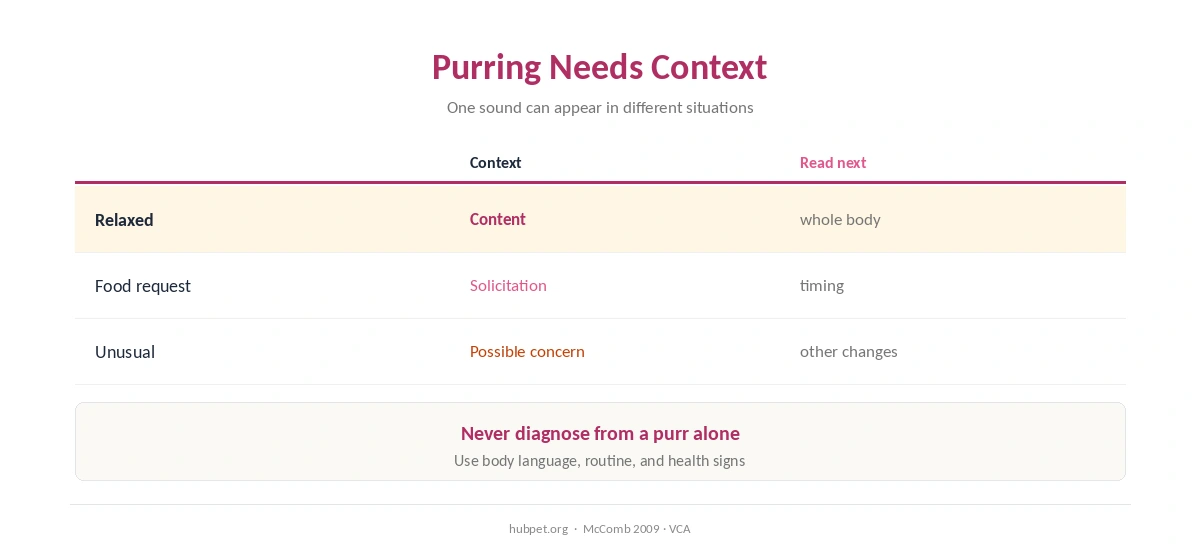
The simplest myth is that purring equals contentment. That interpretation can fit a relaxed cat, but it is not a universal translation. In the 2009 McComb study, people rated food-solicitation purrs as more urgent and less pleasant than purrs recorded in non-solicitation contexts. Therefore, do cats purr only when happy is the wrong yes-or-no shortcut. A purr can occur while the cat is asking for something, and the acoustic pattern can change with context (McComb et al., 2009).
| Context | What the purr can mean | What to check |
|---|---|---|
| Relaxed contact | Affiliative or content state | Loose body, normal routine |
| Food solicitation | Requesting access to food | Timing and repeated request |
| Unusual situation | Possible stress or pain | Whole body and behavior change |
Do Cats Purr Only When Happy? Read the Whole Cat
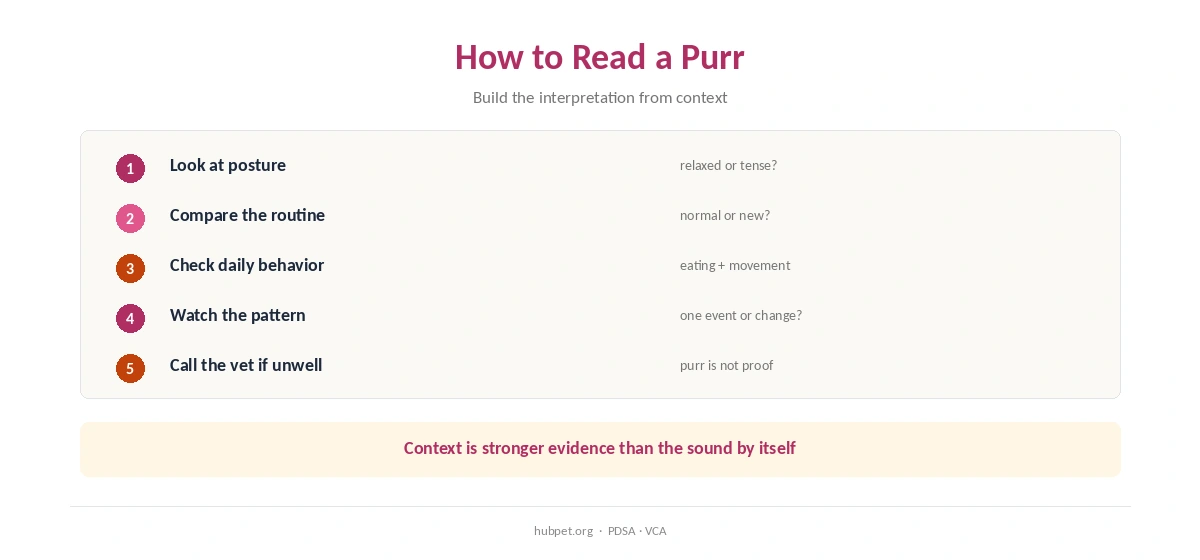
PDSA advises reading purring alongside body language. Relaxed posture supports a content interpretation, while worried posture can point toward anxiety or discomfort (PDSA, accessed 2026). In addition, VCA says cats may purr at times when pain would not be obvious and recommends watching for other behavioral changes (VCA, accessed 2026). The broader signs in signs your pet is in pain are more useful than treating purring as a diagnosis. As a rule, the question do cats purr only when happy needs context rather than a one-sound translation. For a closer look at the related behavior pattern, see why Cats Bite During Petting.
- Check whether the cat’s face, ears, body, and tail look relaxed.
- Compare the purr with the cat’s normal context and routine.
- Notice eating, grooming, movement, hiding, and social changes.
- Treat a new or unusual pattern as information, not proof of one emotion.
- Contact your veterinarian when purring accompanies signs of illness or pain.
This same context rule prevents other behavior myths. A wagging tail is not a simple happiness signal, and a dog’s guilty look does not reliably prove guilt. For cats, normal behaviors such as scratching furniture also need context before owners assign motives.
When Purring Deserves a Closer Look
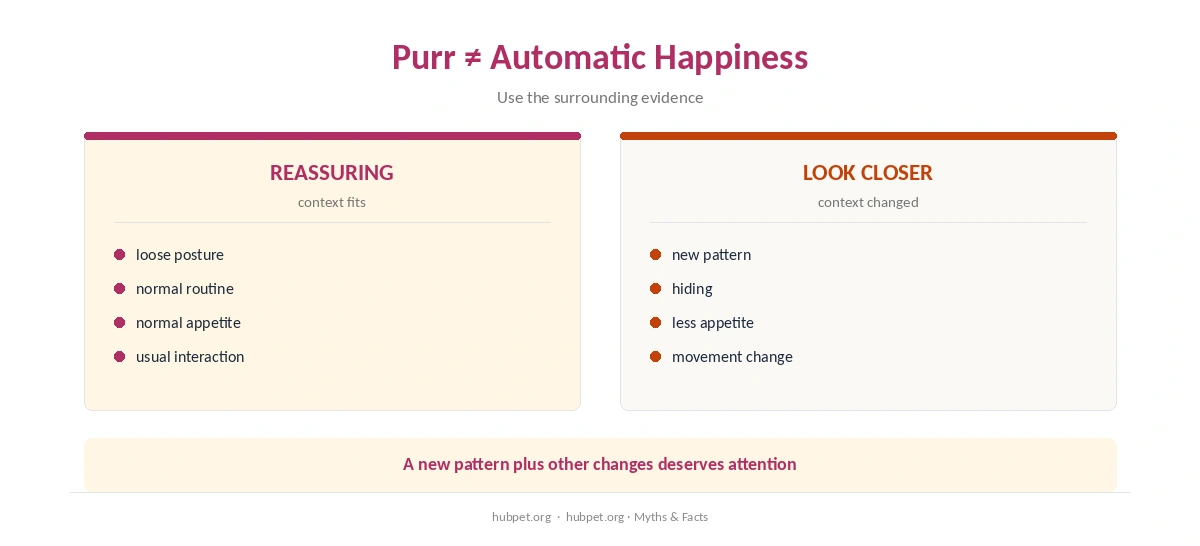
Pay more attention when a cat starts purring much more than usual, purrs in situations that previously did not trigger it, or shows other changes such as reduced appetite, hiding, altered movement, poor grooming, or irritability. VCA describes these as possible pain-related changes rather than a diagnosis from purring alone (VCA, accessed 2026). If the cat seems acutely unwell, use the warning signs in pet emergency signs rather than waiting for the purr to change.
For everyday handling, keep interactions low pressure. The choice-based approach in brushing a cat without stress is a useful example. The new pet owner checklist also helps establish a baseline routine, which makes later changes easier to notice.
How We Research
HubPet uses published veterinary, welfare, behavior, and research sources rather than personal anecdotes. We read these sources on October 11, 2026: McComb et al. 2009 Current Biology study, VCA feline pain-sign guidance, PDSA cat body-language guidance. See How We Research for our method.
Do Cats Purr Only When Happy FAQ
No. Purring often occurs in relaxed contexts, but cats also use purrs while soliciting food, and unusual purring can accompany pain or stress (McComb et al., 2009; VCA, accessed 2026).
No. Read posture, facial expression, routine, and the situation together with the purr.
McComb and colleagues described a purr used while cats sought food. Human listeners rated those recordings as more urgent than non-solicitation purrs (2009).
Yes. Veterinary guidance lists purring at unexpected times as one possible pain-related behavior, but purring alone does not diagnose pain.
Call when the purring is a new pattern and comes with reduced appetite, hiding, movement changes, poor grooming, irritability, or other signs that your cat is unwell.
The Bottom Line
Do cats purr only when happy? The evidence says no. Treat purring as one part of a larger behavioral picture, then use body language, routine, and health changes to decide whether the cat looks relaxed, is asking for something, or needs veterinary attention. For a separate evidence-focused question, see are Cats Naturally Independent and Distant?.