
This article is general information, not veterinary advice. If your pet seems unwell, is in pain or may have eaten something harmful, contact your vet or an animal poison control line right away. Read our vet disclaimer.
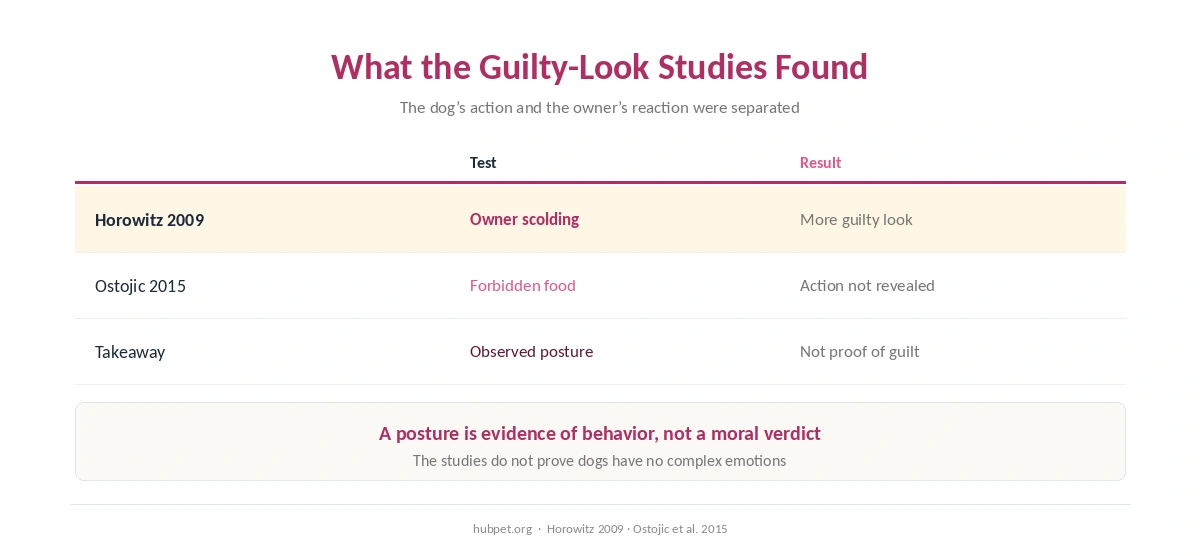
Is it true dogs feel guilty when they lower their head, avert their eyes, or approach cautiously after a mess? The best-known experiments do not show that the so-called guilty look proves guilt. In a 2009 experiment with 14 dogs, Alexandra Horowitz found more “guilty look” behaviors when owners scolded dogs, including dogs that had obeyed the rule (Horowitz, 2009). A 2015 study likewise found that dogs’ greeting behavior did not reliably reveal whether they had eaten forbidden food (Ostojic et al., 2015). Therefore, the look is poor evidence that a dog understands a past misdeed in the human moral sense. A related myths-and-facts page is can Pets Sense When You're Upset?.
Is It True Dogs Feel Guilty? What the Studies Tested
Horowitz changed both what the dog had done and what the owner believed had happened. The dog’s behavior tracked owner scolding more strongly than the dog’s actual obedience or disobedience (Horowitz, 2009). This matters because the owner reaction is part of the experimental context. The 2015 study tested whether the dog’s own action or visible evidence of the misdeed would trigger the look. Neither reliably did so (Ostojic et al., 2015).
| Study | What changed | Main result |
|---|---|---|
| Horowitz 2009 | Dog action and owner knowledge | Scolding predicted more guilty-look behavior |
| Ostojic et al. 2015 | Forbidden food eaten or not | Greeting behavior did not reveal the action |
| Practical takeaway | Owner sees a posture | Do not treat posture as proof of guilt |
Is It True Dogs Feel Guilty? What the Look May Mean Instead
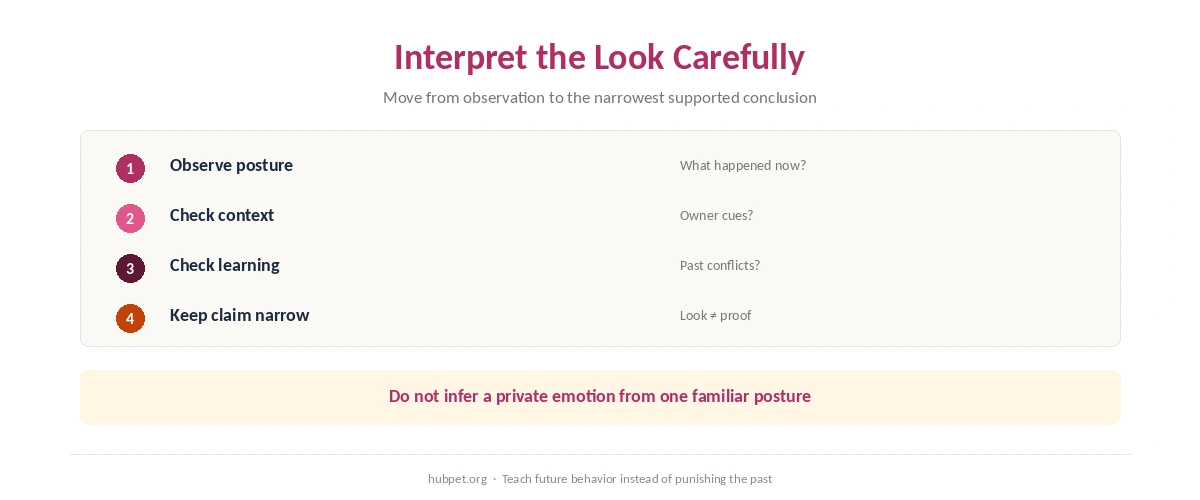
The studies support a more cautious interpretation. A lowered posture, averted gaze, or hesitant approach can be a response to human cues, tension, or previous learning around conflict. VCA also explains that animals learn household rules through consequences and observation, while the familiar “guilty look” may reflect the owner’s emotional response rather than knowledge of a past offense (VCA, accessed 2026). So is it true dogs feel guilty? Science has not established that conclusion from the look alone.
This does not mean dogs have no emotions. It means a specific facial or body pattern cannot prove a complex moral emotion by itself. Consequently, the safer claim is narrow: experiments have not validated the guilty look as a reliable indicator that a dog knows it committed a forbidden act. Is it true dogs feel guilty based on that posture alone? The evidence does not support that inference.
What to Do After You Find a Mess
Punishing a dog after the event does not show the dog what to do next. Instead, clean up, prevent access to the trigger, and teach the replacement behavior in the moment when it can be reinforced. For chewing, food stealing, or house-training mistakes, change the environment so the desired choice becomes easier. This is consistent with the reward-based principles in positive reinforcement training (AVSAB, 2021; reaffirmed 2025). For destructive chewing, use the management steps in stopping furniture chewing. For broader household prevention, see pet-proofing your home.
If the behavior itself changes suddenly or comes with signs that your dog may be unwell, do not read the posture as “guilt.” Compare the change with signs a pet may be in pain and contact your veterinarian when health could be involved. A daily dog care checklist can also make sudden behavior changes easier to notice.
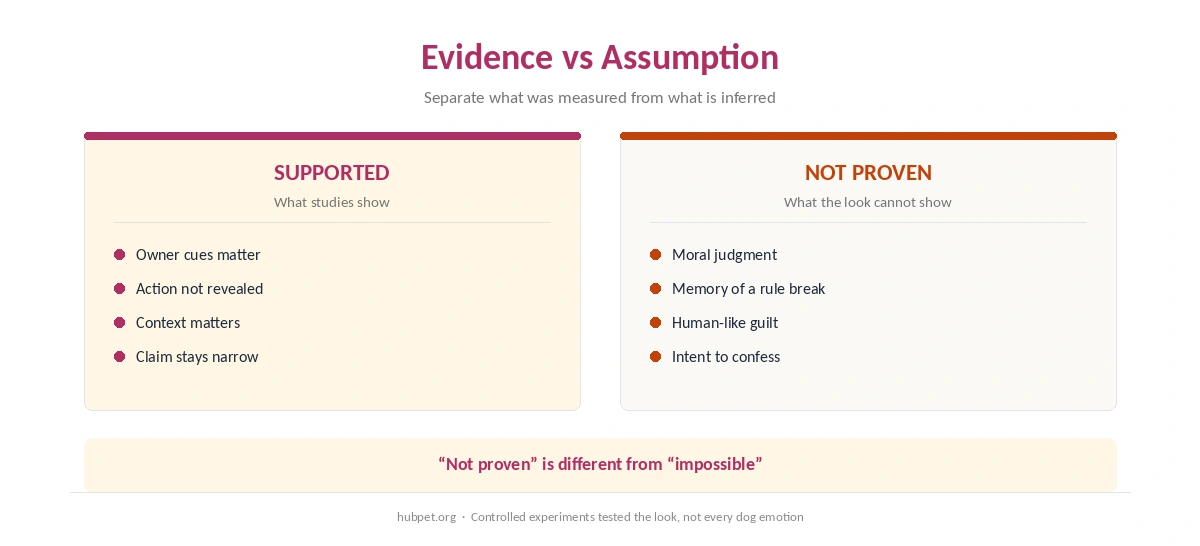
Body language should be read in context. The same caution applies to interpreting a wagging tail. For skills you can teach instead of punishing past behavior, start with basic dog training at home. A related myths-and-facts page is do Dogs Only See in Black and White?.
How We Research
HubPet uses published veterinary, welfare, behavior, and research sources rather than personal anecdotes. We read these sources on October 11, 2026: Horowitz guilty-look experiment, 2009, Ostojic and colleagues guilty-look study, 2015, VCA veterinary behavior overview, AVSAB humane training position. See How We Research for our method.
Is It True Dogs Feel Guilty FAQ
The studies do not show that the guilty look proves guilt. Horowitz 2009 and Ostojic et al. 2015 found that the familiar posture did not reliably track whether the dog had actually broken the rule.
Dogs can respond to context, your body language, the environment, and learned patterns around previous conflicts. A posture alone does not identify a private emotion.
No. It showed that the guilty look was better explained by owner cues in that experiment. It did not test every possible form of guilt or every emotional process in dogs.
No. Use management and reward the behavior you want when the dog can connect its action with the consequence. AVSAB recommends reward-based methods (AVSAB, 2021; reaffirmed 2025).
Contact your veterinarian when a sudden behavior change appears with pain, illness, confusion, appetite changes, or another physical concern.
The Bottom Line
Is it true dogs feel guilty? The familiar “guilty look” is not reliable proof. Experiments found stronger links to owner reactions and context than to whether the dog had committed the forbidden act. Read the posture as information about the current interaction, then teach the future behavior you want.