
This article is general information, not veterinary advice. If your pet seems unwell, is in pain or may have eaten something harmful, contact your vet or an animal poison control line right away. Read our vet disclaimer.
How to keep training consistent between family members is mostly a communication task for people. Dogs Trust guidance checked in 2026 advises using a consistent marker and a shared recall cue. RSPCA guidance also tells households to react consistently and use reward-based training. Therefore, agree on what the cue means before asking the dog to understand it.
How to Keep Training Consistent Between Family Members: Write the Rule Down
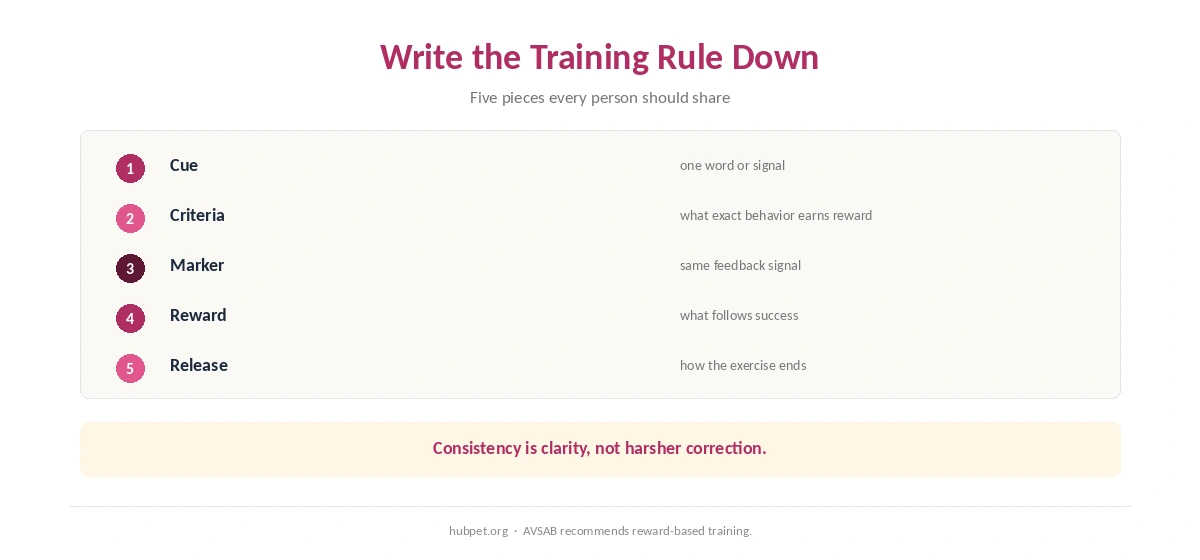
Start with one skill, not the entire household rulebook. Write the cue, the exact behavior that earns reinforcement, the reward, and the release cue. For example, “sit” can mean the dog’s rear reaches the floor and stays there until release. The basic dog training guide can help you define simple criteria.
Use one marker consistently. Dogs Trust guidance checked in 2026 says a marker word should stay the same each time. The positive reinforcement guide explains why the marker and reward need clear timing. Meanwhile, short training sessions make it easier for every family member to practice the same plan.
Also, keep cues distinct. If one person says “down” for lie down while another uses “down” for get off the sofa, the dog receives an ambiguous signal. The common training mistakes guide covers cue confusion and timing. A shared note on the refrigerator is often more useful than adding more words.
How to Keep Training Consistent Between Family Members: Match Consequences
How to keep training consistent between family members also means matching what happens after the behavior. AVSAB’s 2021 Humane Dog Training Position Statement recommends reward-based methods for all dog training and behavior modification. Therefore, household consistency should never mean agreeing on punishment. It should mean agreeing on what to reinforce, what to prevent, and how to make the next repetition easier.
For jumping, one household plan might reinforce four paws on the floor. The jumping guide shows a reward-based approach. For door manners, use the wait-at-the-door guide. For food manners, the wait-for-food guide can give everyone the same sequence.
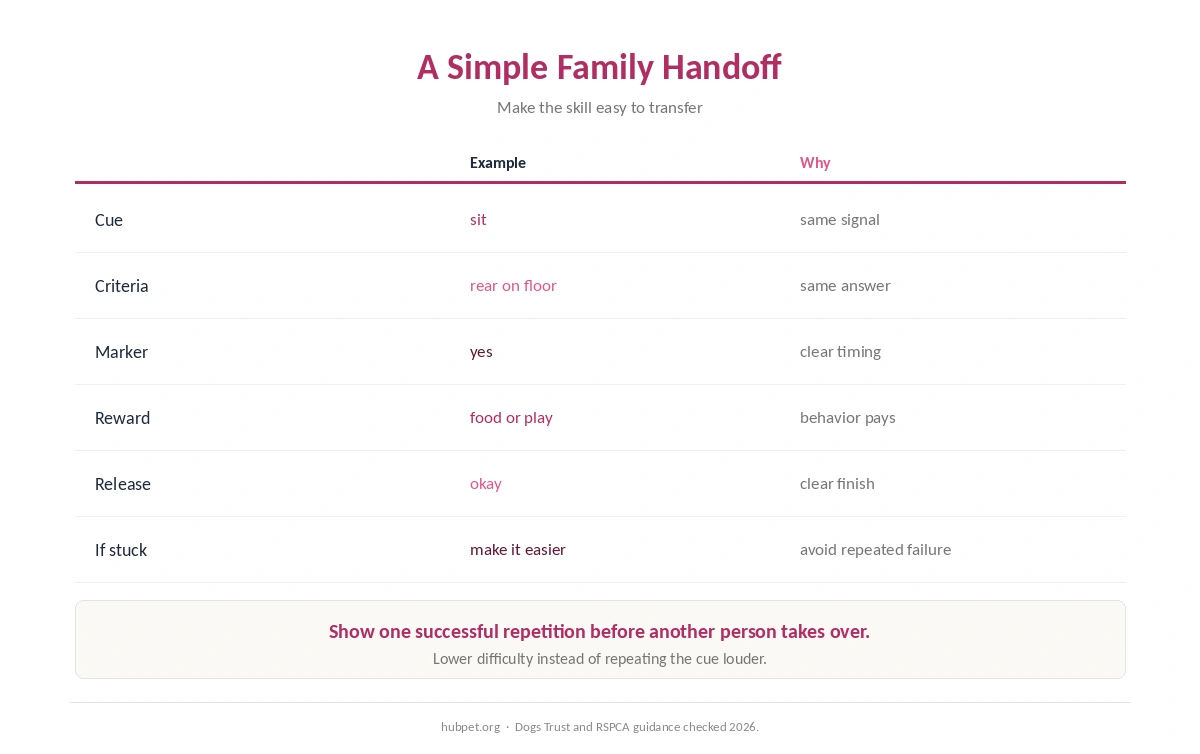
| Write this down | Example | Why it matters |
|---|---|---|
| Cue | “sit” | everyone gives the same signal |
| Criteria | rear on floor | everyone rewards the same action |
| Marker | “yes” | timing stays clear |
| Reward | small food reward or play | desired behavior pays |
| Release | “okay” | dog knows when the exercise ends |
| If dog struggles | make it easier | avoid repeated failed cues |
In practice, how to keep training consistent between family members is to make the plan easy enough that every person can apply it the same way.
Practice easy skills in low-distraction places first. The distraction-training guide can help the family raise difficulty gradually. The settle-on-a-mat guide gives a useful shared household behavior. If visitors are part of the challenge, the doorbell calm guide can keep the response predictable.
Use a Simple Handoff Between People
Before another family member takes over a skill, show them one successful repetition. Then let them use the same cue, marker, and reward rule. If the dog responds differently, lower the distraction or shorten the step rather than repeating the cue more loudly.
Track only the information that changes the next session. The weekly training practice checklist can organize skills. Meanwhile, sit training gives a simple example of clear criteria.
For longer-duration skills, use stay training. For a distance skill, the recall guide shows how to build success gradually.
If a family member cannot follow the plan in a difficult situation, use management. Put distance between the dog and the trigger, use a gate, or pause the session when safe. AVSAB’s 2021 statement supports environmental management alongside reward-based behavior change. That approach is safer than adding force when consistency breaks down.

When to Get Professional Help
Ask a qualified reward-based trainer for help when the family cannot agree on safe criteria, the dog is becoming fearful, or progress repeatedly falls apart in ordinary settings. For aggression, serious fear, resource guarding, or severe separation-related distress, involve a veterinarian or appropriately qualified behavior professional rather than escalating corrections.
How We Research
HubPet reviewed these sources on October 11, 2026: the AVSAB Humane Dog Training Position Statement from 2021, Dogs Trust guidance on positive reinforcement, markers, and recall, and RSPCA reward-based training guidance. AVSAB reaffirmed in 2025 that its 2021 humane-training statement remains its current position. Read our editorial method at How We Research.
No. The important parts are the cue, criteria, marker, consequence, and release rule. Natural differences in voice are less important than clear shared meaning.
Choose one cue and use it consistently going forward. Avoid stacking several words together while the dog is learning.
Rewards can vary with the skill and context. The key is that desired behavior remains worthwhile and the household does not replace rewards with punishment.
Lower the difficulty for the second person and rebuild successful repetitions with the same cue and reward rule.
No. AVSAB’s current position recommends reward-based methods and says aversive methods should not be used for dog training or behavior modification.
How to Keep Training Consistent Between Family Members: Bottom Line
How to keep training consistent between family members is to standardize the cue, behavior criteria, marker, reward timing, release, and fallback plan. Keep practice short and reward-based. When everyone teaches the same answer instead of correcting different mistakes, the dog gets a much clearer learning environment.