
This article is general information, not veterinary advice. If your pet seems unwell, is in pain or may have eaten something harmful, contact your vet or an animal poison control line right away. Read our vet disclaimer.
A panel dog pen is a modular fence you assemble into an exercise enclosure, often using four, six, eight or more hinged sections. The panel count alone cannot tell you how much usable floor space your dog will have: panel width, pen shape, height, door placement and connector style all matter. An eight-panel rectangle may fit a narrow room while an octagon offers a different usable area. This guide helps you estimate layout from *actual panel measurements*, test connectors, decide between indoor and outdoor designs, and spot hazards before a dog enters. It does not treat a higher panel count as automatic proof of safety or recommend combining incompatible systems.
Panel count does not equal usable dog-pen space
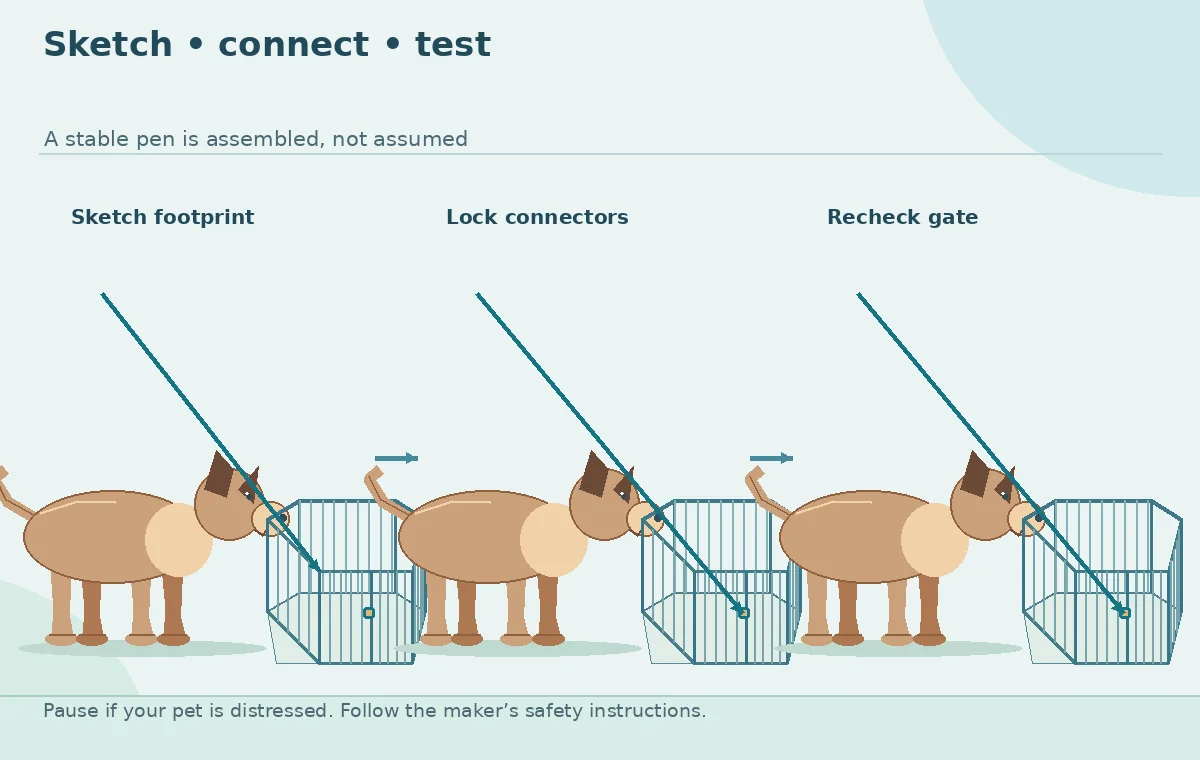
Think of a pen as a perimeter made of connected wall sections. Four rigid panels usually form a simple square or rectangle; six or eight hinged panels may make broader polygonal shapes. Extra segments can allow corners to turn around furniture, but a bent shape can lose useful open floor space. Measure a panel’s *usable* width between connectors, multiply by the number used, and sketch the actual perimeter on the room floor with removable tape. Then check where the gate will swing, how far the panels extend past the base, and whether the dog can lie down and turn without hitting furniture. The count is only a planning clue: 8 panels of 24 inches (61 cm) each yield about 16 feet (4.9 m) of straight panel length before hinges, not a fixed square footage.
| Panel count | Possible arrangement | Planning caution |
|---|---|---|
| 4 panels | Simple compact square or rectangle | Small footprint may limit activity |
| 6 panels | Hexagon or longer rectangle | Check door swing and hinge angles |
| 8 panels | Octagon or adaptable rectangle | Perimeter does not specify area |
| 12–16 panels | Larger zigzag or connected layout if supported | Need adequate stiffness and compatible kits |
| Any modular set | Custom shape within manufacturer rules | Never mix unverified connectors |

A measurement and connector checklist
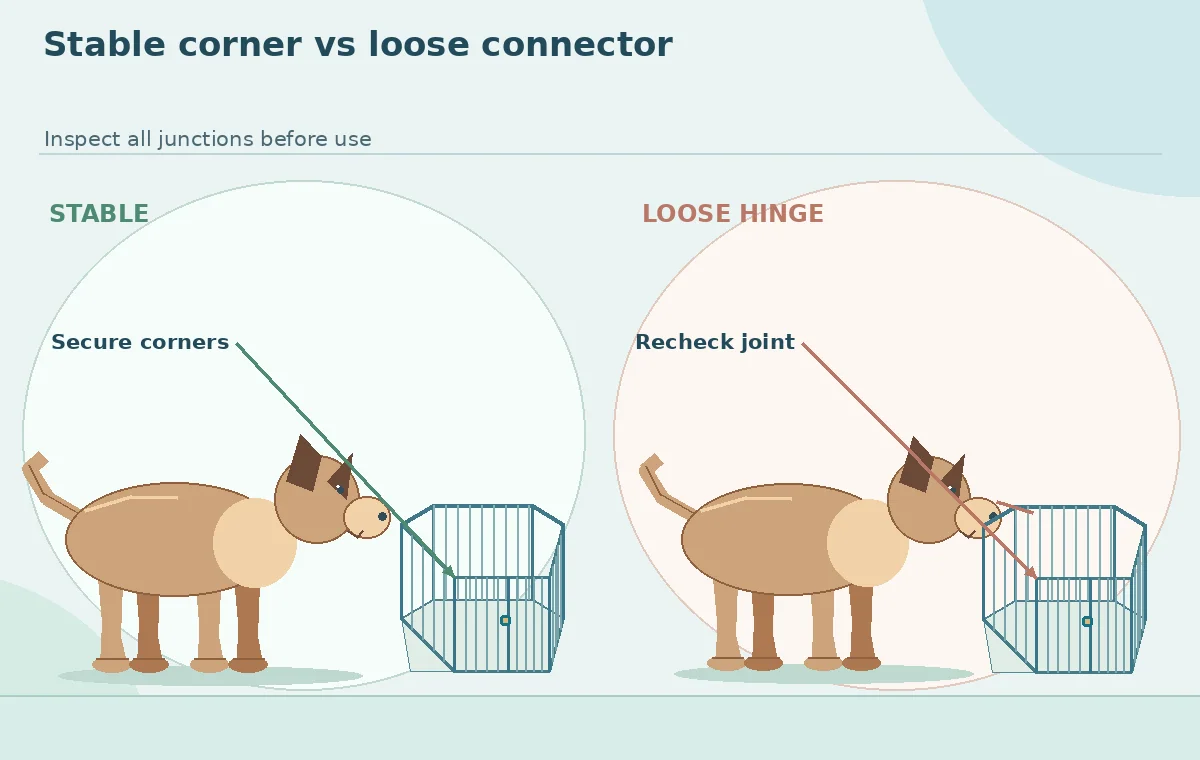
Start with the tallest point your dog can jump or brace against, not just shoulder height. The safer wall height depends on athleticism, climbing habits, and whether nearby furniture provides a stepping stone. Inspect each connector at the top and bottom; a single loose hinge can allow a dog to push out a corner. For hard floors, choose a nonslip solution approved by the manufacturer and avoid leaving sharp stakes or ground anchors loose indoors. An outdoor setup may need compatible ground anchors and shade; do not use indoor-only plastic panels outside when the instructions prohibit it. A fabric pen that folds easily is convenient for travel but may not be suitable for determined chewers. Supervise the first uses and check for tipping and snagging.
- Measure the interior available floor in the intended room, including clearance for the door and furniture.
- Write down each panel’s usable width and height; sketch the desired shape before buying expansion sections.
- Confirm the door location and latch can be reached by a person but not pushed open easily by the dog.
- Inspect every connector, edge, base and panel gap after assembly; no projecting wires or collar snag points.
- Test stability gently without the dog; then introduce the pen through short rewarded sessions and recheck after use.
Choose a layout by purpose and flooring
A compact indoor pen can make a puppy-safe place for a nap and a few toys, but its layout must still allow the dog to turn and stretch. If you need a daytime activity area, a larger open shape may fit better than a narrow corridor. On slick tile, an unstable base can slide when bumped. On carpet, connectors and fabric bottoms may catch fibers or make cleaning harder. Put the door where you can approach calmly without reaching over the walls to lift the dog. For outdoor use, check weather and anchoring claims, then remain aware that a pen does not provide shade, secure fencing or permanent supervision by itself. Follow the specific product’s assembly guide rather than improvising connections.
| Your goal | Layout priority | Safety check |
|---|---|---|
| Quiet indoor rest | Stable compact shape with bed area | No corners that pinch bedding |
| Supervised puppy play | Room to move and toy separation | No climbable nearby furniture |
| Narrow room | Manufacturer-approved elongated shape | Door opens without trapping dog |
| Temporary outdoor time | Outdoor-rated panels and proper anchors | Shade, water and supervision |
| Growing puppy | Approved expansion sections if needed | Height still contains active dog |
How to compare four to sixteen panels in real life
Instead of counting panels in a product headline, put the advertised measurements into a room sketch. An eight-panel set made from short segments can have a smaller maximum perimeter than a six-panel set made from longer segments. Even with equal perimeter, a long thin arrangement has less usable central area than a compact shape. Recheck the connection system when adding panels: two sets from different manufacturers can look similar without being securely compatible. If your dog hops the walls, a higher appropriate enclosure may be necessary, but a pen should not be used to force a panicked animal to stay inside.
For training, reward entering the panel dog pen voluntarily, provide safe enrichment and keep early sessions supervised. The routines in positive puppy crate training transfer to many pen introductions, and a consistent potty schedule helps prevent indoor accidents. If confinement itself is distressing, consult our calmer-confinement guide and consider veterinary or reward-based behavior assistance. More panels will not solve separation anxiety; physical space and emotional comfort need separate assessment.
When to Call Your Vet
Contact a veterinarian if confinement triggers extreme distress, self-injury, repeated bar chewing or other sudden behavior changes. Avoid attaching a dog by its leash to the pen or leaving collars and straps that could catch in the panels. Dogs needing post-surgical exercise limits require an individualized veterinary plan, not a general panel-count formula.
How We Research
We reviewed VCA clinical guidance on exercise pens and reward-based confinement, AKC advice for leaving puppies alone, and manufacturer documentation illustrating matched pen components. The count and perimeter example above is an arithmetic planning illustration, not a tested size or a universal safety rating. We do not claim that an enclosure is escape-proof. Read our editorial standards on the About page.
Sources
VCA — Crate Training and Confinement for Puppies and Dogs; AKC — When Can Puppies Be Left Home Alone?; VCA — To Crate or Not to Crate?; IRIS USA — Pet Playpen Mesh Roof (Compatibility and Specifications).
It depends on each panel’s width, the assembled shape, dog size and intended use. Count is only one variable; sketch the footprint and confirm comfortable movement and stable construction.
Do not assume their hinges or clamps are compatible. Use manufacturer-approved components and check every connection before the dog enters.
Not necessarily. Panel length and the shape of the enclosure change the usable area. A long narrow layout can feel cramped despite its larger perimeter.
Choose based on actual climbing and jumping behavior, not a rigid breed chart. The walls and connectors must remain stable and free of nearby furniture the dog could use to escape.
No. Puppies need regular toileting, movement, interaction and gradual alone-time training. Pens are temporary management spaces rather than substitutes for daily care.