
Dog chew toys serve different purposes: some invite gentle gnawing, others hold food, and a few only survive brief supervised play. A label such as ‘tough’ does not tell you whether a specific object fits your dog’s mouth or chewing style. Before shopping, watch what the dog actually does with a familiar safe toy: gnaw, shred, swallow, carry, or guard it. This guide turns those observations into size, material, and inspection checks. A veterinarian should assess broken teeth, swallowed pieces, or sudden changes in chewing. Review the HubPet veterinary disclaimer for health-information boundaries.
Start with chewing style, not product branding
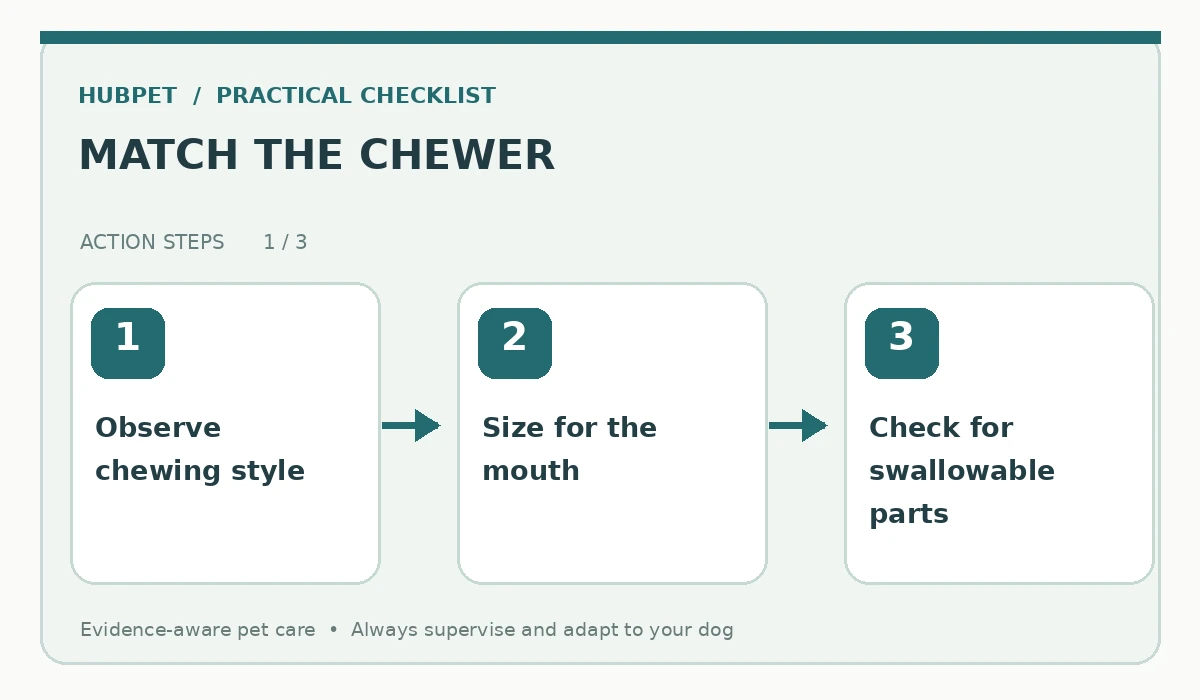
Watch a supervised session and describe what happens. A light chewer may mouth a toy for a minute, while an intense chewer can remove fragments almost immediately. Some dogs focus on seams or squeeze a toy until it cracks. Others prefer carrying objects and rarely gnaw. These patterns matter more than a manufacturer’s breed photograph. Record the condition of the toy after a short session and note whether your dog attempts to eat pieces. A toy that becomes small enough to swallow is no longer an appropriate fit, even if it originally matched the weight guidance on the packaging.
Choose a size the dog cannot swallow whole
Compare the entire toy against the dog’s open mouth, not just its overall length. Ends can be narrow even on a long bone-shaped object. A ball, ring, or detached component that slips deep into the mouth poses a choking risk. Consider how the shape changes when compressed, chewed, or worn. If several dogs share a home, pick up small-dog toys before a larger dog gains access. Do not rely on a universal inch or weight cutoff; the ASPCA recommends matching chews to the individual animal’s size and chewing habits. Observe actual handling before leaving any item available.
Check flexibility and tooth-friendly resistance
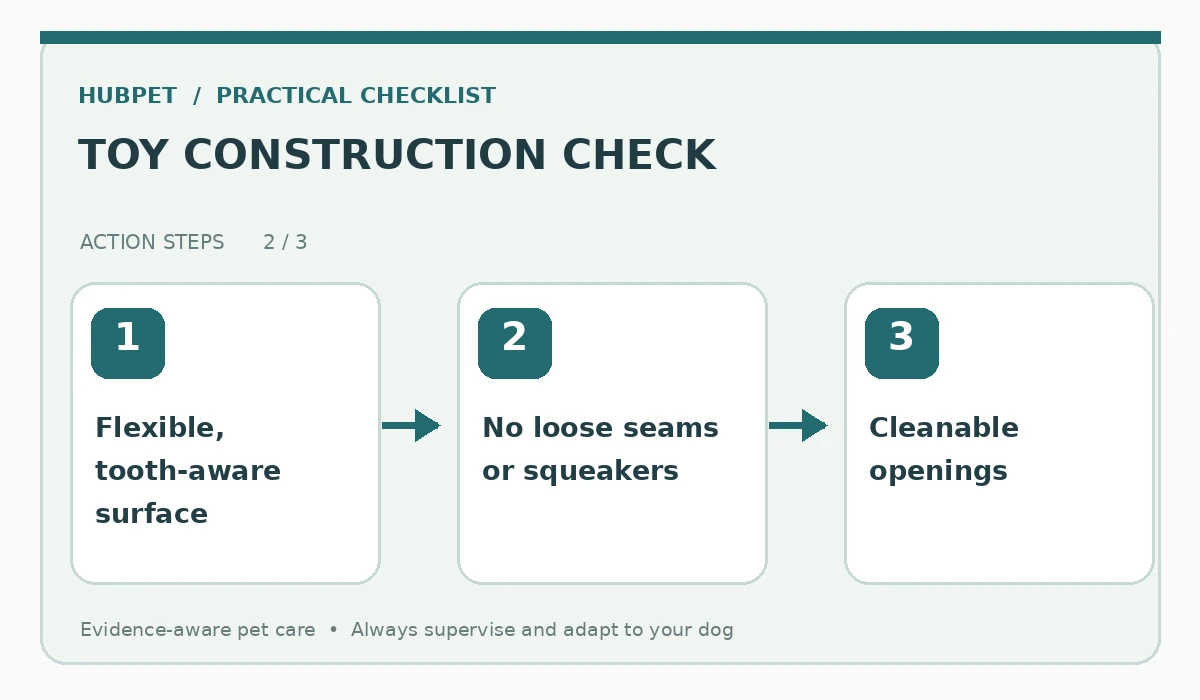
A very rigid object can damage teeth, especially when a determined chewer bites down forcefully. By contrast, an extremely soft toy may tear into swallowable chunks. Feel the material and follow veterinary guidance about avoiding hard objects that do not yield under pressure. The shape should let the dog grip the toy without pressing sharp edges into the gums. Look for protruding screws, staples, glued eyes, or decorative pieces that could detach. If your dog has dental pain or a history of fractured teeth, ask the veterinarian what materials to avoid instead of experimenting with tougher options.
Separate edible chews from reusable toys
Food chews and rubber enrichment toys carry different risks. An edible chew can contribute calories and may disappear quickly in an enthusiastic mouth. A reusable rubber item should not shed sizable pieces, and food packed inside it can spoil when caregivers skip cleaning. Verify labeling for species, age, and intended use, then observe how the dog consumes or manipulates the product. The ASPCA warns that rapid swallowing of chew fragments can cause gastrointestinal obstruction. Avoid advertising claims that suggest any chew works without supervision. A dog that tries to gulp the final piece needs the item removed before it becomes a hazard.
Inspect seams, hollow centers, and trapped-food spaces
Soft fabric toys may have stitched edges, squeakers, or stuffing; hollow rubber toys may have narrow openings where food collects. Check every construction feature before use. Pull gently on accessible seams and inspect whether the surface has cracked or hardened over time. A squeaker is not a reward worth an intestinal blockage if the dog routinely extracts small parts. Consider whether you can actually reach the interior for washing and drying. If you cannot verify the condition of a hidden cavity, choose a simpler design. The safest purchase is often the one you can reliably inspect and maintain.
Set up a short supervised trial
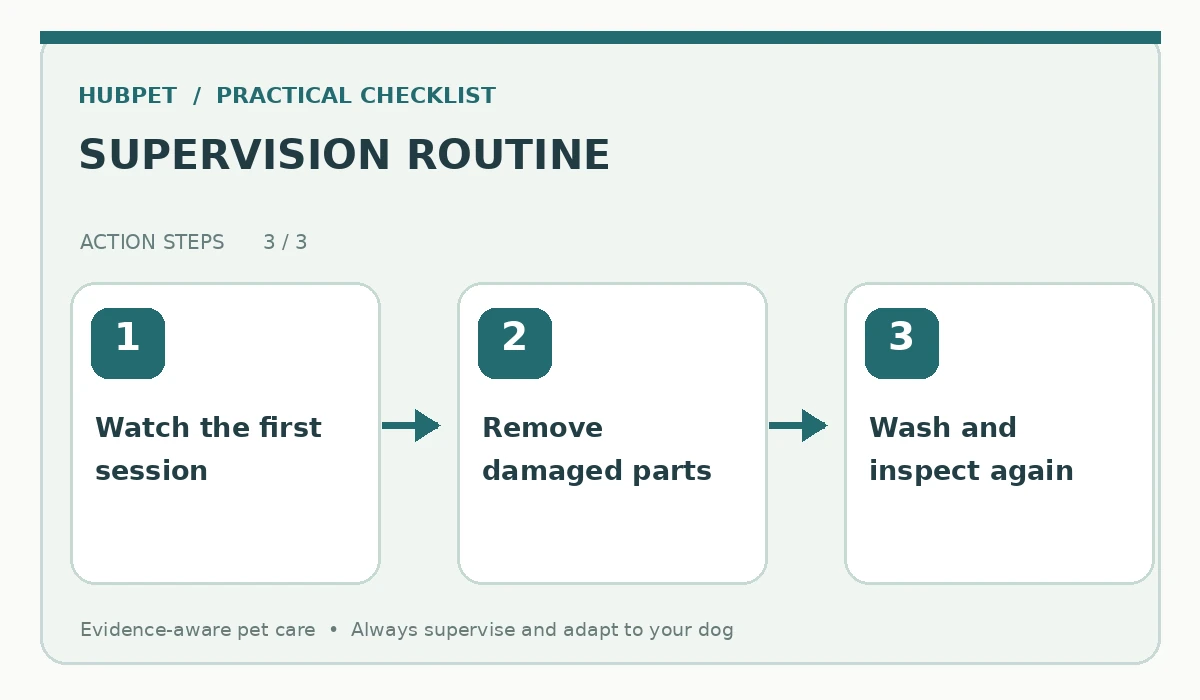
Offer the new toy when the household is calm and you can watch without interruption. Let the dog investigate voluntarily. Look for deliberate chewing rather than frantic tearing, coughing, gagging, or repeated attempts to swallow fragments. Remove and replace the item calmly if damage appears. If the dog guards the object, avoid grabbing it or reaching toward the mouth; use a practiced reward-based trade and seek professional support when guarding creates a bite risk. Keep packaging long enough to follow the manufacturer instructions. No label can substitute for observing how your particular dog interacts with the toy.
Build a rotation around function
Keep a few safe options with different purposes: one quiet gnawing item, one food-dispensing enrichment toy, and a soft carry toy if the dog uses fabric gently. Store the others to maintain novelty, but do not reintroduce damaged objects. Rotate based on interest and wear rather than a fixed shopping schedule. Reward the dog for choosing an allowed item during supervised time. If the dog ignores every option, investigate whether the alternative is comfortable, appropriately sized, and available where chewing usually happens. Add walks, sniffing, play, and social contact instead of expecting chew toys to solve every unmet need.
Know when a chew toy is failing
Discard a toy if it sheds pieces, splits, develops sharp edges, becomes too small, or traps debris you cannot remove. Check older toys after changes in temperature, after outdoor use, and after dishwasher cleaning if the maker permits it. Watch for red flags such as a dog swallowing stuffing, repeated vomiting, choking, or sudden pain when chewing. A suspected ingestion or breathing difficulty requires prompt veterinary advice; do not induce vomiting unless a veterinarian instructs you to do so. Keeping a note of the product material and missing component can help the clinic assess the situation.
Compare value by useful life, not indestructible claims
A higher price does not verify safety, and an ‘indestructible’ label does not prove safety. Compare how clearly the maker describes materials, sizes, cleaning methods, and replacement conditions. The cost of a toy matters less than whether you can use and supervise it appropriately. Avoid stocking up before you know which texture suits your dog. Keep purchase decisions separate from veterinary dental advice: a chew designed for play is not automatically an evidence-tested dental product. If dental benefit is the goal, ask a veterinary professional about appropriate oral-care options.
Use a simple decision before each session
Check the toy’s full size, its current surface condition, any detachable features, and the dog’s state of mind. Decide whether you can supervise the activity and where pieces could fall. Offer the item away from other animals if competition causes tension. Afterward, clean and store it according to directions. If you repeatedly find that every toy is shredded, pause product experiments and ask a veterinarian or qualified reward-based behavior specialist about the chewing pattern. The objective is a satisfying and safer activity for the dog, not finding an object that can never wear out.
How We Research
Our editorial review compared dog-welfare guidance from veterinary institutions and animal behavior organizations with the specific household safety problem in this guide. We separated sourced health or behavior principles from practical owner checklists, and did not test named products or claim that a method prevents every injury. Always check manufacturer instructions and discuss ingestion, pain, persistent panic, or sudden changes with your veterinarian. Our team reviewed sources on October 27, 2026. For editorial background, see About HubPet.
Sources
ASPCA: Dog chews and treats: selection and supervision position statement. Reviewed October 27, 2026.
ASPCA: Destructive chewing: reasons, management, and appropriate alternatives. Reviewed October 27, 2026.
VCA Animal Hospitals: Teeth, teething, and chewing in puppies. Reviewed October 27, 2026.
American Veterinary Society of Animal Behavior: Position statements: humane, reward-based dog training. Reviewed October 27, 2026.
Choose a shape and size your dog cannot swallow whole, even after wear. Check the narrowest end and any detachable parts rather than relying only on the product’s weight range.
No. Very rigid items can damage teeth, while brittle objects may fragment. Ask a veterinarian about suitable resistance, particularly if your dog already has dental problems.
First observe several supervised sessions and follow the product instructions. A dog that tears, swallows, or guards parts should not have that toy without a tailored safety plan.
Yes, cracks can become sharp edges or larger pieces. Remove damaged toys promptly rather than trying to patch them with household glue or tape.
No. They offer one form of enrichment. Dogs also need movement, rest, social contact, and positive guidance; persistent destructive chewing may require veterinary or behavior support.